Results by title
3 books match the query 'Feminism and dance'
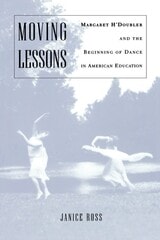
Moving Lessons
Margaret H'Doubler and the Beginning of Dance in American EducationJanice Ross
University of Wisconsin Press, 2000
Moving Lessons is an insightful and sophisticated look at the origins and influence of dance in American universities, focusing on Margaret H'Doubler, who established the first university courses and the first degree program in dance (at the University of Wisconsin). Dance educator and historian Janice Ross shows that H'Doubler (1889–1982) was both emblematic of her time and an innovator who made deep imprints in American culture. An authentic "New Woman," H'Doubler emerged from a sheltered female Victorian world to take action in the public sphere. She changed the way Americans thought, not just about female physicality but also about higher education for women.
Ross brings together many discourses—from dance history, pedagogical theory, women's history, feminist theory, American history, and the history of the body—in intelligent, exciting, and illuminating ways and adds a new chapter to each of them. She shows how H'Doubler, like Isadora Duncan and other modern dancers, helped to raise dance in the eyes of the middle class from its despised status as lower-class entertainment and "dangerous" social interaction to a serious enterprise. Taking a nuanced critical approach to the history of women's bodies and their representations, Moving Lessons fills a very large gap in the history of dance education.
Ross brings together many discourses—from dance history, pedagogical theory, women's history, feminist theory, American history, and the history of the body—in intelligent, exciting, and illuminating ways and adds a new chapter to each of them. She shows how H'Doubler, like Isadora Duncan and other modern dancers, helped to raise dance in the eyes of the middle class from its despised status as lower-class entertainment and "dangerous" social interaction to a serious enterprise. Taking a nuanced critical approach to the history of women's bodies and their representations, Moving Lessons fills a very large gap in the history of dance education.
[more]
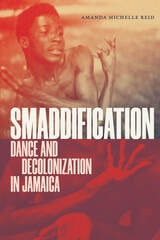
Smaddification
Dance and Decolonization in JamaicaAmanda Michelle Reid
Duke University Press, 2026
In Smaddification, Amanda Michelle Reid uses performance and dance studies to consider body politics in mid-twentieth-century Jamaica following its independence. According to Jamaican scholar and artistic leader Rex Nettleford, cofounder of the National Dance Theatre Company of Jamaica, smaddification refers to the process of becoming someone: of self-actualization through movement, spectacle, and taking up space. Through this lens, Reid traces a dynamic approach to Jamaican decolonization wherein the arts, and movement in particular, became central to activist-dancers’ performances and theories of freedom. She also takes up the work of artists and scholars such as Katherine Dunham, Ivy Baxter, and Sylvia Wynter to bring the maximalist and expressive dance theater productions of this period to life, arguing that their embrace of the spectacular demands that we expand our understanding of Jamaica’s vanguard contributions to global black nationalist aesthetics. Bringing a queer and feminist approach to interpretating this moment of liberation, Smaddification follows the processes through which Jamaican dancers identified, defined, and institutionalized how to move freely as black people in a newly independent nation.
[more]
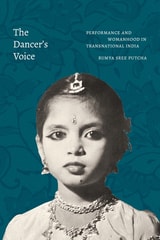
The Dancer's Voice
Performance and Womanhood in Transnational IndiaRumya Sree Putcha
Duke University Press, 2023
In The Dancer’s Voice Rumya Sree Putcha theorizes how the Indian classical dancer performs the complex dynamics of transnational Indian womanhood. Putcha argues that the public persona of the Indian dancer has come to represent India in the global imagination—a representation that supports caste hierarchies and Hindu ethnonationalism, as well as white supremacist model minority narratives. Generations of Indian women have been encouraged to embody the archetype of the dancer, popularized through film cultures from the 1930s to the present. Through analyses of films, immigration and marriage laws, histories of caste and race, advertising campaigns, and her own family’s heirlooms, photographs, and memories, Putcha reveals how women’s citizenship is based on separating their voices from their bodies. In listening closely to and for the dancer’s voice, she offers a new way to understand the intersections of body, voice, performance, caste, race, gender, and nation.
[more]