Results by title
14 books match the query 'Feminism and education'
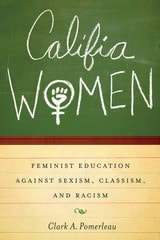
Califia Women
Feminist Education against Sexism, Classism, and RacismBy Clark A. Pomerleau
University of Texas Press, 2013
A dynamic exploration of the Califia Community, a long-running Los Angeles based grassroots alternative education group formed in the mid-1970s, whose richly diverse membership offered a compelling array of responses to feminism’s key issues.
Launched in 1975, the Califia Community organized activist educational camps and other programs in southern California until its dissolution in 1987. An alternative to mainstream academia’s attempts to tie feminism to university courses, Califia blended aspects of feminism that spanned the labels “second wave” and “radical,” attracting women from a range of gender expressions, sexual orientations, class backgrounds, and races or ethnicities. Califia Women captures the history of the organization through oral history interviews, archives, and other forms of primary research. The result is a lens for re-reading trends in feminist and social justice activism of the time period, contextualized against a growing conservative backlash.
Throughout each chapter, readers learn about the triumphs and frictions feminists encountered as they attempted to build on the achievements of the postwar Civil Rights movement. With its backdrop of southern California, the book emphasizes a region that has often been overlooked in studies of East Coast or San Francisco Bay–area activism. Califia Women also counters the notions that radical and lesbian feminists were unwilling to address intersectional identities generally and that they withdrew from political activism after 1975. Instead, the Califia Community shows evidence that these and other feminists intentionally created an educational forum that embraced oppositional consciousness and sought to serve a variety of women, including radical Christian reformers, Wiccans, scholars of color, and GLBT activists.
Composing Feminist Interventions
Activism, Engagement, PraxisKristine L. Blair
University Press of Colorado, 2018
Disciplining Feminism
From Social Activism to Academic DiscourseEllen Messer-Davidow
Duke University Press, 2002
Working within a firm theoretical framework and drawing on years of both personal involvement and fieldwork in and outside of academe, Messer-Davidow traces the metamorphosis of a once insurgent project in three steps. After illustrating how early feminists meshed their activism with institutional processes to gain footholds on campuses and in disciplinary associations, she turns to the relay between institutionalization and intellectualization, examining the way feminist studies coalesced into an academic field beginning in the mid-1970s. Without denying the successes of this feminist passage into the established system of higher learning, Messer-Davidow nonetheless insists that the process of institutionalization itself necessarily alters all new entrants—no matter how radical. Her final chapters look to the future of feminism in an increasingly conservative environment and to the possibilities for social change in general.
Disciplining Feminism’s interdisciplinary scope and cross-sector analysis will attract a broad range of readers interested in women’s studies, American higher education, and the dynamics of social transformation.

Feminist Accused of Sexual Harassment
Jane Gallop
Duke University Press, 1997
Comparing “still new” feminism—as she first encountered it in the early 1970s—with the more established academic discipline that women’s studies has become, Gallop makes a case for the intertwining of learning and pleasure. Refusing to acquiesce to an imperative of silence that surrounds such issues, Gallop acknowledges—and describes—her experiences with the eroticism of learning and teaching. She argues that antiharassment activism has turned away from the feminism that created it and suggests that accusations of harassment are taking aim at the inherent sexuality of professional and pedagogic activity rather than indicting discrimination based on gender—that antiharassment has been transformed into a sensationalist campaign against sexuality itself.
Feminist Accused of Sexual Harassment offers a direct and challenging perspective on the complex and charged issues surrounding the intersection of politics, sexuality, feminism, and power. Gallop’s story and her characteristically bold way of telling it will be compelling reading for anyone interested in these issues and particularly to anyone interested in the ways they pertain to the university.
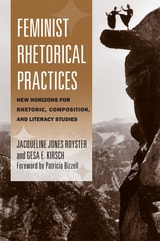
Feminist Rhetorical Practices
New Horizons for Rhetoric, Composition, and Literacy StudiesJacqueline Jones Royster and Gesa E. Kirsch
Southern Illinois University Press, 2012
To contextualize a new and changed landscape for narratives in the history of rhetoric, Royster and Kirsch present four critical terms of engagement—critical imagination, strategic contemplation, social circulation, and globalization—as the foundation for a new analytical model for understanding, interpreting, and evaluating feminist rhetorical inquiry and the study and teaching of rhetoric in general. This model draws directly on the wealth of knowledge and understanding gained from feminist rhetorical practices, especially sensitivity toward meaningfully and respectfully rendering the work, lives, cultures, and traditions of historical and contemporary women in rhetorical scholarship.
Proposing ambitious new standards for viewing and valuing excellence in feminist rhetorical practice, Royster and Kirsch advocate an ethos of respect and humility in the analysis of communities and specific rhetorical performances neglected in rhetorical history, recasting rhetorical studies as a global phenomenon rather than a western one. They also reflect on their own personal and professional development as researchers as they highlight innovative feminist research over the past thirty years to articulate how feminist work is changing the field and pointing to the active participation of women in various discourse arenas and to the practices and genres they use.
Valuable to new and established scholars of rhetoric, Feminist Rhetorical Practice: New Horizons for Rhetoric, Composition, and Literacy Studies is essential for understanding the theoretical, methodological, and ethical impacts of feminist rhetorical studies on the wider field.
Winner, 2014 Winifred Bryan Horner Outstanding Book Award
Generations
Academic Feminists In DialogueDevoney Looser
University of Minnesota Press, 1997
Explores the conflicts and challenges facing older and younger feminist scholars.
In universities and colleges across the country, feminists are debating their histories and future legacies, often expressing these controversies in generational terms. Some older, second wave feminists accuse younger ones of being careerist, overly theoretical, insufficiently political, and not grateful enough to previous generations. Some third wave feminists consider their foremothers naive, universalizing, or elitist, resentful of deviations from their established plans and improperly wielding their power. Generations addresses these divisions and impasses through sophisticated analyses of the challenges of “passing the torch.”
Generations is composed of essays from academic women at various professional stages-from established scholars to junior professors to graduate students. Some are concerned with telling intergenerational feminist histories based on both research and experience. Others describe difficulties faced by feminists of all ages in the academy today. A final cluster considers issues in the highly charged convergence of feminist theory and postmodernism. The promise of feminisms yet to come can be found in these pages, alongside some of the most resonant and important feminist voices of the last two decades. Generations both complicates and enlivens the transmission and rebirth of feminist knowledges from one generation to another. Contributors: Diane Elam, U of Wales; Elizabeth Francis, Brown U; Linda Frost, U of Alabama; Jane Gallop, U of Wisconsin; Dana Heller, Old Dominion U; Jane Kalbfleisch; Jeanne Marecek, Swarthmore College; Nancy K. Miller, CUNY; Mona Narain, Otterbein College; Angela M. S. Nelson, Bowling Green State U; Judith Newton, U of California, Davis; Rebecca Dakin Quinn; Gita Rajan, Fairfield U; Judith Roof, Indiana U; Theresa Ann Sears, U of Missouri at St. Louis; Ruthe Thompson; Michele Wallace, CUNY; Barbara A. White, U of New Hampshire; Lynda Zwinger, U of Arizona.
Leave The Dishes In The Sink
Alison Comish Thorne
Utah State University Press, 2002

Repurposing Composition
Feminist Interventions for a Neoliberal AgeShari J. Stenberg
Utah State University Press, 2015
In Repurposing Composition, Shari J. Stenberg responds to the increasing neoliberal discourse of academe through the feminist practice of repurposing. In doing so, she demonstrates how tactics informed by feminist praxis can repurpose current writing pedagogy, assessment, public engagement, and other dimensions of writing education.
Stenberg disrupts entrenched neoliberalism by looking to feminism’s long history of repurposing “neutral” practices and approaches to the rhetorical tradition, the composing process, and pedagogy. She illuminates practices of repurposing in classroom moments, student writing, and assessment work, and she offers examples of institutions, programs, and individuals that demonstrate a responsibility approach to teaching and learning as an alternative to top-down accountability logic.
Repurposing Composition is a call for purposes of work in composition and rhetoric that challenge neoliberal aims to emphasize instead a public-good model that values difference, inclusion, and collaboration.
Response to Reform
Composition and the Professionalization of TeachingMargaret J. Marshall
Southern Illinois University Press, 2003
Response to Reform: Composition and the Professionalization of Teaching critiques the politics of labor and gender biases inherent in the composition workplace that prevent literacy teachers from attaining professional status and respect. Scrutinizing the relationship between scholarship and teaching, Margaret J. Marshall calls for a reconceptualization of what it means to prepare for and enter the field of composition instruction.
Interrogating the approach the education system takes to certify teachers without actually “professionalizing” their careers, Marshall contends that these programs rely on outdated rhetorics of labor that only widen the gap between teaching and other professional jobs. Such attempts to re-educate literacy teachers exploit and marginalize their work, and thus prevent them from claiming the status of academic professionals. In providing an overview of the history of and language used to literacy instruction, she also points out that while women are overrepresented in composition instruction, they are underrepresented in tenure track and administrative positions.
To correct and combat these inequities, Marshall advocates an alternate alignment of power structures and rhetorical choices. In a wide-ranging survey that sheds new light on the composition workplace as well as higher education at large, Response to Reform: Composition and the Professionalization of Teaching boldly asks us to do away with the reductive language we inherit from the past that characterize teaching and professionalization, as well as our customary responses to public criticism of education. The result is a new articulation of composition as a meritorious profession.
Revisionary Rhetoric, Feminist Pedagogy, and Multigenre Texts
Julie Jung
Southern Illinois University Press, 2005
In this precise and provocative treatise, Julie Jung augments the understanding and teaching of revision by arguing that the process should entail changing attitudes rather than simply changing texts. Revisionary Rhetoric, Feminist Pedagogy, and Multigenre Texts proposes and demonstrates alternative ways of reading, writing, and teaching that hear silences in such a way as to generate personal, pedagogical, and professional revisions. As both a challenge to prevailing revision pedagogies and an elaboration of contemporary feminist rhetorics, the volume encourages students and instructors to examine their identities as scholars of rhetoric and composition and to question how and why revision is taught.
Jung analyzes feminist texts to identify a revisionary rhetoric that is, at its core, most concerned with creating a space in which to engage productively with issues of difference. This synthesis of feminist theory and revision studies yields a pedagogically useful definition of feminist rhetoric, through which Jung examines the insights afforded by multigenre texts in various related contexts: the academic essay, the discipline of rhetoric and composition studies, feminist composition, and the subfields of English studies including rhetoric and composition, literature, and creative writing. Jung illustrates how multigenre texts demand innovative methods of inquiry because they do not fit the conventions of any single genre. Because genre is inextricably tied to the construction of social identity, she explains, multigenre texts also offer a means for understanding and revising disciplinary identity.
Boldly making a case for the revisionary power of multigenre texts, Jung retheorizes revision as a process of disrupting textual clarity so that differences can be identified, contended with, and perhaps understood. Revisionary Rhetoric, Feminist Pedagogy, and Multigenre Texts makes great strides towards defining feminist rhetoric and ascertaining how revision can be theorized, not just practiced. Jung also provides a multigenre epilogue that explores the usefulness of reconceiving revision as a progression towards wholeness rather than perfection.
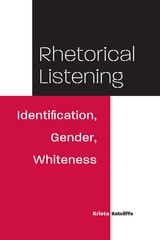
Rhetorical Listening
Identification, Gender, WhitenessKrista Ratcliffe
Southern Illinois University Press, 2005
Extending the feminist rhetorical project to define and model rhetorical listening
Long-ignored within rhetoric and composition studies, listening has returned to the disciplinary radar. Rhetorical Listening: Identification, Gender, Whiteness argues that rhetorical listening facilitates conscious identifications needed for cross-cultural communication.
Krista Ratcliffe establishes eavesdropping, listening metonymically, and listening pedagogically as approaches to rhetorical listening. She defines and models rhetorical listening, addressing identifications with gender and whiteness within public debates, scholarship, and pedagogy. Offering an approach grounded in classical rhetorical theory, Heideggerian theory, feminist theory, and critical race theory, Ratcliffe presents rhetorical listening as an invention tactic that engages spoken and written texts and supplements reading, writing, speaking, and silence as a rhetorical art.
Theorizing intersections of gender and whiteness, Rhetorical Listening examines how whiteness functions as an "invisible" racial category and provides disciplinary and cultural reasons for the displacement of listening and for the use of rhetorical listening as a code of cross-cultural conduct. Ratcliffe presents rhetorical listening in terms of cultural logics, stances, and dominant interpretive tropes. She highlights the modern identification theory of Kenneth Burke and the postmodern identification and disidentification theory of Diana Fuss and presents nonidentification as a more productive site for rhetorical listening.
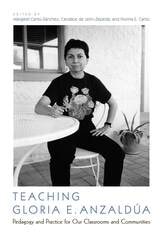
Teaching Gloria E. Anzaldúa
Pedagogy and Practice for Our Classrooms and CommunitiesEdited by Margaret Cantú-Sánchez, Candace de León-Zepeda, Norma E. Cantú
University of Arizona Press, 2020
Gloria Evangelina Anzaldúa—theorist, Chicana, feminist—famously called on scholars to do work that matters. This pronouncement was a rallying call, inspiring scholars across disciplines to become scholar-activists and to channel their intellectual energy and labor toward the betterment of society. Scholars and activists alike have encountered and expanded on these pathbreaking theories and concepts first introduced by Anzaldúa in Borderlands/La frontera and other texts.
Teaching Gloria E. Anzaldúa is a pragmatic and inspiring offering of how to apply Anzaldúa’s ideas to the classroom and in the community rather than simply discussing them as theory. The book gathers nineteen essays by scholars, activists, teachers, and professors who share how their first-hand use of Anzaldúa’s theories in their classrooms and community environments.
The collection is divided into three main parts, according to the ways the text has been used: “Curriculum Design,” “Pedagogy and Praxis,” and “Decolonizing Pedagogies.” As a pedagogical text, Teaching Gloria E. Anzaldúa also offers practical advice in the form of lesson plans, activities, and other suggested resources for the classroom. This volume offers practical and inspiring ways to deploy Anzaldúa’s transformative theories with real and meaningful action.
Contributors
Carolina E. Alonso
Cordelia Barrera
Christina Bleyer
Altheria Caldera
Norma E. Cantú
Margaret Cantú-Sánchez
Freyca Calderon-Berumen
Stephanie Cariaga
Dylan Marie Colvin
Candace de León-Zepeda
Miryam Espinosa-Dulanto
Alma Itzé Flores
Christine Garcia
Patricia M. García
Patricia Pedroza González
María del Socorro Gutiérrez-Magallanes
Leandra H. Hernández
Nina Hoechtl
Rían Lozano
Socorro Morales
Anthony Nuño
Karla O’Donald
Christina Puntasecca
Dagoberto Eli Ramirez
José L. Saldívar
Tanya J. Gaxiola Serrano
Verónica Solís
Alexander V. Stehn
Carlos A. Tarin
Sarah De Los Santos Upton
Carla Wilson
Kelli Zaytoun
Teaching against Violence
The Reassessing ToolboxInez Testoni
Central European University Press, 2014
Valuing Us All
Feminist Pedagogy and EconomicsApril Laskey Aerni and KimMarie McGoldrick, Editors
University of Michigan Press, 1999