Results by title

10 books match the query 'Feminism and mass media'

cover of Feminism and Popular Culture: Investigating the Postfeminist Mystique

Feminism and Popular Culture

Investigating the Postfeminist Mystique

Munford, Rebecca

Rutgers University Press, 2014

When the term “postfeminism” entered the media lexicon in the 1990s, it was often accompanied by breathless headlines about the “death of feminism.” Those reports of feminism’s death may have been greatly exaggerated, and yet contemporary popular culture often conjures up a world in which feminism had never even been born, a fictional universe filled with suburban Stepford wives, maniacal career women, alluring amnesiacs, and other specimens of retro femininity.

In Feminism and Popular Culture, Rebecca Munford and Melanie Waters consider why the twenty-first century media landscape is so haunted by the ghosts of these traditional figures that feminism otherwise laid to rest. Why, over fifty years since Betty Friedan’s critique, does the feminine mystique exert such a strong spectral presence, and how has it been reimagined to speak to the concerns of a postfeminist audience?

To answer these questions, Munford and Waters draw from a rich array of examples from contemporary film, fiction, music, and television, from the shadowy cityscapes of Homeland to the haunted houses of American Horror Story. Alongside this comprehensive analysis of today’s popular culture, they offer a vivid portrait of feminism’s social and intellectual history, as well as an innovative application of Jacques Derrida’s theories of “hauntology.” Feminism and Popular Culture thus not only considers how contemporary media is being visited by the ghosts of feminism’s past, it raises vital questions about what this means for feminism’s future.

[more]
cover of Furious: Technological Feminism and Digital Futures

Furious

Technological Feminism and Digital Futures

Caroline Bassett

Pluto Press, 2019

As digital transformations continue to accelerate in the world, discourses of big data have come to dominate in a number of fields, from politics and economics, to media and education. But how can we really understand the digital world, ask the authors of Furious, when so much of the writing through which we grapple with it remains deeply problematic? In a compelling new work of feminist critical theory, Bassett, Kember and O'Riordan scrutinise many of the assumptions of a masculinist digital world, highlighting the tendency of digital humanities scholarship to venerate and essentialise technical forms, and to adopt gendered writing and citation practices. Contesting these writings, practices and politics, the authors foreground feminist traditions and contributions to the field, offering alternative modes of knowledge production, and a radically different, poetic writing style. Through this prism, Furious brings into focus themes including the automation of home and domestic work, the Anthropocene, and intersectional feminist technofutures.
[more]
cover of In the Event of Women

In the Event of Women

Tani Barlow

Duke University Press, 2021

In the Event of Women outlines the stakes of what Tani Barlow calls “the event of women.” Focusing on the era of the late nineteenth century through the mid-twentieth century's Cultural Revolution, Barlow shows that an event is a politically inspired action to install a newly discovered truth, in this case the mammal origins of human social evolution. Highbrow and lowbrow social theory circulating in Chinese urban print media placed humanity's origin story in relation to commercial capital's modern advertising industry and the conclusion that women's liberation involved selling, buying, and advertising industrial commodities. The political struggle over how the truth of women in China would be performed and understood, Barlow shows, means in part that an event of women was likely global because its truth is vested in biology and physiology. In so doing, she reveals the ways in which historical universals are effected in places where truth claims are not usually sought. This book reconsiders Alain Badiou's concept of the event; particularly the question of whose political moment marks newly discovered truths.
[more]
cover of Insufferable Tools: Feminism Against Big Tech

Insufferable Tools

Feminism Against Big Tech

Sarah Sharma

Duke University Press, 2026

In a world seemingly run by the whims and power plays of Musks and Zucks, Insufferable Tools cuts to the core of modern technology’s gendered politics. Sarah Sharma challenges the idea that the Big Tech broligarchs are neutral utilitarians who view technology as mere tools. She shows instead how these tech giants have turned the internet, and, increasingly, “real life” into a set of environments which they cultivate and manipulate to wield the real tools: us, the users. Sharma critiques a popular system of inclusion she calls “Big Tech Feminism” that attempts to incorporate and make useful people of color, queer people, and others who are seen as broken machines in the current gendered power structures. Deconstructing Big Tech’s patriarchal deployment of media theory to gain and maintain power, Sharma proposes a feminist techno-politics that can forge new futures free from the grip of the truly insufferable tools.
[more]
cover of Postfeminist War: Women in the Media-Military-Industrial Complex

Postfeminist War

Women in the Media-Military-Industrial Complex

Mary Douglas Vavrus

Rutgers University Press, 2019
Media representations and practices that have emerged out of contemporary wars have been well documented by a wide array of books and articles. These treatments, however, have been less attentive to how cultural constructions of military personnel and war itself figure in the depiction of the incursions in Iraq and Afghanistan. In Post-Feminist War, Mary Douglas Vavrus argues that all of these identity categories are integral to our understanding of those fighting, saved, or victimized by war. She considers two important questions: how the construction of gender, race, and class in media are productive of régimes of truth regarding war and military life, and how such constructions may also intensify militarism. By examining news and documentary media produced since September 11, 2001, Vavrus demonstrates that news narratives that include women use feminism selectively in gender equality narratives, which tend to reinforce historically resonant gender, race, and class identity constructions. She ultimately asserts that such reporting advances post-feminism, which, in tandem with banal militarism, subtly pushes military solutions for an array of problems women and girls face. 
[more]
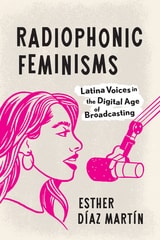
cover of Radiophonic Feminisms: Latina Voices in the Digital Age of Broadcasting

Radiophonic Feminisms

Latina Voices in the Digital Age of Broadcasting

Esther Díaz Martín

University of Texas Press, 2025

2026 Gold Medal for the Best Women's Issues Book, Conference on Latin American History (CLAH)
How Latina voices in commercial radio and podcasting subvert cultural norms and bring feminism to the fore of their work.

What does Latina feminism sound like in popular culture? Drawing on case studies of commercial radio programs and podcasts hosted by Latinas and oriented toward Latinx listenership, Esther Díaz Martín explores how Latina voices create female-specific aural spaces that interrupt the misogynist status quo in US mainstream media.

Radiophonic Feminisms focuses on radio/podcasting as a medium in which women find methods for resisting oppressive gendered cultural imaginaries. Through their specific articulations—that is, the quality of their voices—their music choices, and the soundscapes they construct, Latina hosts since the early 1990s have offered feminist responses to a cultural moment marked by the demographic changes brought on by the political economy of migration and the social changes wrought by media in the digital age. Drawing attention to the invisible antisexist work of creating sound, and to its reception, Díaz Martín bridges the epistemic insights of Chicana feminist theory and sound studies, enriching and further decolonizing our thinking about auditory meaning making.
[more]
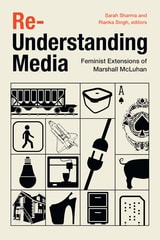
cover of Re-Understanding Media: Feminist Extensions of Marshall McLuhan

Re-Understanding Media

Feminist Extensions of Marshall McLuhan

Sarah Sharma and Rianka Singha, editors

Duke University Press, 2022

The contributors to Re-Understanding Media advance a feminist version of Marshall McLuhan’s key text, Understanding Media: The Extensions of Man, repurposing his insight that “the medium is the message” for feminist ends. They argue that while McLuhan’s theory provides a falsely universalizing conception of the technological as a structuring form of power, feminist critics can take it up to show how technologies alter and determine the social experiences of race, gender, class, and sexuality. This volume showcases essays, experimental writings, and interviews from media studies scholars, artists, activists, and those who work with and create technology. Among other topics, the contributors extend McLuhan’s discussion of transportation technology to the attics and cargo boxes that moved Black women through the Underground Railroad, apply McLuhan’s concept of media as extensions of humans to analyze Tupperware as media of containment, and take up 3D printing as a feminist and decolonial practice. The volume demonstrates how power dynamics are built into technological media and how media can be harnessed for radical purposes.

Contributors. Nasma Ahmed, Morehshin Allahyari, Sarah Banet-Weiser, Wendy Hui Kyong Chun, Brooke Erin Duffy, Ganaele Langlois, Sara Martel, Shannon Mattern, Cait McKinney, Jeremy Packer, Craig Robertson, Sarah Sharma, Ladan Siad, Rianka Singh, Nicholas Taylor, Armond R. Towns, and Jennifer Wemigwans

[more]
cover of Sex And Money: Feminism and Political Economy in the Media

Sex And Money

Feminism and Political Economy in the Media

Eileen R. Meehan

University of Minnesota Press, 2001

A revelatory look at the ways that gender, power, and the media are intertwined.

It all comes down to sex and money: how the media are organized, how they work, what they say, who gets to say it and to whom. That is the message this book delivers—and then parses for its meaning to society and culture. Forcefully and persuasively, this groundbreaking volume uses the media to show how questions of gender and economics are inextricably linked to issues of power in Western capitalist societies. Integrating political economy and feminism, it offers a new understanding of communication at the personal, experiential, institutional, and structural levels-and exposes all the subtle and complex ways in which sex and money are sutured into individuals’ daily lives.

Contributors: Robin Andersen, Fordham U; Ellen Balka, Simon Fraser U; Amy Beer; Carolyn M. Byerly, Ithaca College; Ramona Curry, U of Illinois; Fred Fejes, Florida Atlantic U; Nancy Hauserman, U of Iowa; Michèle Martin, Carleton U, Canada; Stana Martin, Central Missouri State U; Lisa McLaughlin, Miami U, Ohio; Roopali Mukherjee, Indiana U; Angela R. Record; Karen Ross, Coventry U; H. Leslie Steeves, U of Oregon; Angharad N. Valdivia, U of Illinois; Janet Wasko, U of Oregon; and Justin Wyatt.

[more]
cover of We Can Do Better: Feminist Manifestos for Media and Communication

We Can Do Better

Feminist Manifestos for Media and Communication

Linda Steiner

Rutgers University Press, 2025

Feminist Manifestos for Media and Communication brings together evidence-based manifestos for media and communication that take a feminist perspective and add up to a provocative vision of feminist media practices and of feminist communication. The book discusses critical problems and complaints in ways that identify and make the case for actionable, concrete solutions to media problems and deficiencies; it shows how feminist thinking can be usefully and effectively applied to a wide range of journalism, media, and communication practices. The manifestos are not “only” about women but rather offer specific, feasible blueprints for restructuring media in ways that make them fairer and more equitable along many vectors of identity, so that media can better serve democracy. These manifestos give concrete solutions to specific problems that can and should be implemented by journalists, media practitioners, students, faculty, and scholars. The manifestos are organized around three sets of demands: for better media practices, for more participatory online spaces, and for more precise and appropriate language.


[more]