Results by title
6 books match the query 'Feminism and racism'

A Decolonial Feminism
Francoise Verges
Pluto Press, 2021
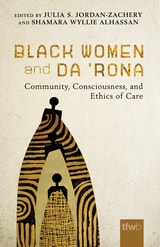
Black Women and da ’Rona
Community, Consciousness, and Ethics of CareEdited by Julia S. Jordan-Zachery and Shamara Wyllie Alhassan
University of Arizona Press, 2023
Recognizing that Black women have been living in pandemics as far back as colonialism and enslavement, this volume acknowledges that records of the past—from the 1918 flu pandemic to the onset of the HIV/AIDS epidemic—often erase the existence and experiences of Black women as a whole. Writing against this archival erasure, this collection consciously recenters the real-time experiences and perspectives of care, policy concerns, grief, and joy of Black women throughout the COVID-19 pandemic.
Nineteen contributors from interdisciplinary fields and diverse backgrounds explore Black feminine community, consciousness, ethics of care, spirituality, and social critique. They situate Black women’s multidimensional experiences with COVID-19 and other violences that affect their lives. The stories they tell are connected and interwoven, bound together by anti-Black gendered COVID necropolitics and commitments to creating new spaces for breathing, healing, and wellness.
Ultimately, this time-warping analysis shows how Black women imagine a more just society, rapidly adapt to changing experiences, and innovate ethics of care even in the midst of physical distancing, which can be instructive for thinking of new ways of living both during and beyond the era of COVID-19.
Contributors
Shamara Wyllie Alhassan
Sharnnia Artis
Keisha L. Bentley-Edwards
Candace S. Brown
Jenny Douglas
Kaja Dunn
Onisha Etkins
Rhonda M. Gonzales
Endia Hayes
Ashley E. Hollingshead
Kendra Jason
Julia S. Jordan-Zachery
Stacie LeSure
Janaka B. Lewis
Michelle Meggs
Nitya Mehrotra
Sherine Andreine Powerful
Marjorie Shavers
Breauna Marie Spencer
Tehia Starker Glass
Amber Walker
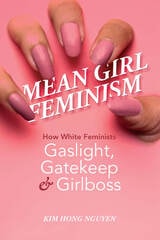
Mean Girl Feminism
How White Feminists Gaslight, Gatekeep, and GirlbossKim Hong Nguyen
University of Illinois Press, 2024
Mean girl feminism encourages girls and women to be sassy, sarcastic, and ironic as feminist performance. Yet it coopts its affect, form, and content from racial oppression and protest while aiming meanness toward people in marginalized groups.
Kim Hong Nguyen’s feminist media study examines four types of white mean girl feminism prominent in North American popular culture: the bitch, the mean girl, the power couple, and the global mother. White feminists mime the anger, disempowerment, and resistance felt by people of color and other marginalized groups. Their performance allows them to pursue and claim a special place within established power structures, present as intellectually superior, substitute nonpolitical playacting for a politics of solidarity and community, and position themselves as better, more enlightened masters than patriarchy. But, as Nguyen shows, the racialized meanness found across pop culture opens possibilities for building an intersectional feminist politics that rejects performative civility in favor of turning anger into liberation.

Public Catastrophes, Private Losses
Sarah Tobias
Rutgers University Press, 2025
This essay collection explores how the definition of catastrophe might be expanded to include many forms of large-scale structural violence on communities, species, and ecosystems. Using feminist methodologies, the contributors to Public Catastrophes, Private Losses trace the connections between seemingly unrelated forms of violence such as structural racism, environmental degradation, and public health crises. In contrast to a news media that focuses on mass fatalities and immediate consequences, these essays call our attention to how catastrophes can also involve slow violence with long-term effects.
The authors also consider how these catastrophes are profoundly shaped by government action or inaction, offering a powerful critique of how government neglect has cost lives and demonstrating how vulnerable populations can be better protected. The essays in this collection examine how public catastrophes imprint themselves on lives, as individuals and communities narrate, process, and grapple with legacies of loss. The book is thus a feminist intervention that challenges the binary between public and private, personal and political.

The Gloria Wekker Reader
Gloria Wekker. Chandra Frank, Nancy Jouwe, and Mikki Stelder, editors. Foreword by Angela Y. Davis.
Duke University Press, 2026

To Exist is to Resist
Black Feminism in EuropeEdited by Akwugo Emejulu and Francesca Sobande
Pluto Press, 2019
Deeply aware that they are constructed as 'Others' living in a racialised and hierarchical continent, the contibutors explore gender, class, sexuality and legal status to show that they are both invisible - presumed to be absent from and irrelevant to European societies - and hyper-visible - assumed to be passive and sexualised, angry and irrational.
Through imagining a future outside the neocolonial frames and practices of contemporary Europe, this book explores a variety of critical spaces including motherhood and the home, friendships and intimate relationships, activism and community, and literature, dance and film.