Results by title
9 books match the query 'Feminist ethics'
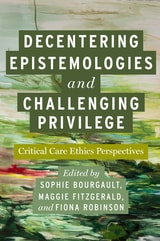
Decentering Epistemologies and Challenging Privilege
Critical Care Ethics PerspectivesSophie Bourgault
Rutgers University Press, 2024
This book advances this project by discussing the ways care ethics contributes to the decentering of dominant epistemologies and to the challenging of privilege and by considering how to decenter care ethics itself via an encounter with non-Western philosophical traditions and alternative epistemologies. Written by scholars from different countries, disciplines, and intellectual traditions, the volume offers original care ethics contributions on epistemic injustice, privileged irresponsibility, ecofeminism, settler colonialism, social movements such as BLM, and various racialized and gendered inequities tied to care work.

Decentralizing Knowledges
Essays on Distributed AgencyLeandro Rodriguez Medina and Sandra Harding, editor
Duke University Press, 2025
Contributors: Linda Martín Alcoff, Elías Barticevic, Johan Henrik Buljo, Ronald Cancino, Cristina Flores, Kim Fortun, Sandra Harding, Line Aimee Kalak, Duygu Kasdogan, Wiebke Keim, Aalok Khandekar, Daniel Lee Kleinman, Wen-Hua Kuo, John Law, Les Levidow, Leandro Rodriguez Medina, Angela Okune, Liv Østmo, Ari Sitas, Maka Suarez, Sharon Traweek, Hebe Vessuri

Embodied Care
Jane Addams, Maurice Merleau-Ponty, and Feminist EthicsMaurice Hamington
University of Illinois Press, 2004
Hamington's argues that human bodies are "built to care"; as a result, embodiment must be recognized as a central factor in moral consideration. He takes the reader on an exciting journey from modern care ethics to Merleau-Ponty's philosophy of the body and then to Jane Addams's social activism and philosophy. The ideas in Embodied Care do not lead to yet another competing theory of morality; rather, they progress through theory and case studies to suggest that no theory of morality can be complete without a full consideration of the body.

Feminism and the Final Foucault
Edited by Dianna Taylor and Karen Vintges
University of Illinois Press, 2004
Rather than simply debating the merits or limitations of Foucault's later work, the essays in this collection examine women's historical self-practices, conceive of feminism as a shared ethos, and consider the political significance of this conceptualization in order to elucidate, experiment with, and put into practice the conceptual "tools" that Foucault offers for feminist ethics and politics. The volume illustrates the ways in which Foucault's later thinking on ethics as "care of the self" can reintroduce a number of issues and themes that feminists jettisoned in the wake of postmodernism, including consciousness raising, feminist therapy, the subject woman, identity politics, and feminist agency.
Taken as a whole, the diversity of feminist viewpoints presented provide important new insights into "the final Foucault," and thus serve as a productive intervention in current Foucault scholarship.

Feminist Ethics in Film
Reconfiguring Care through CinemaJoseph H. Kupfer
Intellect Books, 2012
Popular films can do more than merely entertain us; they can contribute to our understanding of human nature and the ethical theory that informs it. Feminist Ethics in Film explores a varied group of cinematic narratives from the perspective of care-based ethics. The interpersonal relationships they portray disclose important dimensions of care that have been overlooked in less contextualized discussions. In particular, the book examines the relationships between care and community, autonomy, family, and self transformation. Interpreting films from the perspective of the feminist ethics of care both expands our knowledge of this burgeoning area of philosophy and adds depth to our appreciation of the films.
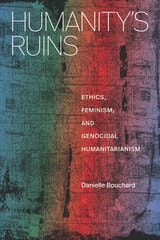
Humanity's Ruins
Ethics, Feminism, and Genocidal HumanitarianismDanielle Bouchard
Duke University Press, 2025

No Longer Patient
Feminist Ethics and Health CareSusan Sherwin
Temple University Press, 1992

Suspect Citizens
Women, Virtue, and Vice in Backlash PoliticsJocelyn Boryczka
Temple University Press, 2012
What drives the cycle of backlashes against women’s ongoing struggle for equality, freedom, and inclusion in American politics? In her innovative and provocative book, Suspect Citizens, Jocelyn Boryczka presents a feminist conceptual history that shows how American politics have largely defined women in terms of their reproductive and socializing functions. This framework not only denies women full citizenship, but also devalues the active political engagement of all citizens who place each other and their government under suspicion.
Developing the gendered dynamics of virtue and vice, Boryczka exposes the paradox of how women are perceived as both virtuous moral guardians and vice-ridden suspect citizens capable of jeopardizing the entire nation’s exceptional future. She uses wide-ranging examples from the Puritans and contemporary debates over sex education to S&M lesbian feminists and the ethics of care to show how to move beyond virtue and vice to a democratic feminist ethics.
Suspect Citizens advances a politics of collective responsibility and belonging.
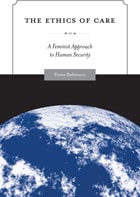
The Ethics of Care
A Feminist Approach to Human SecurityFiona Robinson
Temple University Press, 2011
In The Ethics of Care, Fiona Robinson demonstrates how the responsibilities of sustaining life are central to the struggle for basic human security. She takes a unique approach, using a feminist lens to challenge gender biases in rights-based, individualist approaches.Robinson's thorough and impassioned consideration of care in both ethical and practical terms provides a starting point for understanding and addressing the material, emotional and psychological conditions that create insecurity for people. The Ethics of Careexamines “care ethics” and “security” at the theoretical level and explores the practical implications of care relations for security in a variety of contexts: women's labor in the global economy, humanitarian intervention and peace building, healthcare, and childcare.
Theoretically-innovative and policy-relevant, this critical analysis demonstrates the need to understand the obstacles and inequalities that obstruct the equitable and adequate delivery of care around the world.