207 books match the query 'Feminist theory' and 13 start with a

cover of A Decolonial Feminism

A Decolonial Feminism

Francoise Verges

Pluto Press, 2021

For too long feminism has been co-opted by the forces they seek to dismantle. In this powerful manifesto, Francoise Verges argues that feminists should no longer be accomplices of capitalism, racism, colonialism and imperialism: it is time to fight the system that created the boss, built the prisons and polices women’s bodies. A Decolonial Feminism grapples with the central issues in feminist debates today: from Eurocentrism and whiteness, to power, inclusion and exclusion. Delving into feminist and anti-racist histories, Verges also assesses contemporary activism, movements and struggles, including #MeToo and the Women's Strike. Centring anticolonialism and anti-racism within an intersectional Marxist feminism, the book puts forward an urgent demand to free ourselves from the capitalist, imperialist forces that oppress us.
[more]
cover of A Feminist Legacy: The Rhetoric and Pedagogy of Gertrude Buck

A Feminist Legacy

The Rhetoric and Pedagogy of Gertrude Buck

Suzanne Bordelon

Southern Illinois University Press, 2007

The first book-length investigation of a pioneering English professor and theorist at Vassar College, A Feminist Legacy: The Rhetoric and Pedagogy of Gertrude Buck explores Buck’s contribution to the fields of education and rhetoric during the Progressive Era. By contextualizing Buck’s academic and theoretical work within the rise of women’s educational institutions like Vassar College, the social and political movement toward suffrage, and Buck’s own egalitarian political and social ideals, Suzanne Bordelon offers a scholarly and well-informed treatment of Buck’s achievements that elucidates the historical and contemporary impact of her work and life.

Bordelon argues that while Buck did not call herself a feminist, she embodied feminist ideals by demanding the full participation of her female students and by challenging power imbalances at every academic, social, and political level.

A Feminist Legacy reveals that Vassar College is an undervalued but significant site in the history of women’s argumentation and pedagogy. Drawing on a rich variety of archival sources, including previously unexamined primary material, A Feminist Legacy traces the beginnings of feminist theories of argumentation and pedagogy and their lasting legacy within the fields of education and rhetoric.

[more]
cover of A Feminist Theory of Violence: A Decolonial Perspective

A Feminist Theory of Violence

A Decolonial Perspective

Françoise Vergès

Pluto Press, 2022

'A robust, decolonial challenge to carceral feminism' - Angela Y. Davis

***Winner of an English PEN Award 2022***

The mainstream conversation surrounding gender equality is a repertoire of violence: harassment, rape, abuse, femicide. These words suggest a cruel reality. But they also hide another reality: that of gendered violence committed with the complicity of the State.

In this book, Françoise Vergès denounces the carceral turn in the fight against sexism. By focusing on 'violent men', we fail to question the sources of their violence. There is no doubt as to the underlying causes: racial capitalism, ultra-conservative populism, the crushing of the Global South by wars and imperialist looting, the exile of millions and the proliferation of prisons - these all put masculinity in the service of a policy of death.

Against the spirit of the times, Françoise Vergès refuses the punitive obsession of the State in favour of restorative justice.

[more]
cover of A Question of Sex: Feminism, Rhetoric, and Differences That Matter

A Question of Sex

Feminism, Rhetoric, and Differences That Matter

Kristan Poirot

University of Massachusetts Press, 2014

By the mid-1990s feminist theorists and critics began to challenge conventional thinking about sex difference and its relationship to gender and sexuality. Scholars such as Anne Fausto-Sterling and Judith Butler troubled the sex-gender/nature-nurture divide. Some have asserted that these questions about sex are much too abstract to contribute to a valuable understanding of the material politics faced by feminist movements. In A Question of Sex, Kristan Poirot challenges this assumption and demonstrates that contemporary theories about sex, gender, identity, and difference compel a rethinking of the history of feminist movements and their rhetorical practices.

Poirot focuses on five case studies—the circulation of Sojourner Truth's "Ain't I a Woman?" in early and contemporary feminist contexts; the visual rhetorics of the feminist self-help health movement; the public discourse of Elizabeth Cady Stanton and early nineteenth-century ideas about suffrage, sex, and race; the conflicts over lesbian sexuality in the 1960s and 1970s; and the discourse that surrounds twenty-first-century SlutWalks. In the process, Poirot rethinks the terms through which we understand U.S. feminist movements to explore the ways feminism has questioned sexed distinctions and practices over time. She emphasizes the importance of reading feminist engagements with sex as rhetorical endeavors—practices that are shaped by the instrumental demands of movements, the exigent situations that call for feminists to respond, and the enduring philosophical traditions that circulate in U.S. political contexts., reviewing a previous edition or volume
[more]
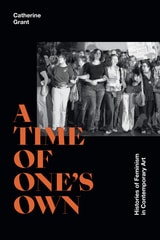
cover of A Time of One's Own: Histories of Feminism in Contemporary Art

A Time of One's Own

Histories of Feminism in Contemporary Art

Catherine Grant

Duke University Press, 2022

In A Time of One’s Own Catherine Grant examines how contemporary feminist artists are turning to broad histories of feminism ranging from political organizing and artworks from the 1970s to queer art and activism in the 1990s. Exploring artworks from 2002 to 2017 by artists including Sharon Hayes, Mary Kelly, Allyson Mitchell, Deirdre Logue, Lubaina Himid, Pauline Boudry, and Renate Lorenz, Grant maps a revival of feminism that takes up the creative and political implications of forging feminist communities across time and space. Grant characterizes these artists’ engagement with feminism as a fannish, autodidactic, and collective form of learning from history. This fandom of feminism allows artists to build relationships with previous feminist ideas, artworks, and communities that reject a generational model and embrace aspects of feminism that might be seen as embarrassing, queer, or anachronistic. Accounting for the growing interest in feminist art, politics, and ideas across generations, Grant demonstrates that for many contemporary feminist artists, the present moment can only be understood through an embodied engagement with history in which feminist pasts are reinhabited and reimagined.
[more]
cover of Abjection Incorporated: Mediating the Politics of Pleasure and Violence

Abjection Incorporated

Mediating the Politics of Pleasure and Violence

Margaret Hennefeld and Nicholas Sammond, editors

Duke University Press, 2019

From the films of Larry Clark to the feminist comedy of Amy Schumer to the fall of Louis C. K., comedic, graphic, and violent moments of abjection have permeated twentieth- and twenty-first-century social and political discourse. The contributors to Abjection Incorporated move beyond simple critiques of abjection as a punitive form of social death, illustrating how it has become a contested mode of political and cultural capital—empowering for some but oppressive for others. Escaping abjection's usual confines of psychoanalysis and aesthetic modernism, core to theories of abjection by thinkers such as Kristeva and Bataille, the contributors examine a range of media, including literature, photography, film, television, talking dolls, comics, and manga. Whether analyzing how comedic abjection can help mobilize feminist politics or how expressions of abjection inflect class, race, and gender hierarchies, the contributors demonstrate the importance of competing uses of abjection to contemporary society and politics. They emphasize abjection's role in circumscribing the boundaries of the human and how the threats abjection poses to the self and other, far from simply negative, open up possibilities for radically new politics.

Contributors. Meredith Bak, Eugenie Brinkema, James Leo Cahill, Michelle Cho, Maggie Hennefeld, Rob King, Thomas Lamarre, Sylvère Lotringer, Rijuta Mehta, Mark Mulroney, Nicholas Sammond, Yiman Wang, Rebecca Wanzo

[more]
cover of Abolition Archives, Feminist Futures

Abolition Archives, Feminist Futures

Kathi Weeks

Duke University Press, 2026

Abolition Archives, Feminist Futures takes up the work of three iconic feminist thinkers—Angela Davis, Shulamith Firestone, and Donna Haraway—to ask how each author’s vision of work, the family, and the carceral state can expand contemporary feminism’s ability to structurally analyze social problems. Kathi Weeks examines the archive of this unexpected collection of Marxist feminists whose works are united by their abolitionist approaches, arguing that feminism can gain a broader constituency by taking up anti-capitalist critique and praxis. Across the book’s chapters, Weeks recontextualizes well-known feminist texts in a new and original light, bringing their insight from the past into the present and future of abolitionist politics.
[more]
cover of Animals and Women: Feminist Theoretical Explorations

Animals and Women

Feminist Theoretical Explorations

Carol J. Adams and Josephine Donovan, eds.

Duke University Press, 1995

Animals and Women is a collection of pioneering essays that explores the theoretical connections between feminism and animal defense. Offering a feminist perspective on the status of animals, this unique volume argues persuasively that both the social construction and oppressions of women are inextricably connected to the ways in which we comprehend and abuse other species. Furthermore, it demonstrates that such a focus does not distract from the struggle for women’s rights, but rather contributes to it.

This wide-ranging multidisciplinary anthology presents original material from scholars in a variety of fields, as well as a rare, early article by Virginia Woolf. Exploring the leading edge of the species/gender boundary, it addresses such issues as the relationship between abortion rights and animal rights, the connection between woman-battering and animal abuse, and the speciesist basis for much sexist language. Also considered are the ways in which animals have been regarded by science, literature, and the environmentalist movement. A striking meditation on women and wolves is presented, as is an examination of sexual harassment and the taxonomy of hunters and hunting. Finally, this compelling collection suggests that the subordination and degradation of women is a prototype for other forms of abuse, and that to deny this connection is to participate in the continued mistreatment of animals and women.
[more]
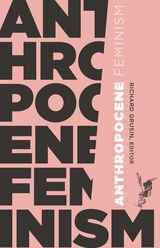
cover of Anthropocene Feminism

Anthropocene Feminism

Richard Grusin

University of Minnesota Press, 2017

What does feminism have to say to the Anthropocene? How does the concept of the Anthropocene impact feminism? This book is a daring and provocative response to the masculinist and techno-normative approach to the Anthropocene so often taken by technoscientists, artists, humanists, and social scientists. By coining and, for the first time, fully exploring the concept of “anthropocene feminism,” it highlights the alternatives feminism and queer theory can offer for thinking about the Anthropocene. 

Feminist theory has long been concerned with the anthropogenic impact of humans, particularly men, on nature. Consequently, the contributors to this volume explore not only what current interest in the Anthropocene might mean for feminism but also what it is that feminist theory can contribute to technoscientific understandings of the Anthropocene. With essays from prominent environmental and feminist scholars on topics ranging from Hawaiian poetry to Foucault to shelled creatures to hypomodernity to posthuman feminism, this book highlights both why we need an anthropocene feminism and why thinking about the Anthropocene must come from feminism. 

Contributors: Stacy Alaimo, U of Texas at Arlington; Rosi Braidotti, Utrecht U; Joshua Clover, U of California, Davis; Claire Colebrook, Pennsylvania State U; Dehlia Hannah, Arizona State U; Myra J. Hird, Queen’s U; Lynne Huffer, Emory U; Natalie Jeremijenko, New York U; Elizabeth A. Povinelli, Columbia U; Jill S. Schneiderman, Vassar College; Juliana Spahr, Mills College; Alexander Zahara, Queen’s U.

[more]
cover of Applications Of Feminist Legal Theory

Applications Of Feminist Legal Theory

edited by D. Kelly Weisberg

Temple University Press, 1996

This book, the second of two volumes, examines the pressing issues that affect women—pornography, prostitution, battery, rape, pay equity, sexual harassment, motherhood, abortion, adoption, new reproductive technologies—and considers them through the lens of feminist legal theory. It features more than sixty articles by well-known legal scholars and feminists. The contributions are arranged thematically and include an introduction and comprehensive literature review by the editor. Applications of Feminist Legal Theory to Women's Lives will be a valuable text for students, a resource for scholars and policy makers, and a useful introduction for general readers.
[more]
cover of Archive of Tongues: An Intimate History of Brownness

Archive of Tongues

An Intimate History of Brownness

Moon Charania

Duke University Press, 2023

In Archive of Tongues Moon Charania explores feminine dispossession and the brown diaspora through a reflection on the life of her mother. Drawing on her mother’s memories and stories of migration, violence, sexuality, queerness, domesticity, and the intimate economies of everyday life, Charania conceptualizes her mother’s tongue as an object of theory and an archive of brown intimate life. By presenting a mode of storytelling that is sensual and melancholic, piercing and sharp, Charania recovers otherwise silenced modes of brown mothers’ survival, disobedience, and meaning making that are often only lived out in invisible, intimate spaces, and too often disappear into them. In narrating her mother’s tongue as both metaphor for and material reservoir of other ways of knowing, Charania gestures to the afflictions, limits, and failures of feminist, queer, and postcolonial scholarly interrogations and the consequences of closing the archive of the brown mother.
[more]
cover of Asexual Erotics: Intimate Readings of Compulsory Sexuality

Asexual Erotics

Intimate Readings of Compulsory Sexuality

Ela Przybylo

The Ohio State University Press, 2019

Challenging what she sees as an obsession with sex and sexuality, Ela Przybylo examines the silence around asexuality in queer, feminist, and lesbian thinking—turning to Audre Lorde’s work on erotics to propose instead an approach she calls asexual erotics, an alternative language for discussing forms of intimacy that are not reducible to sex and sexuality. Beginning with the late 1960s as a time when compulsory sexuality intensified and became increasingly tied to feminist, lesbian, and queer notions of empowerment, politics, and subjectivity, Przybylo looks to feminist political celibacy/asexuality, lesbian bed death, the asexual queer child, and the aging spinster as four figures that are asexually resonant and which benefit from an asexual reading—that is, from being read in an asexually affirming rather than asexually skeptical manner.
 
Through a wide-ranging analysis of pivotal queer, feminist, and anti-racist movements; television and film; art and photography; and fiction, nonfiction, and theoretical texts, each chapter explores asexual erotics and demonstrates how asexuality has been vital to the formulation of intimate ways of knowing and being. Asexual Erotics assembles a compendium of asexual possibilities that speaks against the centralization of sex and sexuality, asking that we consider the ways in which compulsory sexuality is detrimental not only to asexual and nonsexual people but to all.

 
[more]
cover of an other: a black feminist consideration of animal life

an other

a black feminist consideration of animal life

Sharon Patricia Holland

Duke University Press, 2023

In an other, Sharon Patricia Holland offers a new theorization of the human animal/divide by shifting focus from distinction toward relation in ways that acknowledge that humans are also animals. Holland centers ethical commitments over ontological concerns to spotlight those moments when Black people ethically relate with animals. Drawing on writers and thinkers ranging from Hortense Spillers, Sara Ahmed, Toni Morrison, and C. E. Morgan to Jane Bennett, Jacques Derrida, and Donna Haraway, Holland decenters the human in Black feminist thought to interrogate blackness, insurgence, flesh, and femaleness. She examines MOVE’s incarnation as an animal liberation group; uses sovereignty in Morrison’s A Mercy to understand blackness, indigeneity, and the animal; analyzes Charles Burnett’s films as commentaries on the place of animals in Black life; and shows how equestrian novels address Black and animal life in ways that rehearse the practices of the slavocracy. By focusing on doing rather than being, Holland demonstrates that Black life is not solely likened to animal life; it is relational and world-forming with animal lives.
[more]