Results by title

5 books match the query 'Fenves, Peter'
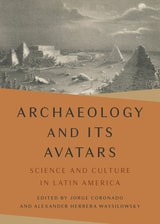
cover of Archaeology and Its Avatars: Science and Culture in Latin America

Archaeology and Its Avatars

Science and Culture in Latin America

Jorge Coronado, Alexander Herrera Wassilowsky

Northwestern University Press, 2026

Illuminating the impact of archaeology on the culture and politics of Latin America

Since the mid-nineteenth century, archaeology has played a critical role in historicizing space and shaping cultural imaginaries. It has brought modern scientific practices into structured contact with ancient objects and landscapes, on the one hand, and modern Indigenous cultures in their material and historical complexity, on the other. Archaeology has thus served a variety of disciplines and practices, from history and anthropology to literary and social criticism and critical theory, and has actively animated practices quite distinct from itself, such as public policy, tourism, urban planning, art, literature, and nation-building.
     
This volume provides a unique analysis of a disciplinary formation crucial to the study of cultural history and theory in Latin America. The contributors represent archaeologists and scholars from a variety of disciplines within the humanities, each of whom approaches archaeology as theory and praxis. Collectively, they map the differences and similarities between archaeological interventions and the ways in which the materiality, practice, and discourse of archaeology have been taken up as analytic, metaphor, and discursive strategy.
 

[more]
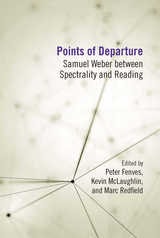
cover of Points of Departure: Samuel Weber between Spectrality and Reading

Points of Departure

Samuel Weber between Spectrality and Reading

Edited by Peter Fenves, Kevin McLaughlin, and Marc Redfield

Northwestern University Press, 2016
Since the late 1960s, when he introduced Theodor Adorno’s work on literature and cultural critique to an English-speaking public, Samuel Weber has stimulated the discovery of new and unexpected links within a broad spectrum of humanistic disciplines, including critical theory and psychoanalysis, media studies and literary analysis, continental philosophy and theater studies. The international group of scholars who contribute to Points of Departure demonstrate the persistent fecundity of Weber’s work. Centered around his essay on the Ghost of Hamlet, as reflected in the writings of Walter Benjamin and Carl Schmitt, the volume is broadly divided into explorations of the nature of spectrality, on the one hand, and the dynamics of reading, on the other. Each of the twelve essays thus takes its point of departure from “Weber’s singular path between languages, cultures, and traditions”—to quote Jacques Derrida, whose fictive “interview with a passing journalist” is published here for the first time.
[more]
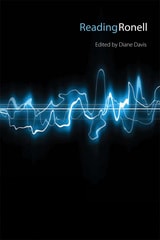
cover of Reading Ronell

Reading Ronell

Edited by Diane Davis

University of Illinois Press, 2008

Avital Ronell has won worldwide acclaim for her work across literature and philosophy, psychoanalysis and popular culture, political theory and feminism, art and rhetoric, drugs and deconstruction. In works such as The Test Drive, Stupidity, Crack Wars, and The Telephone Book, she has perpetually raised new and powerful questions about how we think, what thinking does, and how we fool ourselves about the troubled space between thought and action.

In this collection, some of today's most distinguished and innovative thinkers turn their attention to Ronell's teaching, writing, and provocations, observing how Ronell reads and what comes from reading her. By reading Ronell, and reading Ronell reading, contributors examine the ethico-political implications of her radical dislocations and carefully explicate, extend, and explore the paraconcepts addressed in her works.
[more]
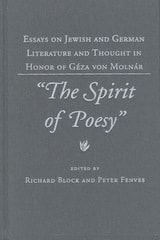
cover of The "Spirit of Poesy": Essays on Jewish and German Literature and Thought in Honor of Geza von Molnar

The "Spirit of Poesy"

Essays on Jewish and German Literature and Thought in Honor of Geza von Molnar

Richard Block and Peter Fenves

Northwestern University Press, 2000
A testament to the "spirit of poesy" that informs the life and work of Geza von Molnar, this volume of essays comes together around his principal preoccupations: the philosophical foundations of Goethe's writings, the structure and reception of German romanticism, the ethics of reading, and the fate of European Jewry. At the center of this work is the idea of a genuinely free humanity—from its ambiguous presence in the aesthetic projects of Goethe and German romanticism to its utter absence in the Nazi extermination camps. Combining works in philosophy, literature, and Jewish studies by established and younger scholars, this collection contributes significantly to an understanding of German culture.
[more]
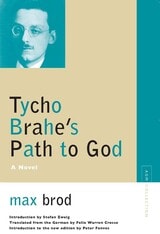
cover of Tycho Brahe's Path to God: A Novel

Tycho Brahe's Path to God

A Novel

Max Brod

Northwestern University Press, 2007

Though best known for his editing and posthumous publication of his friend Franz Kafka's writing, Max Brod was a major novelist in his own right. Tycho Brahe's Path to God, widely considered his finest work and viewed by many as a small masterpiece, concerns the relationship between the great Danish astronomer and the younger, intellectually superior Johannes Kepler. Brod's representation of this complicated relation grew out of his acquaintance with the young Albert Einstein, reproduces his struggles with the Expressionist poet Franz Werfel, and strangely anticipates the most famous act Brod would ever perform: publishing Kafka's writings without his permission. As Brahe attempts to create a diplomatic compromise between the old Ptolemaic system of planetary motion and its modern, Copernican revision, Kepler discards the principle of compromise root and branch. Their conflict thus becomes an emblem of the struggle between a weakened tradition and a self-conscious modernity. The novel manages to convey the intimate, emotional reality of a seventeenth-century political conflict as well as the psychological, political, and artistic turmoil of Brod's own time. This revival of the richly allusive and deeply resonant Tycho Brahe's Path to God is a true literary event.
[more]