Results by title
7 books match the query 'Ferris, Dana R.'

Beyond Convention
Genre Innovation in Academic WritingChristine M. Tardy
University of Michigan Press, 2016
---Foreword by Dana R. Ferris, author of Treatment of Error and Teaching College Writing to Diverse Student Populations
This book attempts to engage directly with the complexities and tensions in genre from both theoretical and pedagogical perspectives. While struggling with questions of why, when, and how different writers can manipulate conventions, Tardy became interested in related research into voice and identity in academic writing and then began to consider the ways that genre can be a valuable tool that allows writing students and teachers to explore expected conventions and transformative innovations. For Tardy, genres aren’t “fixed,” and she argues also that neither genre constraints nor innovations are objective—that they can be accepted or rejected depending on the context.
Beyond Convention considers a range of learning and teaching settings, including first-year undergraduate writing, undergraduate writing in the disciplines, and the advanced academic writing of graduate students and professionals. It is intended for those interested in the complexities of written communication, whether their interests are grounded in genre theory, academic discourse, discourse analysis, or writing instruction. With its attentiveness to context, discipline, and community, it offers a resource for those interested in English for Academic Purposes, English for Specific Purposes, and Writing in the Disciplines. At its heart, this is a book for teachers and teacher educators.

Responding to Writing
A Practical Sourcebook for InstructorsDana R. Ferris, Grant Eckstein, and Betsy Gilliland
University of Michigan Press, 2027
Responding to Writing brings together practical, cutting-edge ideas from teachers who spend their days working with student writers and trying to make feedback genuinely useful. The book shares classroom approaches that have been tested in real courses, from high school settings to college and graduate programs. It shows how teachers, peers, and students themselves can make feedback a more collaborative and manageable part of writing instruction.
Each chapter presents a student‑centered approach that helps writers feel supported and more in control of their own writing and revision process. In addition to a summary of the approach with light background and context, readers will find straightforward examples, tools, and routines they can adapt to their own classrooms, including ways to use technology, build reflection into assignments, and support writers with varied backgrounds and needs. This book offers working instructors a set of dependable methods for helping students improve as writers while keeping feedback purposeful and humane.
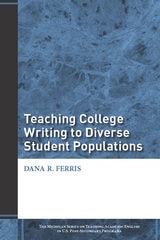
Teaching College Writing to Diverse Student Populations
Dana R. Ferris
University of Michigan Press, 2013
Statistical and anecdotal evidence documents that even states with relatively little ethnic or cultural diversity are beginning to notice and ask questions about long-term resident immigrants in their classes. As shifts in student population become more widespread, there is an even greater need for second language specialists, composition specialists, program administrators, and developers in colleges and universities to understand and adapt to the needs of the changing student audience(s).
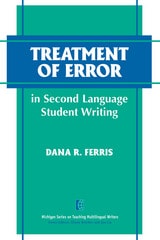
Treatment of Error in Second Language Student Writing
Dana R. Ferris
University of Michigan Press, 2002
Unlike a teachers' manual or a handbook that purports to give all the answers needed, Ferris's research-based volume offers a solid scholarly foundation for the practical ideas presented together with an abundance of illustrative sample texts. This book will be a rich resource in language teaching methodology courses, but experienced teachers too will no doubt benefit from the depth and breadth of Ferris's coverage of various error response techniques as well as of the research that motivates those techniques.
Ferris offers a realistic, well-reasoned account of what second language (L2) writing teacher--or teachers with L2 students in their classes--need to know about error and how to put what they know to use. She persuasively addresses the fundamental error treatment questions that plague novice and expert writing specialists alike: What types of errors should teachers respond to? When should we respond to them? What are the most efficacious ways of responding to them? And ultimately, what role should error treatment play in the teaching of the process of writing?
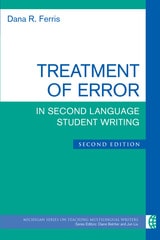
Treatment of Error in Second Language Student Writing, Second Edition
Dana R. Ferris
University of Michigan Press, 2011
Treatment of Error offers a realistic, well-reasoned account of what teachers of multilingual writers need to know about error and how to put what they know to use. As in the first edition, Ferris again persuasively addresses the fundamental error treatment questions that plague novice and expert writing specialists alike: What types of errors should teachers respond to? When should we respond to them? What are the most efficacious ways of responding to them? And ultimately, what role should error treatment play in the teaching of the process of writing?
The second edition improves upon the first by exploring changes in the field since 2002, such as the growing diversity in what is called “L2 writers,” the blurring boundaries between “native” and “non-native” speakers of English, the influence of genre studies and corpus linguistics on the teaching of writing, and the need the move beyond “error” to “second language development” in terms of approaching students and their texts. It also explores what teacher preparation programs need to do to train teachers to treat student error.
The second edition features
* an updating of the literature in all chapters
* a new chapter on academic language development
* a postscript on how to integrate error treatment/language development suggestions in Chapters 4-6 into a writing class syllabus
* the addition of discussion/analysis questions at the end of each chapter, plus suggested readings, to make the book more useful in pedagogy or teacher development workshops
Treatment of Error in Second Language Student Writing, Third Edition
Dana R. Ferris and Sabina Simon
University of Michigan Press, 2027
Treatment of Error in Second Language Student Writing is a practical book for teachers to help students writing in a second/other language develop greater precision (accuracy and style) in the language they use. While it does focus on language errors made by student writers, it goes beyond error to helping them develop strategies to become independent self-editors. It also discusses ongoing second language development—how students can increase and deploy their linguistic resources (grammar and vocabulary) to become more effective communicators of their written ideas.
This new edition retains the accessible design that helps teachers prepare themselves to treat error effectively. It contains guidance on how to organize course syllabi and lessons to provide authentically integrated error treatment and language development that is complementary to the overall goals of a writing course. In addition, the authors have incorporated new research and theory on written corrective feedback, discussion of philosophical questions raised by the translingual and Critical Language Awareness (CLA) movements, and analysis of how AI tools can help (or hinder) the students working to gain greater linguistic control of their writing.

What Error Correction Can(not) Accomplish for Second Language Writers
Dispelling Myths, Discussing OptionsDana R. Ferris
University of Michigan Press, 2018