Results by title
5 books match the query 'Fiddlers'
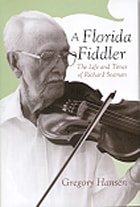
A Florida Fiddler
The Life and Times of Richard SeamanGregory Hansen
University of Alabama Press, 2007
Exploring Florida's cultural landscape through the life of a legendary fiddler.
This biography of 97-year-old Richard Seaman, who grew up in Kissimmee Park, Florida, relies on oral history and folklore research to define the place of musicianship and storytelling in the state's history from one artist's perspective. Gregory Hansen presents Seaman’s assessment of Florida’s changing cultural landscape through his tall tales, personal experience narratives, legends, fiddle tune repertory, and descriptions of daily life.
Seaman’s childhood memories of fiddling performances and rural dances explain the role such gatherings played in building and maintaining social order within the community. As an adult, Seaman moved to Jacksonville, Florida, where he worked as a machinist and performed with his family band. The evolution of his musical repertory from the early 1920s through the 1950s provides a resource for reconstructing social life in the rural south and for understanding how changes in musical style reflect the state's increasingly urban social structure. Hansen includes a set of Seaman's fiddle tunes, transcribed for the benefit of performer and researcher alike. The thirty tall tales included in the volume constitute a representative sample of Florida’s oral tradition in the early years of the 20th century.

Ole Hendricks and His Tunebook
Folk Music and Community on the FrontierAmy M. Shaw
University of Wisconsin Press, 2020
Such tunebooks, popular during the nineteenth century, rarely survive and are often overlooked by folk scholars in favor of commercially produced recordings, published sheet music, or oral tradition. Based on extensive historical and genealogical research, Amy Shaw presents a grounded picture of a musician, his family, and his community in the Upper Midwest, revealing much about music and dance in the area. This notable contribution to regional music and folklore includes more than one hundred of Ole's dance tunes, transcribed into modern musical notation for the first time. Ole Hendricks and His Tunebook will be valuable to readers and scholars interested in ethnomusicology and the Norwegian American immigrant experience.
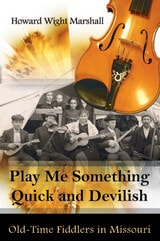
Play Me Something Quick and Devilish
Old-Time Fiddlers in MissouriHoward Wight Marshall
University of Missouri Press, 2012
Beginning with the French villages on the Mississippi River, Marshall leads us chronologically through the settlement of the state and how these communities established our cultural heritage. Other core populations include the “Old Stock Americans” (primarily Scotch-Irish from Kentucky, Tennessee, North Carolina, and Virginia), African Americans, German-speaking immigrants, people with American Indian ancestry (focusing on Cherokee families dating from the Trail of Tears in the 1830s), and Irish railroad workers in the post–Civil War period. These are the primary communities whose fiddle and dance traditions came together on the Missouri frontier to cultivate the bounty of old-time fiddling enjoyed today.
Marshall also examines regional styles in Missouri fiddling and comments on the future of this time-honored, and changing, tradition. Documentary in nature, this social history draws on various academic disciplines and oral histories recorded in Marshall’s forty-some years of research and field experience. Historians, music aficionados, and lay people interested in Missouri folk heritage—as well as fiddlers, of course—will find Play Me Something Quick and Devilish an entertaining and enlightening read.
With 39 tunes, the enclosed Voyager Records companion CD includes a historic sampler of Missouri fiddlers and styles from 1955 to 2012.
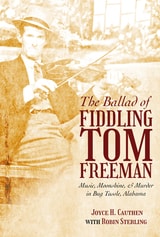
The Ballad of Fiddling Tom Freeman
Music, Moonshine, and Murder in Bug Tussle, AlabamaJoyce H. Cauthen with Robin Sterling
University of Alabama Press, 2026
A raw, firsthand account of feuds, fiddling, moonshining, and survival in a small Alabama town, told by its most colorful chronicler and shaped through careful historical insight.
The Ballad of Fiddling Tom Freeman is a riveting portrait of a forgotten America, drawn from the handwritten memoirs of a bootlegger, fiddler, and chronicler of life in Bug Tussle, Alabama, in the first half of the twentieth century. Today, rural voices are often drowned out by polished narratives, but this book resurrects the unfiltered perspective of a man who lived through—and candidly documented—the chaos and violence in his home place as he shared stories of the large close-knit families who lived there.
Freeman’s storytelling is as wild and tangled as the lives he describes, and author Joyce H. Cauthen, with the assistance of historical researcher Robin Sterling, brings clarity and context to his tales without sanding down their rough edges. The result is a vivid, bottom-up history of a place where lawlessness and loyalty often walked hand in hand.
The Ballad of Fiddling Tom Freeman stands out as a testament to the power of personal narrative. Not just a story about one man, it’s a window into a community shaped by hardship, music, and survival, told in a voice that refuses to be forgotten. This book is essential reading for historians, folklorists, musicians, and anyone drawn to the untamed stories of America’s backroads and backwoods.
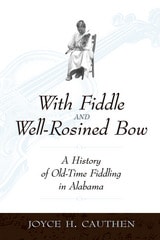
With Fiddle and Well-Rosined Bow
A History of Old-Time Fiddling In AlabamaJoyce H. Cauthen
University of Alabama Press, 2001
Relying on extensive archival research and on sixty interviews with fiddlers and their families and friends, Cauthen tells the rich, full story of old-time fiddling in Alabama.
Writing of life in the Alabama Territory in the late 1700s, A. J. Pickett, the state's first historian, noted that the country abounded in fiddlers, of high and low degree. After the defeat of the Creek Indians at the Battle of Horseshoe Bend in 1813, the number of fiddlers swelled as settlers from the southern states surrounding Alabama claimed the land. The music they played was based on tunes brought from Ireland, Scotland, and England, but in Alabama they developed their own southern accent as their songs became the music of celebration and relaxation for the state's pioneers. Early in the 20th century such music began to be called "old-time fiddling," to distinguish it from the popular music of the day, and the term is still used to distinguish that style from more modern bluegrass and country fiddle styles.
In With Fiddle and Well-Rosined Bow, Cauthen focuses on old-time fiddling in Alabama from the settlement of the state through World War II. Cauthen shows the effects of events, inventions, ethnic groups, and individuals upon fiddlers' styles and what they played. Cauthen gives due weight to the "modest masters of fiddle and bow" who were stars only to their families and communities. The fiddlers themselves tell why they play, how they learned without formal instruction and written music, and how they acquired their instruments and repertoires. Cauthen also tells the stories of "brag" fiddlers such as D.Dix Hollis, Y. Z. Hamilton, Charlie Stripling, "Fiddling" Tom Freeman,"Monkey" Brown, and the Johnson Brothers whose reputations spread beyond their communities through commercial recordings and fiddling contests. Described in vivid detail are the old-style square dances, Fourth of July barbeques and other celebrations, and fiddlers' conventions that fiddler shave reigned over throughout the state's history.