Results by title

4 books match the query 'Field, Edward'
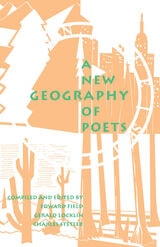
cover of A New Geography of Poets

A New Geography of Poets

Edward Field

University of Arkansas Press, 1993
Sparked by Archibald MacLeish's assertion that "there always was a relationship between poet and place," Field and his co-editors offer an updated look at the contemporary poetry scene in A New Geography of Poets.
[more]
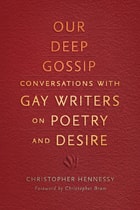
cover of Our Deep Gossip: Conversations with Gay Writers on Poetry and Desire

Our Deep Gossip

Conversations with Gay Writers on Poetry and Desire

Christopher Hennessy; Foreword by Christopher Bram

University of Wisconsin Press, 2013
From Walt Whitman forward, a century and a half of radical experimentation and bold speech by gay and lesbian poets has deeply influenced the American poetic voice. In Our Deep Gossip, Christopher Hennessy interviews eight gay men who are celebrated American poets and writers: Edward Field, John Ashbery, Richard Howard, Aaron Shurin, Dennis Cooper, Cyrus Cassells, Wayne Koestenbaum, and Kazim Ali. The interviews showcase the complex ways art and life intertwine, as the poets speak about their early lives, the friends and communities that shaped their work, the histories of gay writers before them, how sex and desire connect with artistic production, what coming out means to a writer, and much more.
            While the conversations here cover almost every conceivable topic of interest to readers of poetry and poets themselves, the book is an especially important, poignant, far-reaching, and enduring document of what it means to be a gay artist in twentieth- and early twenty-first-century America.
[more]
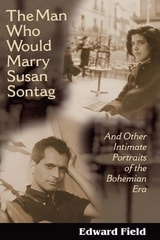
cover of The Man Who Would Marry Susan Sontag: And Other Intimate Literary Portraits of the Bohemian Era

The Man Who Would Marry Susan Sontag

And Other Intimate Literary Portraits of the Bohemian Era

Edward Field

University of Wisconsin Press, 2007

    Long before Stonewall, young Air Force veteran Edward Field, fresh from combat in WWII, threw himself into New York’s literary bohemia, searching for fulfillment as a gay man and poet. In this vivid account of his avant-garde years in Greenwich Village and the bohemian outposts of Paris’s Left Bank and Tangier—where you could write poetry, be radical, and be openly gay—Field opens the closet door to reveal, as never been seen before, some of the most important writers of his time.

    Here are young, beautiful Susan Sontag sitting at the feet of her idol Alfred Chester, who shrewdly plotted to marry her; May Swenson and her two loves; Paul and Jane Bowles in their ambiguous marriage; Frank O’Hara in and out of bed; Fritz Peters, the anointed son of Gurdjieff; and James Baldwin, Isabel Miller (Patience and Sarah), Tobias Schneebaum, Robert Friend, and many others. With its intimate portraits, Field’s memoir brings back a forgotten era—postwar bohemia—bawdy, comical, romantic, sad, and heroic.
[more]
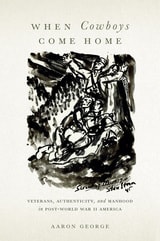
cover of When Cowboys Come Home: Veterans, Authenticity, and Manhood in Post–World War II America

When Cowboys Come Home

Veterans, Authenticity, and Manhood in Post–World War II America

Aaron George

Rutgers University Press, 2024

When Cowboys Come Home: Veterans, Authenticity, and Manhood in Post–World War II America is a cultural and intellectual history of the 1950s that argues that World War II led to a breakdown of traditional markers of manhood and opened space for veterans to reimagine what masculinity could mean. One particularly important strand of thought, which influenced later anxieties over “other-direction” and “conformity,” argued that masculinity was not defined by traits like bravery, stoicism, and competitiveness but instead by authenticity, shared camaraderie, and emotional honesty. To elucidate this challenge to traditional “frontiersman” masculinity, Aaron George presents three intellectual biographies of important veterans who became writers after the war: James Jones, the writer of the monumentally important war novel From Here to Eternity; Stewart Stern, one of the most important screenwriters of the fifties and sixties, including for Rebel without a Cause; and Edward Field, a bohemian poet who used poetry to explore his love for other men. Through their lives, George shows how wartime disabused men of the notion that war was inherently a brave or heroic enterprise and how the alienation they felt upon their return led them to value the authentic connections they made with other men during the war.
 
[more]