Results by title
7 books match the query 'Fifties'
Glimmering Girls
A Novel of the FiftiesMerrill Joan Gerber
University of Wisconsin Press, 2005
Happy Days and Wonder Years
The Fifties and the Sixties in Contemporary Cultural PoliticsMarcus, Daniel
Rutgers University Press, 2004
From Ronald Reagan's image as a Fifties Cold Warrior to Bill Clinton's fandom for Elvis Presley and John F. Kennedy, politicians have invoked the Fifties and the Sixties to connect to their public. Marcus shows how films, television, music, and memoirs have responded to the political nostalgia of today, and why our entertainment remains immersed in reruns, revivals, and references to earlier times. This book offers a new understanding of how politics and popular culture have influenced our notions of the past, and how events from long ago continue to shape our understanding of the present day.
Hollywood TV
The Studio System in the FiftiesBy Christopher Anderson
University of Texas Press, 1994
The 1950s was one of the most turbulent periods in the history of motion pictures and television. During the decade, as Hollywood's most powerful studios and independent producers shifted into TV production, TV replaced film as America's principal postwar culture industry.
This pioneering study offers the first thorough exploration of the movie industry's shaping role in the development of television and its narrative forms. Drawing on the archives of Warner Bros. and David O. Selznick Productions and on interviews with participants in both industries, Christopher Anderson demonstrates how the episodic telefilm series, a clear descendant of the feature film, became and has remained the dominant narrative form in prime-time TV.
This research suggests that the postwar motion picture industry was less an empire on the verge of ruin—as common wisdom has it—than one struggling under unsettling conditions to redefine its frontiers. Beyond the obvious contribution to film and television studies, these findings add an important chapter to the study of American popular culture of the postwar period.
Invasion of the Mind Snatchers
Television's Conquest of America in the FiftiesEric Burns
Temple University Press, 2010
When the first television was demonstrated in 1927, a headline in The New York Times read, “Like a Photo Come to Life.” It was a momentous occasion. But the power of television wasn’t fully harnessed until the 1950s, when the medium was, as Eric Burns says, “At its most preoccupying, its most life-altering.” And Burns, a former NBC News correspondent who is an Emmy-winner for his broadcast writing, knows about the impact of television.
Invasion of the Mind Snatchers chronicles the influence of television that was watched daily by the baby boomer generation. As kids became spellbound by Howdy Doody and The Ed Sullivan Show, Burns reveals, they often acted out their favorite programs. Likewise, they purchased the merchandise being promoted by performers, and became fascinated by the personalities they saw on screen, often emulating their behavior. It was the first generation raised by TV and Burns looks at both the promise of broadcasting as espoused by the inventors, and how that promise was both redefined and lost by the corporations who helped to spread the technology.
Yet Burns also contextualizes the social, cultural, and political events that helped shape the Fifties—from Sputnik and the Rosenberg trial to Senator Joseph McCarthy’s Red Scare. In doing so, he charts the effect of television on politics, religion, race, and sex, and how the medium provided a persuasive message to the young, impressionable viewers.

John Wayne’s World
Transnational Masculinity in the FiftiesBy Russell Meeuf
University of Texas Press, 2013
In a film career that spanned five decades, John Wayne became a U.S. icon of heroic individualism and rugged masculinity. His widespread popularity, however, was not limited to the United States: he was beloved among moviegoers in Asia, Africa, Latin America, and Europe. In John Wayne’s World, Russell Meeuf considers the actor’s global popularity and makes the case that Wayne’s depictions of masculinity in his most popular films of the 1950s reflected the turbulent social disruptions of global capitalism and modernization taking place in that decade.
John Wayne’s World places Wayne at the center of gender- and nation-based ideologies, opening a dialogue between film history, gender studies, political and economic history, and popular culture. Moving chronologically, Meeuf provides new readings of Fort Apache, Red River, Hondo, The Searchers, Rio Bravo, and The Alamo and connects Wayne’s characters with a modern, transnational masculinity being reimagined after World War II. Considering Wayne’s international productions, such as Legend of the Lost and The Barbarian and the Geisha, Meeuf shows how they resonated with U.S. ideological positions about Africa and Asia. Meeuf concludes that, in his later films, Wayne’s star text shifted to one of grandfatherly nostalgia for the past, as his earlier brand of heroic masculinity became incompatible with the changing world of the 1960s and 1970s. The first academic book-length study of John Wayne in more than twenty years, John Wayne’s World reveals a frequently overlooked history behind one of Hollywood’s most iconic stars.
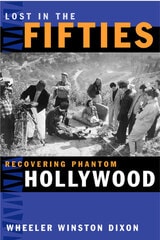
Lost in the Fifties
Recovering Phantom HollywoodWheeler Winston Dixon
Southern Illinois University Press, 2005
Lost in the Fifties: Recovering Phantom Hollywood reveals two 1950s: an era glorified in Hollywood movies and a darker reality reflected in the esoteric films of the decade. Renowned film scholar Wheeler Winston Dixon turns to the margins—the television shows and films of a hidden Hollywood—to offer an authentic view of the 1950s that counters the Tinsel-town version. Dixon examines the lost films and directors of the decade. Contrasting traditional themes of love, marriage, and family, Dixon’s 1950s film world unveils once-taboo issues of rape, prostitution, and gangs. Television shows such as Captain Midnight and Ramar of the Jungle are juxtaposed with the cheerful world of I Love Lucy and Howdy Doody. Highlighting directors including Herbert L. Strock, Leslie Martinson, Arnold Laven, and Charles Haas, Dixon provides new insights on the television series Racket Squad, Topper, and The Rifleman and the teen films I Was a Teenage Werewolf and High School Confidential.
Geared for scholars and students of film and pop culture, Lost in the Fifties includes twenty-five photos—many previously unpublished—and draws on rare interviews with key directors, actors, and producers. The volume provides the first detailed profile of the most prolific producer in Hollywood history, Sam Katzman, and his pop culture classics Rock Around the Clock and Earth vs. The Flying Saucers. Dixon profiles, for the first time, B-movie phenomenon Fred F. Sears, who directed more than fifty touchstone films of a generation, including the noir thriller Chicago Syndicate, the criminal career story Cell 2455 Death Row, and the 3-D color western The Nebraskan. Also profiled is Ida Lupino, the only woman to direct in Hollywood in the 1950s, who tackled issues of bigamy, teenage pregnancy, and sports corruption in The Bigamist, The Hitch-Hiker, Outrage, Never Fear, Not Wanted, and Hard, Fast and Beautiful, when no major studio would touch such controversial topics. Dixon also looks at the era’s social guidance films, which instructed adolescents in acceptable behavior, proper etiquette, and healthy hygiene.
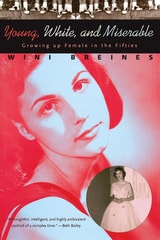
Young, White, and Miserable
Growing Up Female in the FiftiesWini Breines
University of Chicago Press, 2001