Results by title
5 books match the query 'Film Television'
Cycles, Sequels, Spin-offs, Remakes, and Reboots
Multiplicities in Film and TelevisionEdited by Amanda Ann Klein and R. Barton Palmer
University of Texas Press, 2016
With sequels, prequels, remakes, spin-offs, or copies of successful films or franchises dominating film and television production, it sometimes seems as if Hollywood is incapable of making an original film or TV show. These textual pluralities or multiplicities—while loved by fans who flock to them in droves—tend to be dismissed by critics and scholars as markers of the death of high culture. Cycles, Sequels, Spin-offs, Remakes, and Reboots takes the opposite view, surveying a wide range of international media multiplicities for the first time to elucidate their importance for audiences, industrial practices, and popular culture.
The essays in this volume offer a broad picture of the ways in which cinema and television have used multiplicities to streamline the production process, and to capitalize on and exploit viewer interest in previously successful and/or sensational story properties. An impressive lineup of established and emerging scholars talk seriously about forms of multiplicity that are rarely discussed as such, including direct-to-DVD films made in Nigeria, cross-cultural Japanese horror remakes, YouTube fan-generated trailer mash-ups, and 1970s animal revenge films. They show how considering the particular bonds that tie texts to one another allows us to understand more about the audiences for these texts and why they crave a version of the same story (or character or subject) over and over again. These findings demonstrate that, far from being lowbrow art, multiplicities are actually doing important cultural work that is very worthy of serious study.
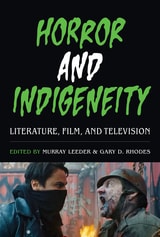
Horror and Indigeneity
Literature, Film, and TelevisionEdited by Murray Leeder and Gary D. Rhodes
University of Texas Press, 2026
A collection of essays about Indigeneity and horror in cinema, literature, and beyond.
How did Indigeneity come to be horrifying? Think of the “Indian burial ground” trope, a staple of 1970s horror cinema, not to mention decades of Western films and fictions that made “savage Indians” the face of fear in popular culture. Can horror do something else in the hands of Indigenous people? Creators such as Eden Robinson and Jeff Barnaby have self-consciously turned to horror to tell new kinds of stories, stories that question who is a monster and what constitutes the monstrous.
Horror and Indigeneity explores representations of Indigenous people in settler horror texts and in the growing corpus of horror by Indigenous writers and filmmakers. Widely spanning time periods and media, the contributors to this edited volume address themes such as cannibalism, eco-horror, historical trauma, and contemporary antiracism as they relate to classical horror cinema and recent works such as The Dead Can’t Dance, Lovecraft Country, and Stephen Graham Jones’s The Only Good Indians. Also featuring interviews with Jones and director T. J. Cuthand, Horror and Indigeneity rethinks the terror of the Other in potent and provocactive terms.
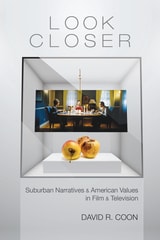
Look Closer
Suburban Narratives and American Values in Film and TelevisionCoon, David R
Rutgers University Press, 2013
In recent years, the media landscape in the United States has followed a pattern similar to that of the physical landscape by becoming increasingly suburbanized. Although it is a far cry from reality, the fantasy of a perfect suburban life still exists in the collective imagination of millions of Americans. This dream of suburban perfection is built around a variety of such ideologically conservative values and ideals as the importance of tradition, the centrality of the nuclear family, the desire for a community of like-minded neighbors, the need for clearly defined gender roles, and the belief that with hard work and determination, anyone can succeed.
Building on the relationships between suburban life and American identity, Look Closer examines and interprets recent narratives that challenge the suburban ideal to reveal how directors and producers are mobilizing the spaces of suburbia to tell new kinds of stories about America. David R. Coon argues that the myth of suburban perfection, popularized by postwar sitcoms and advertisements, continues to symbolize a range of intensely debated issues related to tradition, family, gender, race, and citizenship. Through close examinations of such films as American Beauty, The Truman Show, and Mr. & Mrs. Smith as well as such television series as Desperate Housewives, Weeds, and Big Love, the book demonstrates how suburbia is used to critique the ideologies that underpin the suburban American Dream.
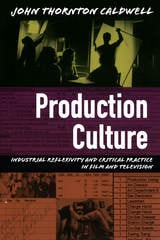
Production Culture
Industrial Reflexivity and Critical Practice in Film and TelevisionJohn Thornton Caldwell
Duke University Press, 2008
Drawing on interviews, observations of sets and workplaces, and analyses of TV shows, industry documents, economic data, and promotional materials, Caldwell shows how film and video workers function in a transformed, post-network industry. He chronicles how workers have responded to changes including media convergence, labor outsourcing, increasingly unstable labor and business relations, new production technologies, corporate conglomeration, and the proliferation of user-generated content. He explores new struggles over “authorship” within collective creative endeavors, the way that branding and syndication have become central business strategies for networks, and the “viral” use of industrial self-reflexivity to motivate consumers through DVD bonus tracks, behind-the-scenes documentaries, and “making-ofs.” A significant, on-the-ground analysis of an industry in flux, Production Culture offers new ways of thinking about media production as a cultural activity.
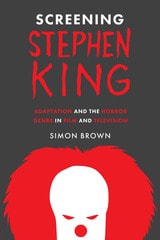
Screening Stephen King
Adaptation and the Horror Genre in Film and TelevisionBy Simon Brown
University of Texas Press, 2018
Since the 1970s, the name Stephen King has been synonymous with horror. His vast number of books has spawned a similar number of feature films and TV shows, and together they offer a rich opportunity to consider how one writer’s work has been adapted over a long period within a single genre and across a variety of media—and what that can tell us about King, about adaptation, and about film and TV horror. Starting from the premise that King has transcended ideas of authorship to become his own literary, cinematic, and televisual brand, Screening Stephen King explores the impact and legacy of over forty years of King film and television adaptations.
Simon Brown first examines the reasons for King’s literary success and then, starting with Brian De Palma’s Carrie, explores how King’s themes and style have been adapted for the big and small screens. He looks at mainstream multiplex horror adaptations from Cujo to Cell, low-budget DVD horror films such as The Mangler and Children of the Corn franchises, non-horror films, including Stand by Me and The Shawshank Redemption, and TV works from Salem’s Lot to Under the Dome. Through this discussion, Brown identifies what a Stephen King film or series is or has been, how these works have influenced film and TV horror, and what these influences reveal about the shifting preoccupations and industrial contexts of the post-1960s horror genre in film and TV.