Results by title
8 books match the query 'Film genres'
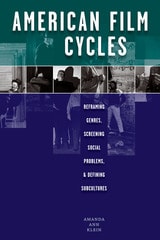
American Film Cycles
Reframing Genres, Screening Social Problems, and Defining SubculturesBy Amanda Ann Klein
University of Texas Press, 2011
A series of movies that share images, characters, settings, plots, or themes, film cycles have been an industrial strategy since the beginning of cinema. While some have viewed them as "subgenres," mini-genres, or nascent film genres, Amanda Ann Klein argues that film cycles are an entity in their own right and a subject worthy of their own study. She posits that film cycles retain the marks of their historical, economic, and generic contexts and therefore can reveal much about the state of contemporary politics, prevalent social ideologies, aesthetic trends, popular desires, and anxieties.
American Film Cycles presents a series of case studies of successful film cycles, including the melodramatic gangster films of the 1920s, the 1930s Dead End Kids cycle, the 1950s juvenile delinquent teenpic cycle, and the 1990s ghetto action cycle. Klein situates these films in several historical trajectories—the Progressive movement of the 1910s and 1920s, the beginnings of America's involvement in World War II, the "birth" of the teenager in the 1950s, and the drug and gangbanger crises of the early 1990s. She shows how filmmakers, audiences, film reviewers, advertisements, and cultural discourses interact with and have an impact on the film texts. Her findings illustrate the utility of the film cycle in broadening our understanding of established film genres, articulating and building upon beliefs about contemporary social problems, shaping and disseminating deviant subcultures, and exploiting and reflecting upon racial and political upheaval.

Cycles, Sequels, Spin-offs, Remakes, and Reboots
Multiplicities in Film and TelevisionEdited by Amanda Ann Klein and R. Barton Palmer
University of Texas Press, 2016
With sequels, prequels, remakes, spin-offs, or copies of successful films or franchises dominating film and television production, it sometimes seems as if Hollywood is incapable of making an original film or TV show. These textual pluralities or multiplicities—while loved by fans who flock to them in droves—tend to be dismissed by critics and scholars as markers of the death of high culture. Cycles, Sequels, Spin-offs, Remakes, and Reboots takes the opposite view, surveying a wide range of international media multiplicities for the first time to elucidate their importance for audiences, industrial practices, and popular culture.
The essays in this volume offer a broad picture of the ways in which cinema and television have used multiplicities to streamline the production process, and to capitalize on and exploit viewer interest in previously successful and/or sensational story properties. An impressive lineup of established and emerging scholars talk seriously about forms of multiplicity that are rarely discussed as such, including direct-to-DVD films made in Nigeria, cross-cultural Japanese horror remakes, YouTube fan-generated trailer mash-ups, and 1970s animal revenge films. They show how considering the particular bonds that tie texts to one another allows us to understand more about the audiences for these texts and why they crave a version of the same story (or character or subject) over and over again. These findings demonstrate that, far from being lowbrow art, multiplicities are actually doing important cultural work that is very worthy of serious study.
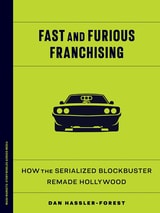
Fast and Furious Franchising
How the Serialized Blockbuster Remade HollywoodDan Hassler-Forest
University of Minnesota Press, 2026
What the popularity of the Fast and Furious film franchise says about Hollywood blockbusters and media production
Fast and Furious Franchising charts the transformation of Hollywood through the story of one of its most successful cinematic universes. Released in 2001, The Fast and the Furious became an unexpected hit, developing into a seven-billion-dollar media franchise with nine direct sequels (so far), one “sidequel,” copious spin-offs, and licensing deals from board games to theme park rides.
Dan Hassler-Forest shows how Fast and Furious paved the way for a new form of serialized storytelling that balanced new distribution practices and expansion into international markets with a savvy awareness of representational politics. By following the series’s development over the past twenty-five years, Fast and Furious Franchising reveals distinct phases that reflect larger media-industrial trends: the postclassical blockbuster era of the early 2000s; the emergence of the megafranchise between 2008 and 2014; the franchise’s “imperial” era, from 2015 through 2019; and the postpandemic crisis era of media saturation and franchise fatigue.
While examining this rapidly changing media landscape, Hassler-Forest offers lively, insightful analyses of the films as they have embraced ever-more-ludicrous plots and unlikely character turns while always maintaining their signature faith in the power of family. As he illuminates the role of the Fast and Furious movies in the global entertainment industry, Hassler-Forest shows how the films’ improbable success proves Dominic Toretto’s adage that, whether “you win by an inch or a mile . . . winning’s winning.”
Retail e-book files for this title are screen-reader friendly with images accompanied by short alt text and/or extended descriptions.
Gender Meets Genre in Postwar Cinemas
Edited by Christine Gledhill
University of Illinois Press, 2012
This remarkable collection uses genre as a fresh way to analyze the issues of gender representation in film theory, film production, spectatorship, and the contexts of reception. With a uniquely global perspective, these essays examine the intersection of gender and genre in not only Hollywood films but also in independent, European, Indian, and Hong Kong cinemas. Working in the area of postcolonial cinema, contributors raise issues dealing with indigenous and global cinemas and argue that contemporary genres have shifted considerably as both notions of gender and forms of genre have changed. The volume addresses topics such as the history of feminist approaches to the study of genre in film, issues of female agency in postmodernity, changes taking place in supposedly male-dominated genres, concepts of genre and its use of gender in global cinema, and the relationship between gender and sexuality in film.

Genre Matters
Essays in Theory and CriticismEdited by Garin Dowd, Lesley Stevenson, and Jeremy Strong
Intellect Books, 2006

Guidelines on Subject Access to Individual Works of Fiction, Drama, Etc.
American Library Association, 2000
Notions of Genre
Writings on Popular Film Before Genre TheoryEdited by Barry Keith Grant and Malisa Kurtz
University of Texas Press, 2016
Much of the writing in film studies published today can be understood as genre criticism, broadly speaking. And even before film studies emerged as an academic discipline in the 1970s, cultural observers within and beyond the academy were writing about genre films and making fascinating attempts to understand their conventions and how they speak to, for, and about the culture that produces them. While this early writing on genre film was often unsystematic, impressionistic, journalistic, and judgmental, it nonetheless produced insights that remain relevant and valuable today.
Notions of Genre gathers the most important early writing on film genre and genre films published between 1945 and 1969. It includes articles by such notable critics as Susan Sontag, Dwight Macdonald, Siegfried Kracauer, James Agee, André Bazin, Robert Warshow, and Claude Chabrol, as well as essays by scholars in academic disciplines such as history, sociology, and theater. Their writings address major issues in genre studies, including definition, representation, ideology, audiences, and industry practices, across genres ranging from comedy and westerns to horror, science fiction, fantasy, gangster films, and thrillers. The only single-volume source for this early writing on genre films, Notions of Genre will be an invaluable resource for scholars and students of film genre, film history, film theory, cultural studies, and popular culture.

Transnational Korean Cinema
Cultural Politics, Film Genres, and Digital TechnologiesDal Yong Jin
Rutgers University Press, 2020
The book emphasizes the economic and industrial aspects of the story, looking at questions on the interaction of politics and economics, including censorship and public funding, and provides a better view of the big picture by laying bare the relationship between film industries, the global market, and government. Jin also sheds light on the operations and globalization strategies of Korean film industries alongside changing cultural policies in tandem with Hollywood’s continuing influences in order to comprehend the power relations within cultural politics, nationally and globally. This is the first book to offer a full overview of the nascent development of Korean cinema.