Results by title

3 books match the query 'Final Solution'

cover of Persecution and Rescue: The Politics of the “Final Solution” in France, 1940-1944

Persecution and Rescue

The Politics of the “Final Solution” in France, 1940-1944

Wolfgang Seibel

University of Michigan Press, 2016

In 1942, two years after invading France, the Germans implemented their policy of exterminating the Jews. In contrast to Jews in many parts of German-occupied Europe, however, the majority of Jews in France survived, thanks to opposition to the Nazi extermination policy from Church dignitaries and the moral indignation of the average Frenchmen. Seeking to maintain popular support, the Vichy Regime bargained with the Germans over the substance and extent of its collaboration, which the Germans needed in order to hold France.

Drawing on German and French sources, Wolfgang Seibel traces the twisted process of political decision-making that shaped the fate of the Jews in German-occupied France during World War II. By analyzing the German-French negotiations, he reveals the underlying logic as well as the actual course of the bargaining process as both the Vichy Regime and the Germans sought a stable relationship. Yet that relationship was continually reshaped by the progress of the war, Germany’s deteriorating prospects, France’s economic and geopolitical position, and the Vichy government’s quest for domestic political support. The Jews’ suffering intensified when the Germans had the upper hand; but when the French felt empowered, the Vichy Regime stopped collaborating in the completion of the “final solution.” Persecution and Rescue: The Politics of the “Final Solution” in France, 1940–1944 demonstrates the ways in which political circumstances can mitigate—or foster—mass crime.

[more]
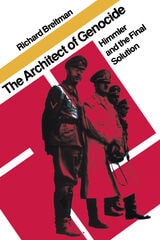
cover of The Architect of Genocide: Himmler and the Final Solution

The Architect of Genocide

Himmler and the Final Solution

Richard Breitman

Brandeis University Press, 1992
Among the Nazi leaders, Heinrich Himmler was, as Richard Breitman observes in this ground- breaking study, an easy man to underestimate—short, pudgy, near-sighted, chinless. Yet Himmler holds a peculiarly memorable place in the roster of Nazi war criminals: he was the man most closely associated with the creation and operation of the Final Solution, the programme of formal mass murder responsible for the deaths of six million Jews in death camps. Thus, to understand the Holocaust it is first necessary to understand Himmler, and it is this The Architect of Genocide at last permits us to do. Drawing on thousands of published and unpublished sources—ranging from the Nuremburg War Crimes trial records to papers held in the Central State Archives of the October Revolution of the Ukrainian SSR in Kiev—Breitman shows us the man himself, growing from unlikeable boyhood to be the perfect bureaucrat, seemingly the antithesis of the mad policies he espoused. At the same time, with unchallengeable authority, he presents us with the hitherto mysterious and much—debated facts about the origins of those policies, establishing among other things that before the war, Himmler had plans to murder all German Jews who would not- or could not—leave the country and that as early as 1939, Himmler was considering the use of gas chambers and crematoriums.
[more]
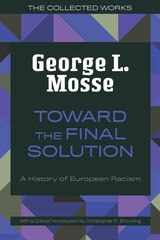
cover of Toward the Final Solution: A History of European Racism

Toward the Final Solution

A History of European Racism

George L. Mosse, With a critical introduction by Christopher R. Browning

University of Wisconsin Press, 2020

Originally published in 1978, Toward the Final Solution was one of the first in-depth studies of the evolution of racism in Europe, from the Age of Enlightenment through the Holocaust and Hitler’s Final Solution. George L. Mosse details how antisemitism and dangerous prejudices have long existed in the European cultural tradition, revealing an appalling and complex history. With the global renewal of extreme, right-wing nationalism, this instrumental work remains as important as ever for understanding how bigotry impacts political, cultural, and intellectual life. This edition of Mosse’s classic book includes a new critical introduction by Christopher R. Browning, author of Ordinary Men: Reserve Police Battalion 101 and the Final Solution in Poland.
[more]