Results by title
39 books match the query 'Financial crises'
After the Flood
How the Great Recession Changed Economic ThoughtEdited by Edward L. Glaeser, Tano Santos, and E. Glen Weyl
University of Chicago Press, 2017
A momentous collection of the best recent scholarship, After the Flood illustrates both the scope of the crises’ impact on our understanding of global financial markets and the innovative processes whereby scholars have adapted their research to gain a greater understanding of them. Among the contributors are José Scheinkman and Lars Peter Hansen, who bring up to date decades of collaborative research on the mechanisms that tie financial markets to the broader economy; Patrick Bolton, who argues that limiting bankers’ pay may be more effective than limiting the activities they can undertake; Edward Glaeser and Bruce Sacerdote, who study the social dynamics of markets; and E. Glen Weyl, who argues that economists are influenced by the incentives their consulting opportunities create.

Austerity Ireland
The Failure of Irish CapitalismKieran Allen and Brian O'Boyle
Pluto Press, 2013
In Austerity Ireland, Kieran Allen challenges this official image and argues that the Irish state's response to the crash has primarily been designed to protect economic privilege. The resulting austerity has been a failure and is likely to produce a decade of hardship.
The book offers a deeply informed and penetrating diagnosis of Ireland's current socio-economic and political malaise, suggesting that a political earthquake is underway which may benefit the left. Austerity Ireland is essential reading for all students of Irish politics and economics, as well as those interested in the politics of austerity and the eurozone crisis.
Banking on Stability
Japan and the Cross-Pacific Dynamics of International Financial Crisis ManagementSaori N. Katada
University of Michigan Press, 2001
Banking on Stability looks at Japan's willingness to cooperate financially with the United States--its most important trade partner--in cases where such compliance yields an improvement in relations. Katada argues that the Japanese government carefully weighs the benefits arising in international and domestic realms when taking on the role of collective crisis manager and concludes that Japan is no exception in having private gain as a central motivation during international financial crises.
Saori Katada is Assistant Professor, School of International Relations, University of Southern California.
Bleakonomics
A Heartwarming Introduction to Financial Catastrophe, the Jobs Crisis and Environmental DestructionRob Larson
Pluto Press, 2012
Written for anyone who is wondering how we’ve come to this point, Rob Larson holds mainstream economic theory up against the grim reality of a planet in meltdown. He looks at scientists’ conclusions about climate change, the business world’s opinions about its own power, and reveals the fingerprints of finance on American elections.
With a unique and engaging approach to each crucial subject, students, academics and activists will find a lot to appreciate in this quiet call-to-arms for a saner and more stable world.
Bubbles and Machines
Gender, Information and Financial CrisesMicky Lee
University of Westminster Press, 2019
China and the Twenty-first-Century Crisis
Minqi Li
Pluto Press, 2015
By looking at the big questions of class struggle, global economic imbalances, peak oil, climate change and political power play, Minqi Li argues that by the time of the next crisis, China will be at the epicentre of these contradictions.
China is the last large region, and source of cheap labour, into which capital could expand: the system is at its limits. By combining this argument with issues surrounding the planet’s ecological limits and the internal politics of the Chinese Communist Party, Li commands a narrative of China at a pivotal, and possibly apocalyptic stage.
Coping with Crisis
Government Reactions to the Great RecessionNancy Bermeo
Russell Sage Foundation, 2013
Curbing Bailouts
Bank Crises and Democratic Accountability in Comparative PerspectiveGuillermo Rosas
University of Michigan Press, 2009
"Rosas's compelling theory and wide-ranging empirical evidence yield a persuasive but surprising conclusion in light of the financial meltdown of 2008–9. In the event of banking crises, not only do elected governments treat taxpayers better and force bankers and their creditors to pay more for their mistakes, but bankers in democracies are more prudent as a consequence . . . essential reading for all interested in the political economy of crisis and in the future of banking regulation."
---Philip Keefer, Lead Economist, Development Research Group, The World Bank
"Rosas convincingly demonstrates how democratic accountability affects the incidence and resolution of banking crises. Combining formal models, case studies, and cutting-edge quantitative methods, Rosas's book represents a model for political economy research."
---William Bernhard, Professor, Department of Political Science, University of Illinois
"When the financial crises of the 1990s hit Asia, Russia, and Latin America, the U.S. scolded them about the moral hazard problems of bailing out the banks. Now, the shoe is on the other foot, with the U.S. struggling to manage an imploding financial sector. Rosas's study of bank bailouts could not be more timely, providing us with both a framework for thinking about the issue and some sobering history of how things go both right and badly wrong. Democratic accountability proves the crucial factor in making sure bailouts are fair, a point that is as relevant for U.S. policy as for an understanding of the emerging markets."
---Stephan Haggard, Krause Professor, Graduate School of International Relations and Pacific Studies, University of California, San Diego
Banking crises threaten the stability and growth of economies around the world. In response, politicians restore banks to solvency by redistributing losses from bank shareholders and depositors to taxpayers, and the burden the citizenry must bear varies from case to case. Whereas some governments stay close to the prescriptions espoused by Sir Walter Bagehot in the nineteenth century that limit the costs shouldered by taxpayers, others engage in generous bank bailouts at great cost to society. What factors determine a government's response?
In this comparative analysis of late-twentieth-century banking crises, Guillermo Rosas identifies political regime type as the determining factor. During a crisis, powerful financial players demand protection of their assets. Rosas maintains that in authoritarian regimes, government officials have little to shield them from such demands and little incentive for rebuffing them, while in democratic regimes, elected officials must weigh these demands against the interests of the voters---that is, the taxpayers. As a result, compared with authoritarian regimes, democratic regimes show a lower propensity toward dramatic, costly bailouts.
Guillermo Rosas is Assistant Professor in the Department of Political Science and Fellow at the Center in Political Economy at Washington University in St. Louis.
Currency Crises
Edited by Paul Krugman
University of Chicago Press, 2000
Reflecting the latest thinking on the subject, this offering from the NBER will serve as a useful basis for further debate on the theory and practice of speculative attacks, as well as a valuable resource as new crises loom.
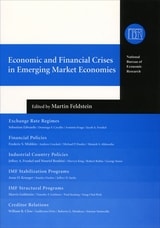
Economic and Financial Crises in Emerging Market Economies
Edited by Martin Feldstein
University of Chicago Press, 2003
This book rises to that challenge, presenting accessible papers and commentaries on the topic not only from leading academic economists, but also from high-ranking government officials (in both industrial and developing nations), senior policymakers at international institutions, and major financial investors. Six non-technical papers, each written by a specialist in the topic, provide essential economic background, introducing sections on exchange rate regimes, financial policies, industrial country policies, IMF stabilization policies, IMF structural programs, and creditor relations. Next, personal statements from the major players give firsthand accounts of what really went on behind the scenes during the crises, giving us a rare glimpse into how international economic policy decisions are actually made. Finally, wide-ranging discussions and debates sparked by these papers and statements are summarized at the end of each section.
The result is an indispensable overview of the key issues at work in these crises, written by the people who move markets and reshape economies, and accessible to not just economists and policymakers, but also to educated general readers.
Contributors:
Montek S. Ahluwalia, Domingo F. Cavallo, William R. Cline, Andrew Crockett, Michael P. Dooley, Sebastian Edwards, Stanley Fischer, Arminio Fraga, Jeffrey Frankel, Jacob Frenkel, Timothy F. Geithner, Morris Goldstein, Paul Keating, Mervyn King, Anne O. Krueger, Roberto Mendoza, Frederic S. Mishkin, Guillermo Ortiz, Yung Chul Park, Nouriel Roubini, Robert Rubin, Jeffrey Sachs, Ammar Siamwalla, George Soros

Ethnography #9
Alan Klima
Duke University Press, 2019
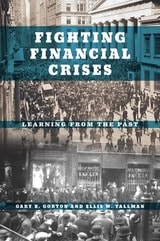
Fighting Financial Crises
Learning from the PastGary B. Gorton and Ellis W. Tallman
University of Chicago Press, 2018
Yet these pre-Fed banking panics, as Gary B. Gorton and Ellis W. Tallman show, bear striking similarities to our recent financial crisis. Fighting Financial Crises thus turns to the past to better understand our uncertain present, investigating how panics during the National Banking Era played out and how they were eventually quelled and prevented. The authors then consider the Fed’s and the SEC’s reactions to the recent crisis, building an informative new perspective on how the modern economy works.
Financial Markets and Financial Crises
Edited by R. Glenn Hubbard
University of Chicago Press, 1991
Using both historical and contemporary episodes of breakdowns in financial trade, contributors to this volume draw insights from theory and empirical data, from the experience of closed and open economies worldwide, and from detailed case studies. They explore the susceptibility of American corporations to economic downturns; the origins of banking panics; and the behavior of financial markets during periods of crisis. Sever papers specifically address the current thrift crisis—including a detailed analysis of the over 500 FSLIC-insured thrifts in the southeast—and seriously challenge the value of recent measures aimed at preventing future collapse in that industry. Government economists and policy makers, scholars of industry and banking, and many in the business community will find these timely papers an invaluable reference.
Financial Sector Development in the Pacific Rim
Edited by Takatoshi Ito and Andrew K. Rose
University of Chicago Press, 2009
The reform in Asian financial sectors—especially in banking and stock markets—has been remarkable since the currency crisis of 1997–98. East Asia is now a major player in international finance, providing serious competition to the more traditional financial centers of London and New York. Financial Sector Development in the Pacific Rim provides a rich collection of theoretical and empirical analyses of the growing capital markets in the region.
Bringing together authors from various East Asian and Pacific nations, this volume examines the institutional factors influencing financial innovation, the consequences of financial development, widespread consolidation occurring through mergers and acquisitions, and the implementation of policy reform. Financial Sector Development in the Pacific Rim offers the comparative analysis necessary to answer broad questions about economic development and the future of Asia.
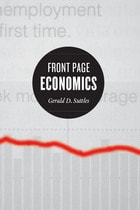
Front Page Economics
Gerald D. Suttles, with Mark D. Jacobs
University of Chicago Press, 2010
In an age when pundits constantly decry overt political bias in the media, we have naturally become skeptical of the news. But the bluntness of such critiques masks the highly sophisticated ways in which the media frame important stories. In Front Page Economics, Gerald Suttles delves deep into the archives to examine coverage of two major economic crashes—in 1929 and 1987—in order to systematically break down the way newspapers normalize crises.
Poring over the articles generated by the crashes—as well as the people in them, the writers who wrote them, and the cartoons that ran alongside them—Suttles uncovers dramatic changes between the ways the first and second crashes were reported. In the intervening half-century, an entire new economic language had arisen and the practice of business journalism had been completely altered. Both of these transformations, Suttles demonstrates, allowed journalists to describe the 1987 crash in a vocabulary that was normal and familiar to readers, rendering it routine.
A subtle and probing look at how ideologies are packaged and transmitted to the casual newspaper reader, Front Page Economics brims with important insights that shed light on our own economically tumultuous times.
Gambling Debt
Iceland's Rise and Fall in the Global EconomyE. Paul Durrenberger
University Press of Colorado, 2014
Gambling Debt is a game-changing contribution to the discussion of economic crises and neoliberal financial systems and strategies. Iceland’s 2008 financial collapse was the first case in a series of meltdowns, a warning of danger in the global order. This full-scale anthropology of financialization and the economic crisis broadly discusses this momentous bubble and burst and places it in theoretical, anthropological, and global historical context through descriptions of the complex developments leading to it and the larger social and cultural implications and consequences.
Chapters from anthropologists, sociologists, historians, economists, and key local participants focus on the neoliberal policies—mainly the privatization of banks and fishery resources—that concentrated wealth among a select few, skewed the distribution of capital in a way that Iceland had never experienced before, and plunged the country into a full-scale economic crisis. Gambling Debt significantly raises the level of understanding and debate on the issues relevant to financial crises, painting a portrait of the meltdown from many points of view—from bankers to schoolchildren, from fishers in coastal villages to the urban poor and immigrants, and from artists to philosophers and other intellectuals.
This book is for anyone interested in financial troubles and neoliberal politics as well as students and scholars of anthropology, sociology, economics, philosophy, political science, business, and ethics.
Publication supported in part by the National Science Foundation.
Contributors:
Vilhjálmur Árnason, Ásmundur Ásmundsson, Jón Gunnar Bernburg, James Carrier, Sigurlína Davíðsdóttir, Dimitra Doukas, Níels Einarsson, Einar Mar Guðmundsson, Tinna Grétarsdóttir, Birna Gunnlaugsdóttir, Guðný S. Guðbjörnsdóttir, Pamela Joan Innes, Guðni Th. Jóhannesson, Örn D. Jónsson, Hannes Lárusson, Kristín Loftsdóttir, James Maguire, Már Wolfgang Mixa, Evelyn Pinkerton, Hulda Proppé, James G. Rice, Rögnvaldur J. Sæmundsson, Unnur Dís Skaptadóttir, Margaret Willson
House of Debt
How They (and You) Caused the Great Recession, and How We Can Prevent It from Happening AgainAtif Mian and Amir Sufi
University of Chicago Press, 2014
Though the banking crisis captured the public’s attention, Mian and Sufi argue strongly with actual data that current policy is too heavily biased toward protecting banks and creditors. Increasing the flow of credit, they show, is disastrously counterproductive when the fundamental problem is too much debt. As their research shows, excessive household debt leads to foreclosures, causing individuals to spend less and save more. Less spending means less demand for goods, followed by declines in production and huge job losses. How do we end such a cycle? With a direct attack on debt, say Mian and Sufi. More aggressive debt forgiveness after the crash helps, but as they illustrate, we can be rid of painful bubble-and-bust episodes only if the financial system moves away from its reliance on inflexible debt contracts. As an example, they propose new mortgage contracts that are built on the principle of risk-sharing, a concept that would have prevented the housing bubble from emerging in the first place.
Thoroughly grounded in compelling economic evidence, House of Debt offers convincing answers to some of the most important questions facing the modern economy today: Why do severe recessions happen? Could we have prevented the Great Recession and its consequences? And what actions are needed to prevent such crises going forward?
House of Debt
How They (and You) Caused the Great Recession, and How We Can Prevent It from Happening AgainAtif Mian and Amir Sufi
University of Chicago Press, 2014
Though the banking crisis captured the public’s attention, Mian and Sufi argue strongly with actual data that current policy is too heavily biased toward protecting banks and creditors. Increasing the flow of credit, they show, is disastrously counterproductive when the fundamental problem is too much debt. As their research shows, excessive household debt leads to foreclosures, causing individuals to spend less and save more. Less spending means less demand for goods, followed by declines in production and huge job losses. How do we end such a cycle? With a direct attack on debt, say Mian and Sufi. More aggressive debt forgiveness after the crash helps, but as they illustrate, we can be rid of painful bubble-and-bust episodes only if the financial system moves away from its reliance on inflexible debt contracts. As an example, they propose new mortgage contracts that are built on the principle of risk-sharing, a concept that would have prevented the housing bubble from emerging in the first place.
Thoroughly grounded in compelling economic evidence, House of Debt offers convincing answers to some of the most important questions facing the modern economy today: Why do severe recessions happen? Could we have prevented the Great Recession and its consequences? And what actions are needed to prevent such crises going forward?
Housing and the Financial Crisis
Edited by Edward L. Glaeser and Todd Sinai
University of Chicago Press, 2013
Housing and the Financial Crisis looks at what happened to prices and construction both during and after the housing boom in different parts of the American housing market, accounting for why certain areas experienced less volatility than others. It then examines the causes of the boom and bust, including the availability of credit, the perceived risk reduction due to the securitization of mortgages, and the increase in lending from foreign sources. Finally, it examines a range of policies that might address some of the sources of recent instability.
Inequality and the Global Economic Crisis
Douglas Dowd
Pluto Press, 2009
Inequality, per se, has been with us for millennia. With the creation, growth and deepening of Capitalism across the globe, inequalities take on new dimensions, unknown in previous eras. As Capitalism has spread its wings across the globe over the last 200 or so years, so inequalities have deepened and widened, both inside Nation Sates, between nation States. These inequalities are of income, wealth and of power.
This book, written by the widely respected economic historian Douglas Dowd at the age of 90, is notable for his own experience and vivid memory, of the 1929-31 recession. Since the 1980s, and the predominance of the present neo-liberal ideology, all of the inequalities that the book presents have grown rapidly. Written as a critique of the counter-productivity of growing economic inequality and vindicated by the present world banking crisis, Dowd presents a strong argument against capitalist expansion, exploitation and oligarchic rule.
Dowd's conclusions, that the globalization and growth of the financial sector will impact painfully upon hundreds of millions of people, unknown to most of us in our lifetime, Dowd's book deals with these issues from the unique perspective of inequality. Presenting both a history of the current crisis and an overview of it's, Inequality will appeal to both a broad general readership, and provides an extremely useful reference point for students of political economy, economic history, contemporary economics and global politics.

International Capital Flows in Calm and Turbulent Times
The Need for New International ArchitectureStephany Griffith-Jones, Ricardo Gottschalk, and Jacques Cailloux, Editors
University of Michigan Press, 2003
The book is unique in its scrutiny of the type of lenders and investors that triggered and deepened the crises, focusing particularly on institutional investors and banks; allocation of their assets; the criteria used in this process; and the impact of the nature of the investor on the volatility of different types of capital flow. It addresses such questions as: What determines or triggers massive changes in perceptions and sentiment by different investors and leaders? To what extent does contagion spread not just among countries but between actors? What are the policy implications of this analysis? The book concludes by examining the asymmetries in the financial architecture discussions and implementation and by offering policy proposals.
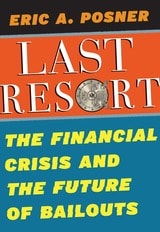
Last Resort
The Financial Crisis and the Future of BailoutsEric A. Posner
University of Chicago Press, 2018
The answer, according to Eric A. Posner, is no. The federal government freely and frequently violated the law with the bailouts—but it did so in the public interest. An understandable lack of sympathy toward Wall Street has obscured the fact that bailouts have happened throughout economic history and are unavoidable in any modern, market-based economy. And they’re actually good. Contrary to popular belief, the financial system cannot operate properly unless the government stands ready to bail out banks and other firms. During the recent crisis, Posner agues, the law didn’t give federal agencies sufficient power to rescue the financial system. The legal constraints were damaging, but harm was limited because the agencies—with a few exceptions—violated or improvised elaborate evasions of the law. Yet the agencies also abused their power. If illegal actions were what it took to advance the public interest, Posner argues, we ought to change the law, but we need to do so in a way that also prevents agencies from misusing their authority. In the aftermath of the crisis, confusion about what agencies did do, should have done, and were allowed to do, has prevented a clear and realistic assessment and may hamper our response to future crises.
Taking up the common objections raised by both right and left, Posner argues that future bailouts will occur. Acknowledging that inevitability, we can and must look ahead and carefully assess our policy options before we need them.
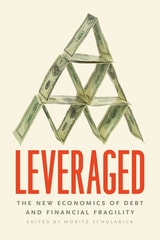
Leveraged
The New Economics of Debt and Financial FragilityEdited by Moritz Schularick
University of Chicago Press, 2022
The 2008 financial crisis was a seismic event that laid bare how financial institutions’ instabilities can have devastating effects on societies and economies. COVID-19 brought similar financial devastation at the beginning of 2020 and once more massive interventions by central banks were needed to heed off the collapse of the financial system. All of which begs the question: why is our financial system so fragile and vulnerable that it needs government support so often?
For a generation of economists who have risen to prominence since 2008, these events have defined not only how they view financial instability, but financial markets more broadly. Leveraged brings together these voices to take stock of what we have learned about the costs and causes of financial fragility and to offer a new canonical framework for understanding it. Their message: the origins of financial instability in modern economies run deeper than the technical debates around banking regulation, countercyclical capital buffers, or living wills for financial institutions. Leveraged offers a fundamentally new picture of how financial institutions and societies coexist, for better or worse.
The essays here mark a new starting point for research in financial economics. As we muddle through the effects of a second financial crisis in this young century, Leveraged provides a road map and a research agenda for the future.
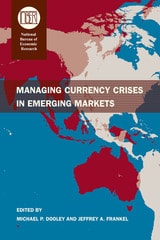
Managing Currency Crises in Emerging Markets
Edited by Michael P. Dooley and Jeffrey A. Frankel
University of Chicago Press, 2003
The contributions here explore the management process from the beginning of a crisis to the long-term effects of the techniques used to minimize it. The first three chapters focus on the earliest responses and the immediate defense of a currency under attack, exploring whether unnecessary damage to economies can be avoided by adopting the right response within the first few days of a financial crisis. Next, contributors examine the adjustment programs that follow, considering how to design these programs so that they shorten the recovery phase, encourage economic growth, and minimize the probability of future difficulties. Finally, the last four papers analyze the actual effects of adjustment programs, asking whether they accomplish what they are designed to do-and whether, as many critics assert, they impose disproportionate costs on the poorest members of society.
Recent high-profile currency crises have proven not only how harmful they can be to neighboring economies and trading partners, but also how important policy responses can be in determining their duration and severity. Economists and policymakers will welcome the insightful evaluations in this important volume, and those of its companion, Sebastian Edwards and Jeffrey A. Frankel's Preventing Currency Crises in Emerging Markets.
Media Amnesia
Rewriting the Economic CrisisLaura Basu
Pluto Press, 2018
Nevada's Great Recession
Looking Back, Moving ForwardElliott Parker
University of Nevada Press, 2017
This is a different kind of economics book. Parker uses his expertise from doing research on the East Asian fiscal crisis to give profound insights into what happened and how to avoid future catastrophes. Marshall personalizes it by providing vignettes of what it was actually like to be in the trenches and fighting the inevitable political battles that came up, and counteracting some of the falsehoods that certain politicians were spreading about the recession.
Parker and Marshall’s book should be required reading for not only every single elected official in Nevada, but for any private citizen who cares about the public good.
Panic Fiction
Women and Antebellum Economic CrisisMary Templin
University of Alabama Press, 2014
Between the mid-1830s and the late 1850s, authors such as Hannah Lee, Catharine Sedgwick, Eliza Follen, Maria McIntosh, and Maria Cummins wrote dozens of novels and stories depicting the effects of financial panic on the home and proposing solutions to economic instability. This unique body of antebellum American women’s writing, which integrated economic discourse with the language and conventions of domestic fiction, is what critic Mary Templin terms “panic fiction.”
In Panic Fiction: Antebellum Women Writers and Economic Crisis, Templin draws in part from the methods of New Historicism and cultural studies, situating these authors and their texts within the historical and cultural contexts of their time. She explores events surrounding the panics of 1837 and 1857, prevalent attitudes toward speculation and failure as seen in newspapers and other contemporaneous texts, women’s relationships to the marketplace, and the connections between domestic ideology and middle-class formation.
Although largely unknown today, the phenomena of “panic fiction” was extremely popular in its time and had an enormous influence on nineteenth-century popular conceptions of speculation, failure, and the need for marketplace reform, providing a distinct counterpoint to the analysis of panic found in newspapers, public speeches, and male-authored literary texts of the time.

Performing the Greek Crisis
Navigating National Identity in the Age of AusterityNatalie Zervou
University of Michigan Press, 2024
Winner of the 2025 Dance Studies Association de la Torre Bueno Book Prize
Performing the Greek Crisis explores the impact of the Greek financial crisis (2009–19) on the performing arts sector in Greece, and especially on contemporary concert dance. When Greece became the first European Union member to be threatened with default, the resulting budget cuts pushed dance to develop in unprecedented directions. The book examines the repercussions that the crisis had on artists’ daily lives and experiences, weaving the personal with the political to humanize a phenomenon that, to date, had been examined chiefly through economic and statistical lenses. Informed by the author’s experience of growing up in Greece and including interviews and rich descriptions of performances, the book offers a glimpse into a pivotal moment in Greek history.
In Greece, dance (and, by extension, the body) has historically held a central role in the process of national identity construction. When the crisis broke out, artists had to navigate through a precariously fluctuating landscape, with their bodies as their only stable referent. By centering the analysis of the Greek crisis on the dancing bodies, Performing the Greek Crisis is able to examine the various ways that artists reconceptualized their history and reframed ideas of national belonging, race, citizenship, and immigration.
Preventing Currency Crises in Emerging Markets
Edited by Sebastian Edwards and Jeffrey A. Frankel
University of Chicago Press, 2002
Topics covered include exchange rate regimes, contagion (transmission of currency crises across countries), the current account of the balance of payments, the role of private sector investors and of speculators, the reaction of the official sector (including the multilaterals), capital controls, bank supervision and weaknesses, and the roles of cronyism, corruption, and large players (including hedge funds).
Ably balancing detailed case studies, cross-country comparisons, and theoretical concerns, this book will make a major contribution to ongoing efforts to understand and prevent international currency crises.
Routine Crisis
An Ethnography of DisillusionSarah Muir
University of Chicago Press, 2021
Anthropologist Sarah Muir offers a cogent meditation on the limits of critique at this historical moment, drawing on deep experience in Argentina but reflecting on a truly global condition. If we feel things are being upended in a manner that is ongoing, tumultuous, and harmful, what would we need to do—and what would we need to give up—to usher in a revitalized critique for today's world? Routine Crisis is an original provocation and a challenge to think beyond the limits of exhaustion and reimagine a form of criticism for the twenty-first century.
South Koreans in the Debt Crisis
The Creation of a Neoliberal Welfare SocietyJesook Song
Duke University Press, 2009
Drawing on her experience during the crisis as an employee in a public works program in Seoul, Song provides an ethnographic assessment of the efforts of the state and civilians to regulate social insecurity, instability, and inequality through assistance programs. She focuses specifically on efforts to help two populations deemed worthy of state subsidies: the “IMF homeless,” people temporarily homeless but considered employable, and the “new intellectuals,” young adults who had become professionally redundant during the crisis but had the high-tech skills necessary to lead a transformed post-crisis South Korea.
The Credit Crunch
Housing Bubbles, Globalisation and the Worldwide Economic CrisisGraham Turner
Pluto Press, 2008
This book argues that the current financial turmoil signals a crisis in globalisation that will directly challenge the free market economic model.
Graham Turner shows that the housing bubbles in the West were deliberately created to mask the damage inflicted by companies shifting production abroad in an attempt to boost profits. As these bubbles burst, economic growth in many developed countries will inevitably tumble. The Japanese crisis of the 1990s shows that banks and governments may struggle to contain the fallout. The problem has not been limited to the US, UK and Europe: housing bubbles have become endemic across wide swathes of emerging market economies. As the West slides, these countries will see an implosion of their credit bubbles too, shaking their faith in the free market.
Turner is an experienced and successful economic forecaster, whose opinions are sought by large international banks and top financial journalists. Drawing from his first hand experience of the Japanese property crash of the 1990s, he presents his analysis in a clear and persuasive style, showing that the end of housing market growth spells disaster for neoliberal globalisation.
The Great Recession
David B. Grusky
Russell Sage Foundation, 2012
The International Monetary Fund and Latin America
The Argentine Puzzle in ContextClaudia Kedar
Temple University Press, 2013
The International Monetary Fund (IMF) has played a critical role in the global economy since the postwar era. But, claims Claudia Kedar, behind the strictly economic aspects of the IMF’s intervention, there are influential interactions between IMF technocrats and local economists—even when countries are not borrowing money.
In The International Monetary Fund and Latin America, Kedar seeks to expose the motivations and constraints of the operations of both the IMF and borrowers. With access to never-before-seen archive materials, Kedar reveals both the routine and behind-the-scenes practices that have depicted International Monetary Fund–Latin American relations in general and the asymmetrical IMF-Argentina relations in particular.
Kedar also analyzes the “routine of dependency” that characterizes IMF-borrower relations with several Latin American countries such as Chile, Peru, and Brazil. The International Monetary Fund and Latin America shows how debtor countries have adopted IMF’s policies during past decades and why Latin American leaders today largely refrain from knocking at the IMF’s doors again.
The Money Problem
Rethinking Financial RegulationMorgan Ricks
University of Chicago Press, 2016
In The Money Problem, Morgan Ricks addresses all of these questions and more, offering a practical yet elegant blueprint for a modernized system of money and banking—one that, crucially, can be accomplished through incremental changes to the United States’ current system. He brings a critical, missing dimension to the ongoing debates over financial stability policy, arguing that the issue is primarily one of monetary system design. The Money Problem offers a way to mitigate the risk of catastrophic panic in the future, and it will expand the financial reform conversation in the United States and abroad.

The Panic of 1819
The First Great DepressionAndrew H. Browning
University of Missouri Press, 2024
The Panic introduced Americans to the new phenomenon of boom and bust, changed the country's attitudes towards wealth and poverty, spurred the political movement that became Jacksonian Democracy, and helped create the sectional divide that would lead to the Civil War. Although it stands as one of the turning points of American history, few Americans today have heard of the Panic of 1819, with the result that we continue to ignore its lessons—and repeat its mistakes.
The Risks of Financial Institutions
Edited by Mark Carey and René M. Stulz
University of Chicago Press, 2007
Until about twenty years ago, the consensus view on the cause of financial-system distress was fairly simple: a run on one bank could easily turn to a panic involving runs on all banks, destroying some and disrupting the financial system. Since then, however, a series of events—such as emerging-market debt crises, bond-market meltdowns, and the Long-Term Capital Management episode—has forced a rethinking of the risks facing financial institutions and the tools available to measure and manage these risks.
The Risks of Financial Institutions examines the various risks affecting financial institutions and explores a variety of methods to help institutions and regulators more accurately measure and forecast risk. The contributors--from academic institutions, regulatory organizations, and banking--bring a wide range of perspectives and experience to the issue. The result is a volume that points a way forward to greater financial stability and better risk management of financial institutions.
The Violence of Austerity
Edited by David Whyte and Vickie Cooper
Pluto Press, 2017
In The Violence of Austerity, David Whyte and Vickie Cooper bring together the passionate voices of campaigners and academics to show that rather than stimulating economic growth, austerity policies have led to a dismantling of the social systems that operated as a buffer against economic hardship. Chapters from major contributors—including Danny Dorling, Mary O’Hara and Rizwaan Sabir—show how austerity is a form of institutional violence more socially harmful and far-reaching than other more politicized and publicized forms of violence, such as terrorism or gun violence. Contributors expose highly significant cases of this institutional violence driven by public sector cuts: police attacks on the homeless, violent evictions of the rented sector, risks faced by people on workfare, and more. The Violence of Austerity is a devastating, authoritative study of the myriad ways austerity policies harm people in Britain that will resonate with anyone concerned with the increasing power of the political elite and the future of social welfare.
Wall Street Women
Melissa S. Fisher
Duke University Press, 2012
Fisher charts the evolution of the women's careers, the growth of their political and economic clout, changes in their perspectives and the cultural climate on Wall Street, and their experiences of the 2008 financial collapse. While most of the pioneering subjects of Wall Street Women did not participate in the women's movement as it was happening in the 1960s and 1970s, Fisher argues that they did produce a "market feminism" which aligned liberal feminist ideals about meritocracy and gender equity with the logic of the market.