Results by title
10 books match the query 'Financial institutions'
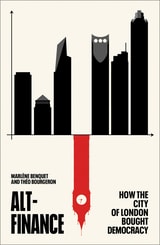
Alt-Finance
How the City of London Bought DemocracyMarlène Benquet
Pluto Press, 2022
Powerful financial forces have supported the neoliberal project since the 1980s to advance their interests, but there are now signs that these forces have a new face and a new strategy.
The majority of the British finance sector threw its support behind Britain leaving the European Union, a flagship institution of neoliberalism. Beyond this counterintuitive move, what was really happening and why? Alt-Finance examines a new authoritarian turn in financialised democracies, focusing on the City of London, revealing a dangerous alternative political project in the making.
In a clash with traditional finance, the new behemoths of financial capital - hedge funds, private equity firms, and real estate funds - have started to cohere around a set of political beliefs, promoting libertarian, authoritarian, climate-denying, and Eurosceptic views. Protecting investments, suppressing social dissent, and reducing state interference is at the core of their mission for a new world order.
By following the money, the authors provide indisputable evidence of these worrying developments. Through a clear analysis of the international dealings of this new authoritarian-libertarian regime, not just in Britain but in the US and Brazil, we can understand how our world is being shaped against our will by struggles between dominant groups.

Fiery Dragons
Banks, Moneylenders and Microfinance in BurmaSean Turnell
National University of Singapore Press, 2009
Financial Deregulation and Integration in East Asia
Edited by Takatoshi Ito and Anne O. Krueger
University of Chicago Press, 1996
In these thirteen essays, American and Asian scholars analyze the effects of financial deregulation and integration on East Asian markets. Topics covered include the roles of the United States and Japan in trading with Asian countries, macroeconomic policy implications of export-led growth in Korea and Taiwan, the effects of foreign direct investment in China, and the impact of financial liberalization in Japan, Korea, and Singapore.
Demonstrating the complexity of financial deregulation and the challenges it poses for policy makers, this volume provides an excellent picture of the overall status of East Asian financial markets for scholars in international finance and Asian economic development.
Financial Markets and Financial Crises
Edited by R. Glenn Hubbard
University of Chicago Press, 1991
Using both historical and contemporary episodes of breakdowns in financial trade, contributors to this volume draw insights from theory and empirical data, from the experience of closed and open economies worldwide, and from detailed case studies. They explore the susceptibility of American corporations to economic downturns; the origins of banking panics; and the behavior of financial markets during periods of crisis. Sever papers specifically address the current thrift crisis—including a detailed analysis of the over 500 FSLIC-insured thrifts in the southeast—and seriously challenge the value of recent measures aimed at preventing future collapse in that industry. Government economists and policy makers, scholars of industry and banking, and many in the business community will find these timely papers an invaluable reference.
Financial Sector Development in the Pacific Rim
Edited by Takatoshi Ito and Andrew K. Rose
University of Chicago Press, 2009
The reform in Asian financial sectors—especially in banking and stock markets—has been remarkable since the currency crisis of 1997–98. East Asia is now a major player in international finance, providing serious competition to the more traditional financial centers of London and New York. Financial Sector Development in the Pacific Rim provides a rich collection of theoretical and empirical analyses of the growing capital markets in the region.
Bringing together authors from various East Asian and Pacific nations, this volume examines the institutional factors influencing financial innovation, the consequences of financial development, widespread consolidation occurring through mergers and acquisitions, and the implementation of policy reform. Financial Sector Development in the Pacific Rim offers the comparative analysis necessary to answer broad questions about economic development and the future of Asia.
Organizing Access To Capital
Advocacy And The Democratizationedited by Gregory D. Squires
Temple University Press, 2003
Regulating Finance
The Political Economy of Spanish Financial Policy from Franco to DemocracyArvid John Lukauskas
University of Michigan Press, 1997

The New Institutionalism in Sociology
Mary C. Brinton
Russell Sage Foundation, 1998

The Power Structure of American Business
Beth A. Mintz and Michael Schwartz
University of Chicago Press, 1985
The Risks of Financial Institutions
Edited by Mark Carey and René M. Stulz
University of Chicago Press, 2007
Until about twenty years ago, the consensus view on the cause of financial-system distress was fairly simple: a run on one bank could easily turn to a panic involving runs on all banks, destroying some and disrupting the financial system. Since then, however, a series of events—such as emerging-market debt crises, bond-market meltdowns, and the Long-Term Capital Management episode—has forced a rethinking of the risks facing financial institutions and the tools available to measure and manage these risks.
The Risks of Financial Institutions examines the various risks affecting financial institutions and explores a variety of methods to help institutions and regulators more accurately measure and forecast risk. The contributors--from academic institutions, regulatory organizations, and banking--bring a wide range of perspectives and experience to the issue. The result is a volume that points a way forward to greater financial stability and better risk management of financial institutions.