Results by title

5 books match the query 'Financialization'
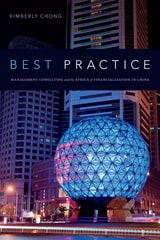
cover of Best Practice: Management Consulting and the Ethics of Financialization in China

Best Practice

Management Consulting and the Ethics of Financialization in China

Kimberly Chong

Duke University Press, 2018

In Best Practice Kimberly Chong provides an ethnography of a global management consultancy that has been hired by Chinese companies, including Chinese state-owned enterprises. She shows how consulting emerges as a crucial site for considering how corporate organization, employee performance, business ethics, and labor have been transformed under financialization. To date financialization has been examined using top-down approaches that portray the rise of finance as a new logic of economic accumulation. Best Practice, by contrast, focuses on the everyday practices and narratives through which companies become financialized. Effective management consultants, Chong finds, incorporate local workplace norms and assert their expertise in the particular terms of China's national project of modernization, while at the same time framing their work in terms of global “best practices.” Providing insight into how global management consultancies refashion Chinese state-owned enterprises in preparation for stock market flotation, Chong demonstrates both the dynamic, fragmented character of financialization and the ways in which Chinese state capitalism enables this process.
[more]
cover of Brokers of Power: The Financialization of the US Electricity System

Brokers of Power

The Financialization of the US Electricity System

Conor Harrison

University of Minnesota Press, 2026

A detailed look at the financial interests impacting the energy transition

The twenty-first century has seen major transformations in the US electricity sector—but while the use of coal power wanes and the need for renewable energy becomes more urgent, financial actors maintain a complicating influence on the trajectory of energy transition. Brokers of Power identifies changing patterns of investment intertwined with the shift from state-regulated electricity monopolies to a market-driven price model and the embrace of wind and solar hookups to the grid.

Drawing from case studies such as catastrophic Winter Storm Uri that hit Texas in 2021 and in-depth interviews with people working in the electricity and financial sectors, Conor Harrison reveals how the various entanglements of private equity, investment banking, and financial modeling are shaping the future and raising the costs of this vital infrastructure. Today’s financial firms, he shows, are engaged in the electricity industry beyond matters of investment: they own electricity generation infrastructure, trade electricity on markets, capture federal renewable energy tax credits, and advise on electricity firm operating strategy.

Looking beyond technology and policy, Harrison interrogates what it means to have powerful financial institutions as the primary agents of change in the fraught and ongoing energy transition. A timely and invaluable contribution to the fields of geography, environmental studies, and the energy social sciences, Brokers of Power is a cautionary account delving into the complexities surrounding the push for decarbonization.

Retail e-book files for this title are screen-reader friendly with images accompanied by short alt text and/or extended descriptions.

[more]
cover of Experimental Practice: Technoscience, Alterontologies, and More-Than-Social Movements

Experimental Practice

Technoscience, Alterontologies, and More-Than-Social Movements

Dimitris Papadopoulos

Duke University Press, 2018
In Experimental Practice Dimitris Papadopoulos explores the potential for building new forms of political and social movements through the reconfiguration of the material conditions of existence. Rather than targeting existing institutions in demands for social justice, Papadopoulos calls for the creation of alternative ontologies of everyday life that would transform the meanings of politics and justice. Inextricably linked to technoscience, these “alterontologies”—which Papadopoulos examines in a variety of contexts, from AIDS activism and the financialization of life to hacker communities and neuroscience—form the basis of ways of life that would embrace the more-than-social interdependence of the human and nonhuman worlds. Speaking to a matrix of concerns about politics and justice, social movements, matter and ontology, everyday practice, technoscience, the production of knowledge, and the human and nonhuman, Papadopoulos suggests that the development of alterontologies would create more efficacious political and social organizing.
[more]
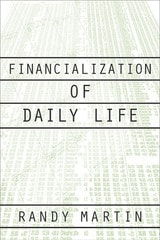
cover of Financialization Of Daily Life

Financialization Of Daily Life

Randy Martin

Temple University Press, 2002
While trillions of dollars came and went in the stock market boom of the 1990s, the image of "every man and woman a CEO" may turn out to be the era's lasting legacy. Business news, once reserved to specialized papers or sections of the larger news of the day, came to the forefront in cable television and in cultural images of how ordinary people, through the internet and other avenues could not only master their financial life, but move money and equity around with the ease of a financial titan. Financialization of Daily Life looks at how this transformation occurred, and how it is just now becoming a significant, and troubling, aspect of our political and cultural life.Randy Martin takes us through all of the aspects of our "financialization." He examines how the shift in economic life arose not only from changes in culture, but also from new policy priorities that emphasize controlling inflation over promoting growth. He offers a close reading of self-help literature that teaches parents how to rear financially literate children and to instruct adults in the fundamentals of fiscal management. He examines just what a society that treats financial investment as a national past time really looks like, and how that society is transforming the world.In a country rocked by scandals in accounting and banking, the identification ordinary citizens make with, and the risk with which they engage in, the stock market calls into question the very basis of our economic system. Randy Martin spells out in clear terms the implications our financial doings—and undoing—have for the way we organize our lives, and, especially, our money.
[more]
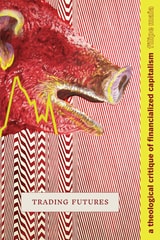
cover of Trading Futures: A Theological Critique of Financialized Capitalism

Trading Futures

A Theological Critique of Financialized Capitalism

Filipe Maia

Duke University Press, 2022

The discourse of financialized capitalism tries to create a future predictable enough to manage risk for the wealthy, to shape the future into a profit-making site that constrains and privatizes the sense of what’s possible. Here, people’s hopes and meaning-making energies are policed through the burden of debt. In Trading Futures Filipe Maia offers a theological reflection on hope and the future, calling for escape routes from the debt economy. Drawing on Marxism, continental philosophy, and Latin American liberation theology, Maia provides a critical portrayal of financialization as a death-dealing mechanism that colonizes the future in its own image. Maia elaborates a Christian eschatology of liberation that offers a subversive mode of imagining future possibilities. He shows how the Christian vocabulary of hope can offer a way to critique the hegemony of financialized capitalism, propelling us in the direction of a just future that financial discourse cannot manage or control.
[more]