Results by title

5 books match the query 'Findlen, Paula'
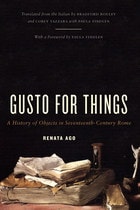
cover of Gusto for Things: A History of Objects in Seventeenth-Century Rome

Gusto for Things

A History of Objects in Seventeenth-Century Rome

Renata Ago

University of Chicago Press, 2013
We live in a material world—our homes are filled with things, from electronics to curios and hand-me-downs, that disclose as much about us and our aspirations as they do about current trends. But we are not the first: the early modern period was a time of expanding consumption, when objects began to play an important role in defining gender as well as social status. Gusto for Things reconstructs the material lives of seventeenth-century Romans, exploring new ways of thinking about the meaning of things as a historical phenomenon.
 
Through creative use of account books, inventories, wills, and other records, Renata Ago examines early modern attitudes toward possessions, asking what people did with their things, why they wrote about them, and how they passed objects on to their heirs. While some inhabitants of Rome were connoisseurs of the paintings, books, and curiosities that made the city famous, Ago shows that men and women of lesser means also filled their homes with a more modest array of goods. She also discovers the genealogies of certain categories of things—for instance, books went from being classed as luxury goods to a category all their own—and considers what that reveals about the early modern era. An animated investigation into the relationship between people and the things they buy, Gusto for Things paints an illuminating portrait of the meaning of objects in preindustrial Europe.
[more]
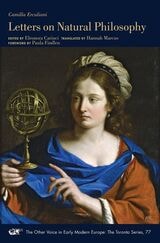
cover of Letters on Natural Philosophy: The Scientific Correspondence of a Sixteenth-Century Pharmacist, with Related Texts

Letters on Natural Philosophy

The Scientific Correspondence of a Sixteenth-Century Pharmacist, with Related Texts

Camilla Erculiani

Iter Press, 2020

In her Letters on Natural Philosophy, published originally in Krakow in 1584, Camilla Erculiani proposed her new theory of the natural causes of the universal flood in the biblical book of Genesis. Erculiani weaves together her understanding of Aristotelian, Platonic, Galenic, and astrological traditions and combines them with her own observations of the world as seen from her apothecary shop in sixteenth-century Padua. This publication brought Erculiani to the attention of the Inquisition, which accused her of heresy, silencing her for centuries.

 This edition presents the first full English translation of Erculiani’s book and other relevant texts, bringing to light the cultural context and scientific thought of this unique natural philosopher.
[more]
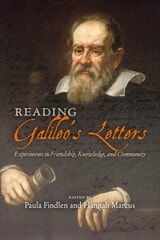
cover of Reading Galileo's Letters: Experiments in Friendship, Knowledge, and Community

Reading Galileo's Letters

Experiments in Friendship, Knowledge, and Community

Edited by Paula Findlen and Hannah Marcus

University of Chicago Press, 2027

Essays by many of the foremost experts on Galileo offer an interdisciplinary approach to the legendary scientist’s correspondence.

The Tuscan mathematician, physicist, and astronomer Galileo Galilei (1564–1642) is one of history’s most iconic and controversial figures. Letters form the backbone of what one early Galileo scholar called the “private Galileo,” and his correspondence is indeed a record of his family and friendships; his intellectual evolution; his professional interactions with other scientific figures; and his relations with patrons, brokers, and publishers. Last, but hardly least, his letters are a unique cultural artifact of Galileo the writer and master of vernacular prose. 

Galileo’s correspondence crossed Europe in public mail pouches, through diplomatic messengers, and was written in code. Today, there are 3,272 surviving letters to or from Galileo and his many friends, family members, disciples, and rivals across Europe. This volume examines these letters as an essential aspect of Galileo’s personal and scientific career. They are what the editors call his “experiments in friendship,” which enabled, abetted, and often served as early drafts of the theories in his published works. This collaborative volume brings together different approaches, case studies, and forms of expertise—historical and literary, intellectual and material, archival and digital. It is a must-read for all Galileo enthusiasts and anyone interested in how to make the most of a rich record of correspondence.
[more]
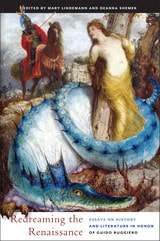
cover of Redreaming the Renaissance: Essays on History and Literature in Honor of Guido Ruggiero

Redreaming the Renaissance

Essays on History and Literature in Honor of Guido Ruggiero

Mary Lindemann

University of Delaware Press, 2024
Redreaming the Renaissance seeks to remedy the dearth of conversations between scholars of history and literary studies by building on the pathbreaking work of Guido Ruggiero to explore the cross-fertilization between these two disciplines, using the textual world of the Italian Renaissance as proving ground. In this volume, these disciplines blur, as they did for early moderns, who did not always distinguish between the historical and literary significance of the texts they read and produced. Literature here is broadly conceived to include not only belles lettres, but also other forms of artful writing that flourished in the period, including philosophical writings on dreams and prophecy; life-writing; religious debates; menu descriptions and other food writing; diaries, news reports, ballads, and protest songs; and scientific discussions. The twelve essays in this collection examine the role that the volume’s dedicatee has played in bringing the disciplines of history and literary studies into provocative conversation, as well as the methodology needed to sustain and enrich this conversation.
[more]
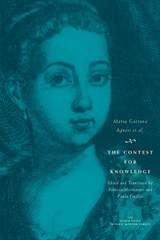
cover of The Contest for Knowledge: Debates over Women's Learning in Eighteenth-Century Italy

The Contest for Knowledge

Debates over Women's Learning in Eighteenth-Century Italy

Maria Gaetana Agnesi, Diamante Medaglia Faini, Aretafila Savini de' Rossi, and the Accademia de' Ricovrati

University of Chicago Press, 2005

At a time when women were generally excluded from scholarly discourse in the intellectual centers of Europe, four extraordinary female letterate proved their parity as they lectured in prominent scientific and literary academies and published in respected journals. During the Italian Enlightenment, Maria Gaetana Agnesi, Giuseppa Eleonora Barbapiccola, Diamante Medaglia Faini, and Aretafila Savini de' Rossi were afforded unprecedented deference in academic debates and epitomized the increasing ability of women to influence public discourse.

The Contest for Knowledge reveals how these four women used the methods and themes of their male counterparts to add their voices to the vigorous and prolific debate over the education of women during the eighteenth century. In the texts gathered here, the women discuss the issues they themselves thought most urgent for the equality of women in Italian society specifically and in European culture more broadly. Their thoughts on this important subject reveal how crucial the eighteenth century was in the long history of debates about women in the academy.
[more]