Results by title
6 books match the query 'Finnegans wake'

A Concordance to Finnegans Wake
Clive Hart
University of Minnesota Press, 1963
A Concordance to Finnegans Wake was first published in 1963. Minnesota Archive Editions uses digital technology to make long-unavailable books once again accessible, and are published unaltered from the original University of Minnesota Press editions.
This concordance, the first full-scale work dealing with the language of James Joyce's last period, provides a finding-list and analytical index for his last work, Finnegans Wake. There are three parts: the first consisting of a complete alphabetical index to the vocabulary of Finnegans Wake,the second comprising a list of syllabifications (showing the inner parts of compound words), and the third providing a list of some 10,000 English words suggested by Joycean distortions.
The primary word-index, similar in most respects to those which have already been published for Joyce's Ulysses and Stephen Hero, list in alphabetical order all of the 63,924 different words which make up the vocabulary of Finnegans Wake and provides page-line references for every occurrence of all but a small handful of the most common English words. Except for punctuation marks, every typographical unit in the book is accounted for, and each is listed just as it appears in the text.
The second on syllabification lists in alphabetical order the inner parts of over 10,000 complex words in Finnegans Wake which are built up out of simpler elements and which would be impossible to find from the primary index alone.
In the last section, called "Overtones," the aim is to list the English words suggested by Joyce's puns and distortions. Much information gleaned from the Joycean research of the past decade is gathered together here.
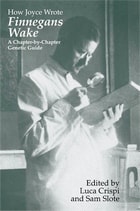
How Joyce Wrote Finnegans Wake
A Chapter-by-Chapter Genetic GuideEdited by Luca Crispi and Sarn Slote
University of Wisconsin Press, 2008
The introduction by Luca Crispi, Sam Slote, and Dirk Van Hulle offers a chronology of the composition of Finnegans Wake, an archival survey of the manuscripts, and an introduction to genetic criticism. Then, the volume provides a chapter-by-chapter interpretation of Finnegans Wake from a variety of perspectives, probing the book as a work in progress. The fruit of more than two decades’ worth of Wakean genetic studies, this book is the essential starting point for all future studies of Joyce’s most complex and fascinating work.
James Joyce and the Philosophers at Finnegans Wake
Donald Phillip Verene
Northwestern University Press, 2016
Joyce's Book of the Dark
Finnegans WakeJohn Bishop
University of Wisconsin Press, 1993
“Joyce’s Book of the Dark gives us such a blend of exciting intelligence and impressive erudition that it will surely become established as one of the most fascinating and readable Finnegans Wake studies now available.”—Margot Norris, James Joyce Literary Supplement
Scandinavian Elements of Finnegans Wake
Dounia Bunis Christiani
Northwestern University Press, 1965
Textual Awareness
A Genetic Study of Late Manuscripts by Joyce, Proust, and MannDirk Van Hulle
University of Michigan Press, 2004
A key issue in both textual criticism and the so-called crisis of the novel is the tension between the finished and the unfinished. After a theoretical examination of the relationship between genetic and textual criticism, Dirk Van Hulle uses the three case studies to show how?at each stage in the writing process?the text still had the potential of becoming something entirely different; how and why these geneses proceeded the way they did; how Joyce, Proust, and Mann allowed contingencies to shape their work; how these authors recycled the words of their critics in order to inoculate their works against them; how they shaped an intertextual dimension through the processing of source texts and reading notes; and how text continually generated more text.
Van Hulle's exploration of process sheds new light on the remarkable fact that so many modernist authors protected their manuscripts, implying both the authors' urge to grasp everything and their awareness of the dangers of their encyclopedic projects. Textual Awareness offers new insights into the artificiality of the artifact?the novel?that are relevant to the study of literary modernism in general and the study of James Joyce, Marcel Proust, and Thomas Mann in particular.
Dirk Van Hulle is Assistant Professor of English and German Literature, University of Antwerp.