Results by title
7 books match the query 'Finucci, Valeria'
Celinda, A Tragedy
A Bilingual EditionValeria Miani
Iter Press, 2010
—Virginia Cox
Professor of Italian, New York University
Floridoro
A Chivalric RomanceModerata Fonte
University of Chicago Press, 2006
First published in 1581, Floridoro remains a vivacious and inventive narrative by a singular poet.
Generation and Degeneration
Tropes of Reproduction in Literature and History from Antiquity through Early Modern EuropeValeria Finucci and Kevin Brownlee, eds.
Duke University Press, 2001
The discourses on reproduction, biology, degeneration, legacy, and lineage that this book broaches not only bring to the forefront concepts of sexual identity and gender politics but also show how they were culturally constructed and reconstructed through the centuries by medicine, philosophy, the visual arts, law, religion, and literature. The contributors reflect on a wide range of topics—from what makes men “manly” to the identity of Christ’s father, from what kinds of erotic practices went on among women in sixteenth-century seraglios to how men’s hemorrhoids can be variously labeled. Essays scrutinize stories of menstruating males and early writings on the presumed inferiority of female bodily functions. Others investigate a psychomorphology of the clitoris that challenges Freud’s account of lesbianism as an infantile stage of sexual development and such topics as the geographical origins of medicine and the materialization of genealogy in the presence of Renaissance theatrical ghosts.
This collection will engage those in English, comparative, Italian, Spanish, and French studies, as well as in history, history of medicine, and ancient and early modern religious studies.
Contributors. Kevin Brownlee, Marina Scordilis Brownlee, Elizabeth Clark, Valeria Finucci, Dale Martin, Gianna Pomata, Maureen Quilligan, Nancy Siraisi, Peter Stallybrass,Valerie Traub
Mirtilla, A Pastoral
A Bilingual EditionIsabella Andreini
Iter Press, 2018
The Other Voice in Early Modern Europe - The Toronto Series: Volume 62
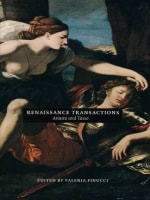
Renaissance Transactions
Ariosto and TassoValeria Finucci, ed.
Duke University Press, 1999
Resituating these writers’ works in the context of the Renaissance while also offering appraisals of their uncanny “postmodernity,” the contributors to this volume focus primarily on Ariosto’s Orlando furioso and Tasso’s Gerusalemme liberata. Essays center on questions of national and religious identity, performative representation, and the theatricality of literature. They also address subjects regarding genre and gender, social and legal anthropology, and reactionary versus revolutionary writing. Finally, they advance the historically significant debate about what constitutes modern literature by revisiting with new perspective questions first asked centuries ago: Did Ariosto invent a truly national, and uniquely Italian, literary genre—the chivalric romance? Or did Tasso alone, by equaling the epic standards of Homer and Virgil, make it possible for a literature written in Italian to attain the status of its classical Greek and Latin antecedents?
Arguing that Ariosto and Tasso are still central to the debate on what constitutes modern narrative, this collection will be invaluable to scholars of Italian literature, literary history, critical theory, and the Renaissance.
Contributors. Jo Ann Cavallo, Valeria Finucci, Katherine Hoffman, Daniel Javitch, Constance Jordan, Ronald L. Martinez, Eric Nicholson, Walter Stephens, Naomi Yavneh, Sergio Zatti
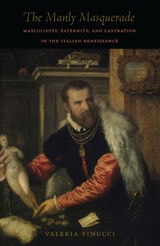
The Manly Masquerade
Masculinity, Paternity, and Castration in the Italian RenaissanceValeria Finucci
Duke University Press, 2003
Highlighting the fissures running through Italian Renaissance ideas of manliness, Finucci describes how, alongside pervasive images of the virile, sexually active man, early modern Italian culture recognized the existence of hermaphrodites and started to experiment with a new kind of sexuality by manufacturing a non-man: the castrato. Following the creation of castrati, the Church forbade the marriage of all non-procreative men, and, in this move, Finucci identifies a powerful legitimation of the view that what makes men is not the possession of male organs or the ability to have sex, but the capability to father. Through analysis, anecdote, and rich cultural description, The Manly Masquerade exposes the "real" early modern man: the paterfamilias.
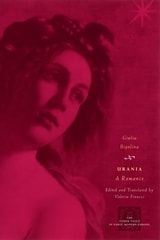
Urania
A RomanceGiulia Bigolina
University of Chicago Press, 2004
The first known prose romance written by a woman in Italian, Bigolina's Urania centers on the monomaniacal love of a female character falling into melancholy when her beloved leaves her for a more beautiful woman. A tale that includes many of the conventions that would later become standards of the genre—cross-dressing, travel, epic skirmishes, and daring deeds—Urania also contains the earliest treatise on the worth of women.
Also included in this volume, the novella Giulia Camposampiero is the only extant part of a probable longer narrative written in the style of the Decameron. While employing some of those same gender and role reversals as Urania, including the privileging of heroic constancy in both men and women, it chronicles the tribulations that a couple undergoes until their secret marriage is publicly recognized.