Results by title

5 books match the query 'Fires and fire prevention'
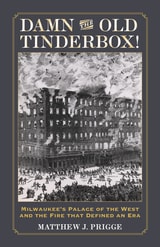
cover of Damn the Old Tinderbox!: Milwaukee’s Palace of the West and the Fire that Defined an Era

Damn the Old Tinderbox!

Milwaukee’s Palace of the West and the Fire that Defined an Era

Matthew J. Prigge

Wisconsin Historical Society Press, 2019

In the dead of an unassuming January night in 1883, Milwaukee’s Newhall House hotel was set on fire. Two hours later, the building—once among the tallest in the nation—lay in ruins and over seventy people were dead. It was a tragedy that brought global notice to Milwaukee, with daring escapes and rescues and heart-wrenching tales of victims burned to death or killed as they leapt from the burning building. From the great horror emerged an even greater string of mysteries: Who had set the fire and who was to blame for the staggering loss of life? The Newhall’s hard-luck barkeeper? A gentleman arsonist? What of the many other unexplained fires at the hotel? Had the Newhall’s management neglected fire safety to boost their profits? 
 
Damn the Old Tinderbox! is the gripping tale of one of the Gilded Age’s forgotten calamities, a fire that remains among the deadliest unsolved arsons in American history, and a significant chapter in both the history of Milwaukee and the Midwest. 
 
[more]
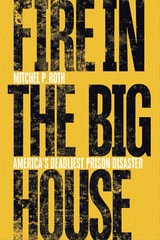
cover of Fire in the Big House: America’s Deadliest Prison Disaster

Fire in the Big House

America’s Deadliest Prison Disaster

Mitchel P. Roth

Ohio University Press, 2019

On April 21, 1930—Easter Monday—some rags caught fire under the Ohio Penitentiary’s dry and aging wooden roof, shortly after inmates had returned to their locked cells after supper. In less than an hour, 320 men who came from all corners of Prohibition-era America and from as far away as Russia had succumbed to fire and smoke in what remains the deadliest prison disaster in United States history.

Within 24 hours, moviegoers were watching Pathé’s newsreel of the fire, and in less than a week, the first iteration of the weepy ballad “Ohio Prison Fire” was released. The deaths brought urgent national and international focus to the horrifying conditions of America’s prisons (at the time of the fire, the Ohio Penitentiary was at almost three times its capacity). Yet, amid darkening world politics and the first years of the Great Depression, the fire receded from public concern.

In Fire in the Big House, Mitchel P. Roth does justice to the lives of convicts and guards and puts the conflagration in the context of the rise of the Big House prison model, local and state political machinations, and American penal history and reform efforts. The result is the first comprehensive account of a tragedy whose circumstances—violent unrest, overcrowding, poorly trained and underpaid guards, unsanitary conditions, inadequate food—will be familiar to prison watchdogs today.
[more]
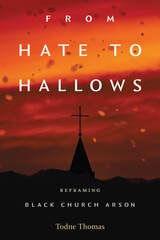
cover of From Hate to Hallows: Reframing Black Church Arson

From Hate to Hallows

Reframing Black Church Arson

Todne Thomas

Duke University Press, 2026

From Hate to Hallows intervenes in the public discourse surrounding the burning of Black churches in the United States—conversations largely dominated by white, conservative political imaginaries—to provide a critical account of the anti-Black racism and economic exploitation animating these acts of violence. Todne Thomas centers an ethnographic examination of a Knoxville, Tennessee, church that was burned in 2015 as the primary case study of this intervention. By exploring the congregants’ experiences and perspectives on the event, Thomas privileges Black meaning-making as a primary source of social and political analysis. She draws on their explanations for the arson to explore the social, historical, and religious contexts of white supremacy, vandalism, gentrification and urban redevelopment, and the End Times as each relate to church burning. From Hate to Hallows challenges the dominant picture of Black church arson as episodic and aberrant events and instead foregrounds them as central moments in the construction of a twenty-first-century United States steeped in racial and economic domination.
[more]
cover of Guidance Note 4: Protection Against Fire

Guidance Note 4

Protection Against Fire

The Institution of Engineering and Technology

The Institution of Engineering and Technology, 2015
Protection against fire is a key element of Amendment 3 to the 17th Edition. Vital changes will potentially vastly improve the safety of contractors, consumers and the fire services. Guidance Note 4: Protection Against Fire provides clear guidance on how to apply the updated aspects of BS 7671.
[more]
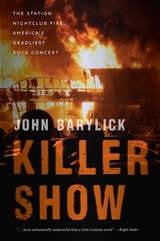
cover of Killer Show: The Station Nightclub Fire, America’s Deadliest Rock Concert

Killer Show

The Station Nightclub Fire, America’s Deadliest Rock Concert

John Barylick

University Press of New England, 2015

On February 20, 2003, the deadliest rock concert in U.S. history took place at a roadhouse called The Station in West Warwick, Rhode Island. That night, in the few minutes it takes to play a hard-rock standard, the fate of many of the unsuspecting nightclub patrons was determined with awful certainty. The blaze was ignited when pyrotechnics set off by Great White, a 1980s heavy-metal band, lit flammable polyurethane “egg crate” foam sound insulation on the club’s walls. In less than 10 minutes, 96 people were dead and 200 more were injured, many catastrophically. The final death toll topped out, three months later, at the eerily unlikely round number of 100. The story of the fire, its causes, and its legal and human aftermath is one of lives put at risk by petty economic decisions—by a band, club owners, promoters, building inspectors, and product manufacturers. Any one of those decisions, made differently, might have averted the tragedy. Together, however, they reached a fatal critical mass. Killer Show is the first comprehensive exploration of the chain of events leading up to the fire, the conflagration itself, and the painstaking search for evidence to hold the guilty to account and obtain justice for the victims. Anyone who has entered an entertainment venue and wondered, “Could I get out of here in a hurry?” will identify with concertgoers at The Station. Fans of disaster nonfiction and forensic thrillers will find ample elements of both genres in Killer Show.
[more]