Results by title
5 books match the query 'First - Year Writing'
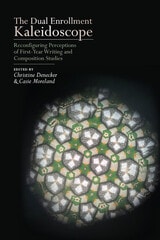
Dual Enrollment Kaleidoscope
Reconfiguring Perceptions of First-Year Writing and Composition StudiesChristine Denecker
Utah State University Press, 2022
The Dual Enrollment Kaleidoscope serves as a starting point for elevating the voices of those who do dual enrollment (DE) work—those who historicize, legitimize, scrutinize, critically analyze, align, and assess it—pushing readers beyond unique, singular views of DE first-year composition and positioning DE’s impact on composition instruction as one that shifts dependent upon perspective. Just as kaleidoscopes reconfigure images, DE provides writing studies with reflecting images of what FYC was, is, and could be.
DE disrupts long-held beliefs of who should take and who should teach college writing. Giving higher education pause about the place of writing instruction within the academy, DE force those in the field to reflect upon the purposes and value of FYC and its pedagogical approaches. Featuring seventeen chapters written by a wide and diverse range of authors, this collection includes the voices of prominent scholars in rhetoric and composition at two- and four-year public and private institutions, as well as emerging scholars in the field. It also features a variety of methodologies, including archival research, quantitative and qualitative data collection, and autoethnography.
Few texts have been published on dual enrollment writing in rhetoric and composition studies. The Dual Enrollment Kaleidoscope should be mandatory reading for anyone interested in or tasked with doing the work of DE writing instruction, administration, mentoring, or assessment.
Contributors: Dominic Ashby, Anna Bogen, Tyler Branson, Melanie Burdick, Scott Campbell, Christine R. Farris, David Gehler, Leigh Graziano, Jane Greer, Jennifer Hadley, Jacquelyn Hoermann-Elliott, Joseph Jones, Nancy Knowles, Amy Lueck, Miles McCrimmon, Katie McWain, Annie S. Mendenhall, Keith Miller, Brice Nordquist, Cornelia Paraskevas, Jill Parrot, Shirley K Rose, Barbara Schneider, Erin Scott-Stewart
[more]
Excellence in First-Year Writing
2019/2020Dana Nichols
Michigan Publishing Services, 2020
[more]
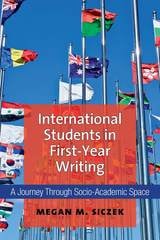
International Students in First-Year Writing
A Journey Through Socio-Academic SpaceMegan M. Siczek
University of Michigan Press, 2018
The book explores the journey of 10 international students to better understand their experiences at a U.S. educational institution and how they constructed and revealed these experiences in this particular socio-academic space. The study features a series of three interviews during the semester that the participants were enrolled in a mainstream first-year writing course; their stories not only capture their experiences but reveal inspiring stories that “give voice” to students outside the dominant cultural and linguistic community.
This study raises questions about how to support international students:
This study raises questions about how to support international students:
- In what ways can it inform our practices and policies relative to the internationalization of education and the development of global perspectives and competencies?
- What does it reveal that could impact daily instruction of L2 writing, particularly when it comes to international students’ need to meet the expectations of “university-level writing” in U.S. institutions of higher education?
- On an individual level, what can we learn from these students and about ourselves as a result of our interactions?
[more]
The Radical Case for Teaching Skim Reading in First-Year Writing
Ellen C. Carillo
Utah State University Press, 2025
The Radical Case for Teaching Skim Reading in First-Year Writing encourages faculty, particularly in writing studies, to check internal biases toward deep reading and teach skim reading in first-year writing courses. Written by Ellen C. Carillo, who has previously published on the importance of teaching deep reading, this small book is a controversial prompt for further discussion and exploration.
Data from studies of the lived experiences of undergraduates indicate that students do not need deep reading practices in the majority of their classes across the disciplines and, moreover, that students succeed in their classes by skim reading. Rather than imagining an idealized set of circumstances that allow for sustained deep reading, as does a great deal of the scholarship on reading in writing studies, The Radical Case for Teaching Skim Reading in First-Year Writing argues for teaching students reading practices that will support their success in their college writing assignments rather than those strategies the field believes should support their success.
In our information landscape and our fragile democracy, encouraging skimming as opposed to deep reading may seem like a gamble—this very tendency toward the quick rather than the critical has undoubtedly contributed to the current crisis of mass misinformation. However, teaching students to use skim reading as a strategic tool for purposeful engagement and efficient yet thoughtful information filtering better equips them to navigate the rapidly changing information landscape and manage the fast-paced flow of content from diverse media sources.
[more]

Tracing the Impact of First-Year Writing
Identity, Process, and Transfer at a Public UniversityLaura Wilder
Utah State University Press, 2024
Tracing the Impact of First-Year Writing presents the results of a large-scale longitudinal study of college writers that explores the impact of a required first-year writing course with a comparative approach not previously available. Over five years Laura Wilder conducted 143 interviews with, and collected 774 pages of writing from, 58 students, half of whom had taken a new first-year writing course and half who had not. Wilder found that while in many ways the experiences of both groups are comparable—demonstrating how students receive valuable educations in rhetoric and writing from a variety of sources beyond a first-year writing course—students who took the first-year writing course were much more likely to identify as writers. This identification supported students’ use of writing in powerfully generative and knowledge-building ways that they carried with them long after the course into other appropriate contexts.
In contrast to previous longitudinal studies of college writers undertaken at institutions with high prestige and resources, Tracing the Impact of First-Year Writing explores the role of writing at a regional public university and documents how students’ experiences with writing can be highly divergent across the curriculum and unequal across campuses. Additionally, this book includes the voices of students who do not identify as capable writers and have strongly negative emotional reactions to writing and writing instruction and adds empirical support to innovative calls in the field to transform the first-year writing course into one that inspires students to reflectively consider writing itself.
In contrast to previous longitudinal studies of college writers undertaken at institutions with high prestige and resources, Tracing the Impact of First-Year Writing explores the role of writing at a regional public university and documents how students’ experiences with writing can be highly divergent across the curriculum and unequal across campuses. Additionally, this book includes the voices of students who do not identify as capable writers and have strongly negative emotional reactions to writing and writing instruction and adds empirical support to innovative calls in the field to transform the first-year writing course into one that inspires students to reflectively consider writing itself.
[more]