Results by title
4 books match the query 'First Hundred Years'
A History of the Crusades, Volume I
The First Hundred YearsSeries Edited by Kenneth M. Setton; Volume Edited by Marshall W. Baldwin
University of Wisconsin Press, 1969
Bibb County, Alabama
The First Hundred YearsRhoda C. Ellison
University of Alabama Press, 1984
This model county history chronicles one hundred years in the life of a representative Deep South county
The history of Bibb County between 1818 and 1918 is in many ways representative of the experience of central Alabama during that period. Bibb County shares physical characteristics with the areas both to its north and to its south. In its northern section is a mineral district and in its southern valleys fertile farming country; therefore, its citizens have sometimes allied themselves with the hill counties and sometimes with their Black Belt neighbors.
Both sections of the county developed in step with the surrounding counties. Bibb's foundries were established during the same time and by the same iron masters as Shelby County, and its coal mines in the same decade as Jefferson County. Its farmers planted the same crops and faced the same problems as those in Perry, Autauga, and Tuscaloosa counties. Like Tuscaloosa, Bibb endeavored to promote river transportation for both its industrial and its agricultural products.
This carefully documented history is based on a variety of original sources, from personal letters to government records. It is generously illustrated with early maps and with old pictures of Bibb landmarks, many of which have now vanished.
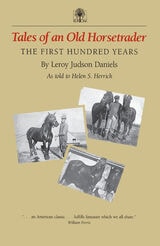
Tales of an Old Horsetrader
The First Hundred YearsLeroy Judson Daniels
University of Iowa Press, 1987
Leroy Daniels was born in 1882 near Adair, Iowa. When he was ten, his father gave him a pony and a checkbook and sent him out to buy cattle. By the time he was sixteen, he was alone on a ranch in Montana with a herd of seventy wild horses to break. At twenty-one, he was trading horses in the Chicago stockyards, where he told Henry Ford that a horse was better than a car any day. At one hundred, he retired to tell his memoirs.
The years in between are well worth reading about. Lee Daniels followed a plow all day long, worked coal to make ends meet, raised and traded and sold all manner of four-legged stock. But horses were always part of his life. Daniels traded them in Chicago for decades, sold them to Italy, England, France, and Belgium during World War I, inspected them for the army once the U.S. joined the Allies, bought them for eighty dollars in the morning and sold them for thousands by noon. He handled show horses, work horses, and trick horses, traveled the country over to fill his show barn with the best of them, befriended, understood, and loved them.
These pages tell the tale of a unique and vigorous American whose every word reveals his love of this land and its animals. If you weren't lucky enough to live like Lee Daniels, reading about his life is the next best thing.
The Constitution in the Supreme Court
The First Hundred Years, 1789-1888David P. Currie
University of Chicago Press, 1985
"A thorough, systematic, and careful assessment. . . . As a reference work for constitutional teachers, it is a gold mine."—Charles A. Lofgren, Constitutional Commentary