Results by title

3 books match the query 'First person narrative'
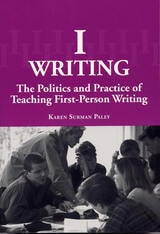
cover of I-Writing: The Politics and Practice of Teaching First-Person Writing

I-Writing

The Politics and Practice of Teaching First-Person Writing

Karen Surman Paley

Southern Illinois University Press, 2001

In this ethnographic study of the teaching of writing, Karen Surman Paley reveals the social significance of first-person writing and the limitations of a popular taxonomy of composition studies. Paley looks critically at the way social constructionists have created an “Other” in the field of composition studies and named it “expressivist.”

Paley demonstrates the complexity of approaches to teaching writing through an ethnographic study of two composition faculty at Boston College, a programthat some would say is “expressivist.” She prompts her colleagues to consider how family experiences shape the way students feel about and treat people of races, religions, genders, and sexual preferences other than their own. Finally, she suggests to the field of composition that practitioners spend less time shoring up taxonomies of the field and more time sharing pedagogies.

[more]
cover of Wild Mother Dancing: Maternal Narrative in Canadian Literature

Wild Mother Dancing

Maternal Narrative in Canadian Literature

Di Brandt

University of Manitoba Press, 1993
[more]
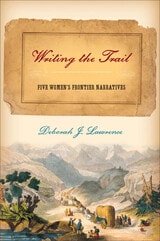
cover of Writing the Trail: Five Women's Frontier Narratives

Writing the Trail

Five Women's Frontier Narratives

Deborah Lawrence

University of Iowa Press, 2006

For a long time, the American West was mainly identified with white masculinity, but as more women’s narratives of westward expansion came to light, scholars revised purely patriarchal interpretations. Writing the Trail continues in this vein by providing a comparative literary analysis of five frontier narratives---Susan Magoffin’s Down the Santa Fe Trail and into Mexico, Sarah Royce’s A Frontier Lady, Louise Clappe’s The Shirley Letters, Eliza Farnham’s California, In-doors and Out, and Lydia Spencer Lane’s I Married a Soldier---to explore the ways in which women’s responses to the western environment differed from men’s.Throughout their very different journeys---from an eighteen-year-old bride and self-styled “wandering princess” on the Santa Fe Trail, to the mining camps of northern California, to garrison life in the Southwest---these women moved out of their traditional positions as objects of masculine culture. Initially disoriented, they soon began the complex process of assimilating to a new environment, changing views of power and authority, and making homes in wilderness conditions.Because critics tend to consider nineteenth-century women’s writings as confirmations of home and stability, they overlook aspects of women’s textualizations of themselves that are dynamic and contingent on movement through space. As the narratives in Writing the Trail illustrate, women’s frontier writings depict geographical, spiritual, and psychological movement. By tracing the journeys of Magoffin, Royce, Clappe, Farnham, and Lane, readers are exposed to the subversive strength of travel writing and come to a new understanding of gender roles on the nineteenth-century frontier.
[more]