Results by title

4 books match the query 'Fischer, Claude S.'
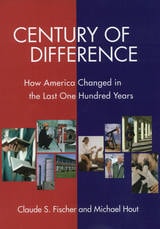
cover of Century of Difference: How America Changed in the Last One Hundred Years

Century of Difference

How America Changed in the Last One Hundred Years

Claude S. Fischer

Russell Sage Foundation, 1976

In every generation, Americans have worried about the solidarity of the nation. Since the days of the Mayflower, those already settled here have wondered how newcomers with different cultures, values, and (frequently) skin color would influence America. Would the new groups create polarization and disharmony? Thus far, the United States has a remarkable track record of incorporating new people into American society, but acceptance and assimilation have never meant equality. In Century of Difference, Claude Fischer and Michael Hout provide a compelling—and often surprising—new take on the divisions and commonalities among the American public over the tumultuous course of the twentieth century. Using a hundred years worth of census and opinion poll data, Century of Difference shows how the social, cultural, and economic fault lines in American life shifted in the last century. It demonstrates how distinctions that once loomed large later dissipated, only to be replaced by new ones. Fischer and Hout find that differences among groups by education, age, and income expanded, while those by gender, region, national origin, and, even in some ways, race narrowed. As the twentieth century opened, a person's national origin was of paramount importance, with hostilities running high against Africans, Chinese, and southern and eastern Europeans. Today, diverse ancestries are celebrated with parades. More important than ancestry for today's Americans is their level of schooling. Americans with advanced degrees are increasingly putting distance between themselves and the rest of society—in both a literal and a figurative sense. Differences in educational attainment are tied to expanding inequalities in earnings, job quality, and neighborhoods. Still, there is much that ties all Americans together. Century of Difference knocks down myths about a growing culture war. Using seventy years of survey data, Fischer and Hout show that Americans did not become more fragmented over values in the late-twentieth century, but rather were united over shared ideals of self-reliance, family, and even religion. As public debate has flared up over such matters as immigration restrictions, the role of government in redistributing resources to the poor, and the role of religion in public life, it is important to take stock of the divisions and linkages that have typified the U.S. population over time. Century of Difference lucidly profiles the evolution of American social and cultural differences over the last century, examining the shifting importance of education, marital status, race, ancestry, gender, and other factors on the lives of Americans past and present. A Volume in the Russell Sage Foundation Census Series
[more]
cover of Made in America: A Social History of American Culture and Character

Made in America

A Social History of American Culture and Character

Claude S. Fischer

University of Chicago Press, 2010

Our nation began with the simple phrase, “We the People.” But who were and are “We”? Who were we in 1776, in 1865, or 1968, and is there any continuity in character between the we of those years and the nearly 300 million people living in the radically different America of today?

With Made in America, Claude S. Fischer draws on decades of historical, psychological, and social research to answer that question by tracking the evolution of American character and culture over three centuries. He explodes myths—such as that contemporary Americans are more mobile and less religious than their ancestors, or that they are more focused on money and consumption—and reveals instead how greater security and wealth have only reinforced the independence, egalitarianism, and commitment to community that characterized our people from the earliest years. Skillfully drawing on personal stories of representative Americans, Fischer shows that affluence and social progress have allowed more people to participate fully in cultural and political life, thus broadening the category of “American” —yet at the same time what it means to be an American has retained surprising continuity with much earlier notions of American character.

Firmly in the vein of such classics as The Lonely Crowd and Habits of the Heart—yet challenging many of their conclusions—Made in America takes readers beyond the simplicity of headlines and the actions of elites to show us the lives, aspirations, and emotions of ordinary Americans, from the settling of the colonies to the settling of the suburbs.

[more]
cover of Still Connected: Family and Friends in America Since 1970

Still Connected

Family and Friends in America Since 1970

Claude S. Fischer

Russell Sage Foundation, 2011

National news reports periodically proclaim that American life is lonelier than ever, and new books on the subject with titles like Bowling Alone generate considerable anxiety about the declining quality of Americans' social ties. Still Connected challenges such concerns by asking a simple yet significant question: have Americans' bonds with family and friends changed since the 1970s, and, if so, how? Noted sociologist Claude Fischer examines long-term trends in family ties and friendships and paints an insightful and ultimately reassuring portrait of Americans' personal relationships. Still Connected analyzes forty years of survey research to address whether and how Americans' personal ties have changed—their involvement with relatives, the number of friends they have and their contacts with those friends, the amount of practical and emotional support they are able to count on, and how emotionally tied they feel to these relationships. The book shows that Americans today have fewer relatives than they did forty years ago and that formal gatherings have declined over the decades—at least partially as a result of later marriages and more women in the work force. Yet neither the overall quantity of personal relationships nor, more importantly, the quality of those relationships has diminished. Americans' contact with relatives and friends, as well as their feelings of emotional connectedness, has changed relatively little since the 1970s. Although Americans are marrying later and single people feel lonely, few Americans report being socially isolated and the percentage who do has not really increased. Fischer maintains that this constancy testifies to the value Americans place on family and friends and to their willingness to adapt to changing circumstances in ways that sustain their social connections. For example, children now often have schedules as busy as their parents. Yet today's parents spend more quality time with their children than parents did forty years ago—although less in the form of organized home activities and more in the form of accompanying them to play dates or sports activities. And those family meals at home that seem to be disappearing? While survey research shows that families dine at home together less often, it also shows that they dine out together more often. Americans are fascinated by the quality of their relationships with family and friends and whether these bonds fray or remain stable over time. With so many voices heralding the demise of personal relationships, it's no wonder that confusion on this topic abounds. An engrossing and accessible social history, Still Connected brings a much-needed note of clarity to the discussion. Americans' personal ties, this book assures us, remain strong.
[more]
cover of To Dwell among Friends: Personal Networks in Town and City

To Dwell among Friends

Personal Networks in Town and City

Claude S. Fischer

University of Chicago Press, 1982

[more]