Results by title
11 books match the query 'Fischer, Lucy'
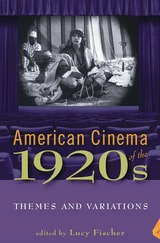
American Cinema of the 1920s
Themes and VariationsFischer, Lucy
Rutgers University Press, 2009
In ten original essays, American Cinema of the 1920s examines the film industry's continued growth and prosperity while focusing on important themes of the era.
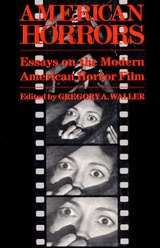
American Horrors
Essays on the Modern American Horror FilmEdited by Gregory A. Waller
University of Illinois Press, 1988
In this collection of twelve essays, Gregory Waller balances detailed studies of both popular films (Night of the Living Dead, The Exorcist, and Halloween) and particularly problematic films (Don't Look Now and Eyes of Laura Mars) with discussions of such central thematic preoccupations as the genre's representation of violence and female victims, its reflexivity and playfulness, and its ongoing redefinition of the monstrous and the normal.
In addition, American Horrors includes a filmography of movies and telefilms and an annotated bibliography of books and articles about horror since 1968.
Art Direction and Production Design
Fischer, Lucy
Rutgers University Press, 2015
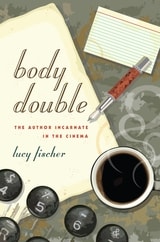
Body Double
The Author Incarnate in the CinemaLucy Fischer
Rutgers University Press, 2013
Body Double explores the myriad ways that film artists have represented the creative process. In this highly innovative work, Lucy Fischer draws on a neglected element of auteur studies to show that filmmakers frequently raise questions about the paradoxes of authorship by portraying the onscreen writer. Dealing with such varied topics as the icon of the typewriter, the case of the writer/director, the authoress, and the omnipresent infirm author, she probes the ways in which films can tell a plausible story while contemplating the conditions and theories of their making.
By examining many forms of cinema, from Hollywood and the international art cinema to the avant-garde, Fischer considers the gender, age, and mental or physical health of fictionalized writers; the dramatized interaction between artists and their audiences and critics; and the formal play of written words and nonverbal images.
By analyzing such movies as Adaptation,Diary of a Country Priest, Naked Lunch, American Splendor, and Irezumi, Fischer tracks the parallels between film author and character, looking not for the creative figure who stands outside the text, but for the one who stands within it as corporeal presence and alter-ego.
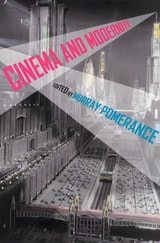
Cinema and Modernity
Pomerance, Murray
Rutgers University Press, 2006
The modern impulse gave us captivating technology and dark anxiety, rampant mobility and a world filled with strangers, the futuristic city and a fragmentation of experience. Motion pictures––the quintessence of modernism––entered into this cultural, technical, and philosophical richness with a vast public appeal and a jarring new vision of what life could be.
In Cinema and Modernity, Murray Pomerance brings together new essays by seventeen leading scholars to explore the complexity of the essential connection between film and modernity. Among the many films considered are Detour, Shock Corridor, The Last Laugh, Experiment in Terror, The Great Dictator, Leave Her to Heaven, The Talented Mr. Ripley, Eyes Wide Shut, Sunrise, The Crowd, The Shape of Things to Come, The War of the Worlds, The Day the Earth Stood Still, Scarlet Street, Shadow of a Doubt, Stella Dallas, The Blue Angel, Sullivan’s Travels, and Catch Me If You Can.
Gender Meets Genre in Postwar Cinemas
Edited by Christine Gledhill
University of Illinois Press, 2012
This remarkable collection uses genre as a fresh way to analyze the issues of gender representation in film theory, film production, spectatorship, and the contexts of reception. With a uniquely global perspective, these essays examine the intersection of gender and genre in not only Hollywood films but also in independent, European, Indian, and Hong Kong cinemas. Working in the area of postcolonial cinema, contributors raise issues dealing with indigenous and global cinemas and argue that contemporary genres have shifted considerably as both notions of gender and forms of genre have changed. The volume addresses topics such as the history of feminist approaches to the study of genre in film, issues of female agency in postmodernity, changes taking place in supposedly male-dominated genres, concepts of genre and its use of gender in global cinema, and the relationship between gender and sexuality in film.
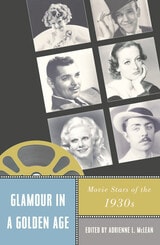
Glamour in a Golden Age
Movie Stars of the 1930sMcLean, Adrienne L
Rutgers University Press, 2010
Stardom is approached as an effect of, and influence on, the particular historical and industrial contexts that enabled these actors and actresses to be discovered, featured in films, publicized, and to become recognized and admired-sometimes even notorious-parts of the cultural landscape. Using archival and popular material, including fan and mass market magazines, other promotional and publicity material, and of course films themselves, contributors also discuss other artists who were incredibly popular at the time, among them Ann Harding, Ruth Chatterton, Nancy Carroll, Kay Francis, and Constance Bennett.
Headline Hollywood
A Century of Film ScandalMcLean, Adrienne L
Rutgers University Press, 2001
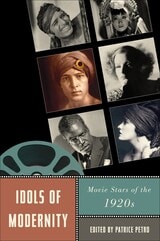
Idols of Modernity
Movie Stars of the 1920sPetro, Patrice
Rutgers University Press, 2010
Bringing together the best new work oncinemaand stardom in the 1920s, this illustrated collection showcases the range of complex social, institutional, and aesthetic issues at work in American cinema of this time. Attentive to stardom as an ensemble of texts, contexts, and social phenomena stretching beyond the cinema, major scholars provide careful analysis of the careers of both well-known and now forgotten stars of the silent and early sound era—Douglas Fairbanks, Buster Keaton, the Talmadge sisters, Rudolph Valentino, Gloria Swanson, Clara Bow, Colleen Moore, Greta Garbo, Anna May Wong, Emil Jannings, Al Jolson, Ernest Morrison, Noble Johnson, Evelyn Preer, Lincoln Perry, and Marie Dressler.
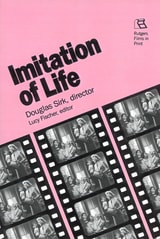
Imitation of Life
Douglas Sirk, DirectorFischer, Lucy
Rutgers University Press, 1991
Because of the special stamp he put on his melodramas, Sirk's best works transcend the constraints of their genre. In them, he both exemplified and critiqued postwar, conservative, materialistic life and its false value systems. There is much in Sirk, particularly in Imitation of Life, that is of interest to us today. The time seems to be right for a new look at the film, its reception amidst scandal over the affairs of its star—Lana Turner—the relationships between its mothers and daughters, the tensions between its men and its women, the friendships between its black and white women, and the ambiguous, controversial approach of Sirk to his material.
This volume includes the complete continuity script of the film, critical commentary and published reviews, interviews with the director, and a filmography and bibliography. It also includes an excellent introduction by Lucy Fischer.
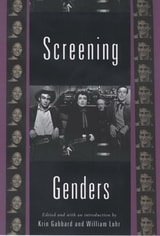
Screening Genders
The American Science Fiction FilmGabbard, Krin
Rutgers University Press, 2008
The book begins with a general introduction that traces the movement of gender theory from the margins of film studies to its center. The ten essays that follow address a range of topics, including screen stars; depictions of gay, straight, queer, and transgender subjects; and the relationship between gender and genre. Widely respected scholars, including Robert T. Eberwein, Lucy Fischer, Chris Holmlund, E. Ann Kaplan, Kathleen Rowe Karlyn, David Lugowski, Patricia Mellencamp, Jerry Mosher, Jacqueline Reich, and Chris Straayer, focus on the radical ideological advances of contemporary cinema, as well as on those groundbreaking films that have shaped our ideas about masculinity and femininity, not only in movies but in American culture at large.
The first comprehensive overview of the history of gender theory in film, this book is an ideal text for courses and will serve as a foundation for further discussion among students and scholars alike.