Results by title
7 books match the query 'Fleming, Peter'

Brazilian Adventure
Peter Fleming
Northwestern University Press, 1999
Nothing indeed. In 1932, Peter Fleming, a literary editor, traded his pen for a pistol and took off as part of the celebrated search for missing English explorer Colonel P.H. Fawcett. With meager supplies, faulty maps, and packs of rival newspapermen on their trail, Fleming and his companions marched, canoed, and hacked through 3,000 miles of wilderness and alligator-ridden rivers in search of the fate of the lost explorer. One of the great adventure stories, Brazilian Adventure is as fresh a story today as it was when originally published in 1933.

Dark Academia
How Universities DiePeter Fleming
Pluto Press, 2021
“Fleming's books are sparklingly sardonic and hilariously angry”—Guardian
“An excellent and important book''—Journal of Education, Innovation, and Communication
To Professor Peter Fleming, there is a strong link between the neo-liberalization of higher education over the last 20 years and the psychological hell now endured by its staff and students. He believes that impersonal and unforgiving management hierarchies have supplanted academic judgement, collegiality, and professional common sense. He bemoans the modern system of higher education and shines a spotlight on what’s gone wrong and why.
While academia was once thought of as the best job in the world, one that fosters autonomy, craft, intrinsic job satisfaction, and vocational zeal, you would be hard-pressed to find a lecturer who believes that now.
Fleming delves into this new metrics-obsessed, overly hierarchical world to bring out the hidden underbelly of what he terms the 'zombie university'. He examines:
*Commercialization
*Mental illness and self-harm
*The rise of managerialism
*Students as consumers and evaluators
*The competitive individualism which casts a dark sheen of alienation over departments
*And much more!
Arguing that time has almost run out to reverse this decline, this book shows how academics and students need to act now if they are to begin to fix this broken system.

Genetic Algorithms in Engineering Systems
A.M.S. Zalzala
The Institution of Engineering and Technology, 1997

News from Tartary
A Journey from Peking to KashmirPeter Fleming
Northwestern University Press, 1999
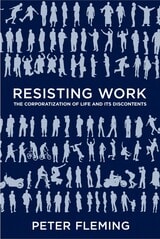
Resisting Work
The Corporatization of Life and Its DiscontentsPeter Fleming
Temple University Press, 2015
A job is no longer something we "do," but instead something we "are." As the boundaries between work and non-work have dissolved, we restructure ourselves and our lives using social ingenuity to get things done and be resourceful outside the official workday.
In his provocative book, Resisting Work Peter Fleming insists that many jobs in the West are now regulated by a new matrix of power-biopower-where "life itself" is put to work through our ability to self-organize around formal rules. This neoliberal system of employment tries to absorb our life attributes--from our consumer tastes, "downtime," and sexuality--into employment so that questions of human capital and resources replace questions of employee, worker, and labor.
Fleming then suggests that the corporation turns to communal life-what he calls "the common"-in order to reproduce itself and reinforce corporate culture. Yet a resistance against this new definition of work is in effect, and Fleming shows how it may already be taking shape.

The Death of Homo Economicus
Work, Debt and the Myth of Endless AccumulationPeter Fleming
Pluto Press, 2017
In The Death of Homo Economicus, Fleming presents this controversial claim with the same fierce logic and perception that launched his Guardian column into popularity. Fleming argues that as an invented model of a human being, Homo economicus is, in reality, a tool used by economists and capitalists to manage our social world through the state, business, and even family. As workers, we are barraged with constant reminders that we should always strive toward this ideal persona. It’s implied—and sometimes directly stated—that if we don’t then we are failures. Ironically, the people most often encouraged to emulate this model are those most predisposed to fail due to their socioeconomic circumstances: the poor, the unemployed, students, and prisoners.
Fleming illuminates why a peculiar proactive negativity now marks everyday life in capitalist societies, and he explores how this warped, unattainable model for workers would cause chaos if enacted to the letter. Timely and revelatory, The Death of Homo Economicus offers a sharp, scathing critique of who we are supposed to be in the workplace and beyond.
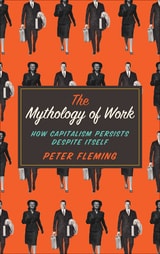
The Mythology of Work
How Capitalism Persists Despite ItselfPeter Fleming
Pluto Press, 2015
In The Mythology of Work, Peter Fleming examines how neoliberal society uses the ritual of work—and the threat of its denial—to maintain the late capitalist class order. Work becomes a universal reference point, devoid of any moral or political worth, transforming our society into a factory that never sleeps. Blending critical theory with recent accounts of job-related suicides, office-induced paranoia, fear of relaxation, managerial sadism, and cynical corporate social responsibility campaigns, Fleming paints a bleak picture of a society in which economic and emotional disasters greatly outweigh any professed benefits.