Results by title
3 books match the query 'Fletcher, Robert'
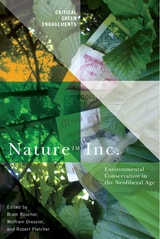
Nature Inc.
Environmental Conservation in the Neoliberal AgeEdited by Bram Büscher, Wolfram Dressler, and Robert Fletcher
University of Arizona Press, 2014
Can “market forces” solve the world’s environmental problems? The stakes are undeniably high. With wildlife populations and biodiversity riches threatened across the globe, it is obvious that new and innovative methods of addressing the crisis are vital to the future of the planet. But is “the market” the answer?
As public funding for conservation efforts grows ever scarcer and the private sector is brimming with ideas about how its role—along with its profits— can grow, market forces have found their way into environmental management to a degree unimaginable only a few years ago. Ecotourism, payment for environmental services (PES), and new conservation finance instruments such as species banking, carbon trading, and biodiversity derivatives are only some of the market mechanisms that have sprung into being. This is “Nature™ Inc.”: a fast-growing frontier of networks, activities, knowledge, and regulations that are rapidly changing the relations between people and nature on both global and local scales.
Nature™ Inc. brings together cutting-edge research by respected scholars from around the world to analyze how “neoliberal conservation” is reshaping human–nature relations that have been fashioned over two centuries of capitalist development. Contributors synthesize and add to a growing body of academic literature that cuts across the disciplinary boundaries of geography, sociology, anthropology, political science, and development studies to critically interrogate the increasing emphasis on neoliberal market-based mechanisms in environmental conservation. They all grapple with one overriding question: can capitalist market mechanisms resolve the environmental problems they have helped create?
[more]
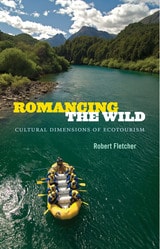
Romancing the Wild
Cultural Dimensions of EcotourismRobert Fletcher
Duke University Press, 2014
The worldwide development of ecotourism—including adventures such as mountain climbing and whitewater rafting, as well as more pedestrian pursuits such as birdwatching—has been extensively studied, but until now little attention has been paid to why vacationers choose to take part in what are often physically and emotionally strenuous endeavors. Drawing on ethnographic research and his own experiences working as an ecotour guide throughout the United States and Latin America, Robert Fletcher argues that participation in rigorous outdoor activities resonates with the particular cultural values of the white, upper-middle-class Westerners who are the majority of ecotourists. Navigating 13,000-foot mountain peaks or treacherous river rapids demands deferral of gratification, perseverance through suffering, and a willingness to assume risks in pursuit of continuous progress. In this way, characteristics originally cultivated for professional success have been transferred to the leisure realm at a moment when traditional avenues for achievement in the public sphere seem largely exhausted. At the same time, ecotourism provides a temporary escape from the ostensible ills of modern society by offering a transcendent "wilderness" experience that contrasts with the indoor, sedentary, mental labor characteristically performed by white-collar workers.
[more]
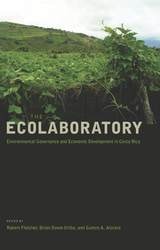
The Ecolaboratory
Environmental Governance and Economic Development in Costa RicaEdited by Robert Fletcher, Brian Dowd-Uribe, and Guntra A. Aistara
University of Arizona Press, 2020
Despite its tiny size and seeming marginality to world affairs, the Central American republic of Costa Rica has long been considered an important site for experimentation in cutting-edge environmental policy. From protected area management to ecotourism to payment for environmental services (PES) and beyond, for the past half-century the country has successfully positioned itself at the forefront of novel trends in environmental governance and sustainable development. Yet the increasingly urgent dilemma of how to achieve equitable economic development in a world of ecosystem decline and climate change presents new challenges, testing Costa Rica’s ability to remain a leader in innovative environmental governance.
This book explores these challenges, how Costa Rica is responding to them, and the lessons this holds for current and future trends regarding environmental governance and sustainable development. It provides the first comprehensive assessment of successes and challenges as they play out in a variety of sectors, including agricultural development, biodiversity conservation, water management, resource extraction, and climate change policy.
By framing Costa Rica as an “ecolaboratory,” the contributors in this volume examine the lessons learned and offer a path for the future of sustainable development research and policy in Central America and beyond.
[more]