Results by title
20 books match the query 'Flight'

Dreams of Flight
The Lives of Chinese Women Students in the WestFran Martin
Duke University Press, 2022
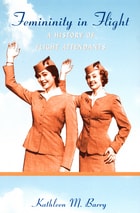
Femininity in Flight
A History of Flight AttendantsKathleen M. Barry
Duke University Press, 2007
From the moment the first stewardesses took flight in 1930, flight attendants became glamorous icons of femininity. For decades, airlines hired only young, attractive, unmarried white women. They marketed passenger service aloft as an essentially feminine exercise in exuding charm, looking fabulous, and providing comfort. The actual work that flight attendants did—ensuring passenger safety, assuaging fears, serving food and drinks, all while conforming to airlines’ strict rules about appearance—was supposed to appear effortless; the better that stewardesses performed by airline standards, the more hidden were their skills and labor. Yet today flight attendants are acknowledged safety experts; they have their own unions. Gone are the no-marriage rules, the mandates to retire by thirty-two. In Femininity in Flight, Kathleen M. Barry tells the history of flight attendants, tracing the evolution of their glamorized image as ideal women and their activism as trade unionists and feminists.
Barry argues that largely because their glamour obscured their labor, flight attendants unionized in the late 1940s and 1950s to demand recognition and respect as workers and self-styled professionals. In the 1960s and 1970s, flight attendants were one of the first groups to take advantage of new laws prohibiting sex discrimination. Their challenges to airlines’ restrictive employment policies and exploitive marketing practices (involving skimpy uniforms and provocative slogans such as “fly me”) made them high-profile critics of the cultural mystification and economic devaluing of “women’s work.” Barry combines attention to the political economy and technology of the airline industry with perceptive readings of popular culture, newspapers, industry publications, and first-person accounts. In so doing, she provides a potent mix of social and cultural history and a major contribution to the history of women’s work and working women’s activism.
Flight And Other Stories
José Skinner
University of Nevada Press, 2001

Flight From Fiesta
Frank Waters
Ohio University Press, 1987
Frank Waters, whose work has spanned half a century, has continually attempted to depict the reconciliation of opposites, to heal the national wounds of polarization.
Flight From Fiesta, Waters’ first novel in nearly two decades, is testimony to that aspiration, emerging as a moving and masterfully–told story of two characters who must discover the potential for common ground between their personalities.
Set in Santa Fe in the mid–fifties, the story itself is deceptively simple. Elsie, a spoiled, self–centered ten–year–old Anglo tourist girl, has come to the annual Fiesta with her divorced mother and her mother’s lover. When Elsie runs away from her hotel, she encounters Inocencio, an old alcoholic Pueblo Indian now reduced to selling pottery beneath the portal of the Palace of the Governors. With childish cunning she maneuvers Inocencio into taking her away with him. In the wake of the child’s disappearance, as the local posse–mentality intensifies and Inocencio is suspected of kidnapping and perhaps molesting her, the frightened Indian flees to the hills, taking Elsie with him on a week–long odyssey through the mountains, towns, and pueblos of New Mexico.
Waters’ eye is precise, providing sharp visual detail on very page. His ear is flawless, especially in his rendering of the laconic and stolid Indian speech patterns. All through his book there is an immediacy and a feel for place and culture that cannot be fabricated but must be gained, as Waters himself has gained it, through a lifetime among these people, these towns, and these mountains. The reconciliation of the two fugitives of Flight From Fiesta serves to point, not didactically or allegorically, but emotionally and spiritually, but emotionally and spiritually, to the possibility of the grander reconciliation that Waters envisions.
Flight from the Mother Stone
PoemsLaurence Lieberman
University of Arkansas Press, 2000
In his newest collection of poetry, Laurence Leiberman widens the scope of his previous Caribbean collections by drawing attention to the small enchanting islands of the Grenadines, a chain running between Grenada and St. Vincent. These outposts, often frequented by sailors, are mainly off the beaten tourist tracks. Lieberman’s poems bring to life all the overlooked people, hidden places, and indigenous but rarely seen animals which can be found on these islands.
These poems are as powerful as voodoo, full of energetic narratives in which Lieberman acts as observer while his characters—native “Caribs” and friends—guide us through the mystifying world of Guyana and the Caribbean: the planting of tree farms, local myths and religious sects, the daily crises of manual laborers working in the gold and diamond mines, and encounters with watras and harpy eagles.
Lieberman’s lines are rhythmic and strong; voices swirl in and out of his stanzas. From Lieberman’s own precise observations to his inclusion of Caribbean dialects, the language created here is deeply textured and unique. The majority of these poems are narratives, stories about a culture that is extremely attuned to the richness of its past. They remind their readers that no matter how diverse a society becomes, it remains irrevocably connected to the land it was born of and the plants and animals that struggle to survive in its midst.
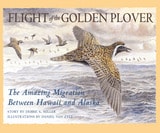
Flight of the Golden Plover
The Amazing Migration Between Hawaii and AlaskaDebbie S. Miller
University of Alaska Press, 2011
The remarkable story of the golden plover’s annual migration, this beautifully illustrated nature title for young readers sees the small but mighty plover embark on a six-thousand-mile flight between the frozen Alaska tundra and gentle grassy slopes of the Hawaiian Islands. Equally at home in his two very different habitats, the once-endangered golden plover has evolved many behaviors and adaptations that make it perfectly well-suited to each of its homes, and this book contains many fascinating facts about them. Readers are also introduced to the plover’s neighbors and friends—from the giant Hawaiian goose, or nene, to the musk ox, grizzly bear, arctic fox, and sandhill crane.

Flight
Sunken Garden Poetry PrizeChaun Ballard
Tupelo Press, 2018
Geographies of Flight
Phillis Wheatley to Octavia ButlerWilliam Merrill Decker
Northwestern University Press, 2020
African American writing commonly represents New World topography as a set of entrapments, contesting the open horizons, westward expansion, and individual freedom characteristic of the white, Eurocentric literary tradition. Geographies of Flight: Phillis Wheatley to Octavia Butler provides the first comprehensive treatment of the ways in which African American authors across three centuries have confronted the predicament of inhabiting space under conditions of bondage and structural oppression. William Merrill Decker examines how, in testifying to those conditions, fourteen black authors have sought to transform a national cartography that, well into the twenty-first century, reflects white supremacist assumptions. These writers question the spatial dimensions of a mythic American liberty and develop countergeographies in which descendants of the African diaspora lay claim to the America they have materially and culturally created.
Tracking the testimonial voice in a range of literary genres, Geographies of Flight explores themes of placement and mobility in the work of Phillis Wheatley, Olaudah Equiano, David Walker, Frederick Douglass, Harriet Jacobs, Booker T. Washington, Ida B. Wells-Barnett, W. E. B. Du Bois, Richard Wright, Ralph Ellison, Malcolm X, James Baldwin, Toni Morrison, and Octavia Butler.
Lines of Flight
Discursive Time and Countercultural Desire in the Work of Thomas PynchonStefan Mattessich
Duke University Press, 2002
Mattessich theorizes a new kind of time—subjective displacement—dramatized in the parody, satire, and farce deployed through Pynchon’s oeuvre. In particular, he is interested in showing how this sense of time relates to the counterculture of the 1960s and 1970s. Examining this movement as an instance of flight or escape and exposing the beliefs behind it, Mattessich argues that the counterculture’s rejection of the dominant culture ultimately became an act of self-cancellation, a rebellion in which the counterculture found itself defined by the very order it sought to escape. He points to parallels in Pynchon’s attempts to dramatize and enact a similar experience of time in the doubling-back, crisscrossing, and erasure of his writing. Mattessich lays out a theory of cultural production centered on the ethical necessity of grasping one’s own susceptibility to discursive forms of determination.
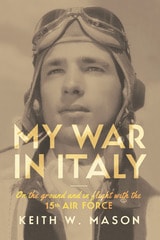
My War in Italy
On the Ground and in Flight with the 15th Air ForceKeith W. Mason
University of Missouri Press, 2027
Six weeks before Pearl Harbor, Keith Mason received a $150 uniform allowance, a pair of silver wings, and his first assignment as a flight instructor: Randolph Field, Texas. Two years later, he was Squadron Officer in the 460th Bomb Group, 15th Air Force in Spinazzola, Italy - flying the harrowing combat missions he dreamed of as a boy in rural Iowa.
As a memoir of one man’s war years, Mason provides insight on the inner workings of serving as an airman during World War II: facing stultifying boredom, stupefying incompetence, paralyzing fear, and stunning success. Details of how crews were selected for combat missions, of the necessity to occasionally break up crews, and of select missions in which Mason was a participant are important additions to the history and literature of this often neglected theater.
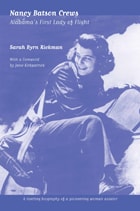
Nancy Batson Crews
Alabama's First Lady of FlightSarah Byrn Rickman
University of Alabama Press, 2009
This is the story of an uncommon woman--high school cheerleader, campus queen, airplane pilot, wife, mother, politician, business-woman--who epitomizes the struggles and freedoms of women in 20th-century America, as they first began to believe they could live full lives and demanded to do so. World War II offered women the opportunity to contribute to the work of the country, and Nancy Batson Crews was one woman who made the most of her privileged beginnings and youthful talents and opportunities.
In love with flying from the time she first saw Charles Lindbergh in Birmingham, (October 1927), Crews began her aviation career in 1939 as one of only five young women chosen for Civilian Pilot Training at the University of Alabama. Later, Crews became the 20th woman of 28 to qualify as an "Original" Women's Auxiliary Ferrying Squadron (WAFS) pilot, employed during World War II shuttling P-38, P-47, and P-51 high-performance aircrafts from factory to staging areas and to and from maintenance and training sites. Before the war was over, 1,102 American women would qualify to fly Army airplanes. Many of these female pilots were forced out of aviation after the war as males returning from combat theater assignments took over their roles. But Crews continued to fly, from gliders to turbojets to J-3 Cubs, in a postwar career that began in California and then resumed in Alabama.
The author was a freelance journalist looking to write about the WASP (Women Airforce Service Pilots) when she met an elderly, but still vital, Nancy Batson Crews. The former aviatrix held a reunion of the surviving nine WAFS for an interview with them and Crews, recording hours of her own testimony and remembrance before Crews's death from cancer in 2001. After helping lead the fight in the '70s for WASP to win veteran status, it was fitting that Nancy Batson Crews was buried with full military honors.
On the Wing
American Poems of Air and Space FlightOlsen, Karen Yelena
University of Iowa Press, 2005
Surviving Spanish Conquest
Indian Fight, Flight, and Cultural Transformation in Hispaniola and Puerto RicoKaren F. Anderson-Córdova
University of Alabama Press, 2017
In Surviving Spanish Conquest: Indian Fight, Flight, and Cultural Transformation in Hispaniola and Puerto Rico, Karen F. Anderson-Córdova draws on archaeological, historical, and ethnohistorical sources to elucidate the impacts of sixteenth-century Spanish conquest and colonization on indigenous peoples in the Greater Antilles. Moving beyond the conventional narratives of the quick demise of the native populations because of forced labor and the spread of Old World diseases, this book shows the complexity of the initial exchange between the Old and New Worlds and examines the myriad ways the indigenous peoples responded to Spanish colonization.
Focusing on Hispaniola and Puerto Rico, the first Caribbean islands to be conquered and colonized by the Spanish, Anderson-Córdova explains Indian sociocultural transformation within the context of two specific processes, out-migration and in-migration, highlighting how population shifts contributed to the diversification of peoples. For example, as the growing presence of “foreign” Indians from other areas of the Caribbean complicated the variety of responses by Indian groups, her investigation reveals that Indians who were subjected to slavery, or the “encomienda system,” accommodated and absorbed many Spanish customs, yet resumed their own rituals when allowed to return to their villages. Other Indians fled in response to the arrival of the Spanish.
The culmination of years of research, Surviving Spanish Conquest deftly incorporates archaeological investigations at contact sites copious use of archival materials, and anthropological assessments of the contact period in the Caribbean. Ultimately, understanding the processes of Indian-Spanish interaction in the Caribbean enhances comprehension of colonization in many other parts of the world. Anderson-Córdova concludes with a discussion regarding the resurgence of interest in the Taíno people and their culture, especially of individuals who self-identify as Taíno. This volume provides a wealth of insight to historians, anthropologists, archaeologists, and those interested in early cultures in contact.
Texas Takes Wing
A Century of Flight in the Lone Star StateBy Barbara Ganson
University of Texas Press, 2014
This book celebrates the aviators, astronauts, airline executives, and other innovators who have made Texas an influential world leader in the aerospace industry over the past century.
Tracing the hundred-year history of aviation in Texas, aviator and historian Barbara Ganson brings to life the colorful personalities that shaped the phenomenally successful development of this industry in the state. Weaving stories and profiles of aviators, designers, manufacturers, and those in related services, Texas Takes Wing covers the major trends that propelled Texas to the forefront of the field. Covering institutions from San Antonio’s Randolph Air Force Base (the West Point of this branch of service) to Brownsville’s airport with its Pan American Airlines instrument flight school (which served as an international gateway to Latin America as early as the 1920s) to Houston’s Johnson Space Center, home of Mission Control for the U.S. space program, the book provides an exhilarating timeline and engaging history of dozens of unsung pioneers as well as their more widely celebrated peers.
Drawn from personal interviews as well as major archives and the collections of several commercial airlines, including American, Southwest, Braniff, Pan American Airways, and Continental, this sweeping history captures the story of powered flight in Texas since 1910. With its generally favorable flying weather, flat terrain, and wide open spaces, Texas has more airports than any other state and is often considered one of America’s most aviation-friendly places. Texas Takes Wing also explores the men and women who made the region pivotal in military training, aircraft manufacturing during wartime, general aviation, and air servicing of the agricultural industry. The result is a soaring history that will delight aviators and passengers alike.
The Falcon Experience
A Flight with Chicago’s Field MuseumIllustrations by Peggy Macnamara; Written by Katie Macnamara
Northwestern University Press, 2026
A joyful, educational flight from the halls of Chicago’s Field Museum to the nests of mighty peregrine falcons
Rosie the Tarantula, famous for her adventure in the corridors and collections of Chicago’s celebrated Field Museum of Natural History, is back. This time, Rosie is focused not on spiders, but on falcons! The Falcon Experience brings us with Rosie as she follows Mary Hennen, the museum’s real-life peregrine program director, giving children and parents alike a front-row seat to the lives of these majestic birds and the scientist who cares for them. Rosie learns how falcons fly, hunt, eat, mate, construct nests and raise chicks (via the peregrine webcam!) in unexpected and challenging places in the city. Mary’s teachings also show how humans can be the key to helping our natural environment.
Beautifully illustrated with watercolors by renowned Field Museum artist-in-residence Peggy Macnamara, The Falcon Experience is told by Peggy’s daughter, author and educator Katie Macnamara, in rhyme ideal for reading aloud to children. This keepsake-quality book will delight budding young scientists and their families while providing a colorful, interactive experience with one of Chicago’s foremost cultural institutions.
The Flight from Ambiguity
Essays in Social and Cultural TheoryDonald N. Levine
University of Chicago Press, 1985
The Flight of the Condor
Stories of Violence and War from ColombiaTranslated and compiled by Jennifer Gabrielle Edwards; Foreword by Hugo Chaparro
University of Wisconsin Press, 2007
This anthology reflects some of Colombia’s finest literary talent, and most of these stories appear here for the first time in English translation. They reveal the contradictions and complexities of the human condition, yet they also offer hope for the future. In their bold revelations of the depths of despair, these writers provide gripping portrayals of humanity’s tenacious resistance to those very depths.
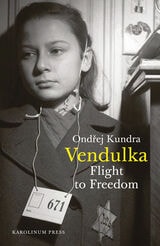
Vendulka
Flight to FreedomOndrej Kundra
Karolinum Press, 2021
Famed Czech photographer Jan Lukas snapped an offhand portrait of twelve-year-old Vendulka Vogl in March 1943. A friend of the Vogls, Lukas was saying goodbye to the family, who were soon to leave Prague for a concentration camp. The photograph almost didn’t see the light of day—Lukas knew that if the Nazis found it on him, he could wind up in the camps as well—but the image was eventually developed and came to symbolize the Holocaust and humanize its victims. Seventy years after this famous picture was taken, investigative journalist Ondřej Kundra discovered that, despite all odds, Vendulka Vogl had survived the camps of Terezín, Auschwitz, and Christianstadt, and was in fact still alive and living in the United States. Kundra persuaded her to tell the remarkable story surrounding the photograph: her survival, her later decision to flee the Communist regime for America, and how she later reconnected with Jan Lukas, maintaining a lifelong friendship.
Vogl’s thrillingly moving story, Kundra’s sharp and engaging writing, and Lukas’s striking photography all combine to make Vendulka an inspiring investigation into the horrors of totalitarianism and the redemptive beauty of friendship.
Why Don't Jumbo Jets Flap Their Wings?
Flying Animals, Flying Machines, and How They Are DifferentDavid E. Alexander
Rutgers University Press, 2009
Why Don’t Jumbo Jets Flap Their Wings? offers a fascinating explanation of how nature and human engineers each arrived at powered flight. What emerges is a highly readable account of two very different approaches to solving the same fundamental problems of moving through the air, including lift, thrust, turning, and landing. The book traces the slow and deliberate evolutionary process of animal flight—in birds, bats, and insects—over millions of years and compares it to the directed efforts of human beings to create the aircraft over the course of a single century.
Among the many questions the book answers:
- Why are wings necessary for flight?
- How do different wings fly differently?
- When did flight evolve in animals?
- What vision, knowledge, and technology was needed before humans could learn to fly?
- Why are animals and aircrafts perfectly suited to the kind of flying they do?
David E. Alexander first describes the basic properties of wings before launching into the diverse challenges of flight and the concepts of flight aerodynamics and control to present an integrated view that shows both why birds have historically had little influence on aeronautical engineering and exciting new areas of technology where engineers are successfully borrowing ideas from animals.
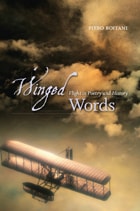
Winged Words
Flight in Poetry and HistoryPiero Boitani
University of Chicago Press, 2007
Flight has always fascinated human minds, but until a century ago it remained a dream—the exclusive domain of birds, gods, and mythological heroes. From the myths of the ancients to the poetry of Pindar and Yeats, Winged Words traces the imprint of the human impulse to fly from premodern times to the age of terrorism in both literature and history.
Piero Boitani begins his analysis with an account of the way the myths of Pegasus and Icarus have persisted from classical to twentieth-century politics and literature. He then takes up the figure of Hermes; the roles of halcyons and eagles in classical, biblical, and later literatures; and literary response to Pieter Brueghel’s The Fall of Icarus. Honing in on modern figures and concerns, Boitani also offers a fascinating discussion of author-pilot Antoine de Saint-Exupéry and concludes with a meditation on the flight of the hijacked airliners on 9/11. Throughout, Winged Word brings a remarkable range of men of action, politicians, theologians, writers, and artists into dialogue with each other: Shakespeare with T. S. Eliot, Horace with Ovid, Leonardo with Milton, Leopardi with Mallarmé, Saint-Exupéry with Faulkner and Rilke, and the Ulysses of Homer with the Ulysses of Dante. Ultimately, by showing how writers and fliers have looked to the ancients for inspiration, Boitani testifies to the modern relevance of poetry and the classics.