Results by title
15 books match the query 'Flusser, Vilém'
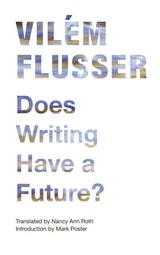
Does Writing Have a Future?
Vilém Flusser
University of Minnesota Press, 2010
Confirming Flusser’s status as a theorist of new media in the same rank as Marshall McLuhan, Jean Baudrillard, Paul Virilio, and Friedrich Kittler, the balance of this book teases out the nuances of these developments. To find a common denominator among texts and practices that span millennia, Flusser looks back to the earliest forms of writing and forward to the digitization of texts now under way. For Flusser, writing—despite its limitations when compared to digital media—underpins historical consciousness, the concept of progress, and the nature of critical inquiry. While the text as a cultural form may ultimately become superfluous, he argues, the art of writing will not so much disappear but rather evolve into new kinds of thought and expression.

Generations
Vilém Flusser
University of Minnesota Press, 2027
A vision of modern humanity trapped inside the system it has created
Written in the 1960s and unpublished until 2017, Generations is Vilém Flusser’s largest work and the foundation for many of his later theories on media and post-history. In this ambitious study of the Modern Age, Flusser traces a devastating shift in Western civilization that ultimately leads to the modern “apparatus”: the impersonal, cybernetic system of self-programmed objectification that has become our reality.
Flusser presents history as a recurring struggle between generations, with each new generation overturning the values of the former and eventually drifting into a state of existential avoidance. This cycle becomes the basis for a powerful diagnosis of the modern condition. Flusser identifies a critical shift toward self-worship and collective will in humanity’s understanding of progress and divinity during the Renaissance. This shift foregrounded our path toward an automated world driven by apathetic functionaries serving the apparatus and widespread fascist irrationalism, catastrophically realized during the Holocaust.
With surprising relevance to the digital present that gradually empties the world of its grounded reality, Generations offers a striking account of humanity’s relationship to technology, algorithms, and systems of control. Flusser’s concept of the “apparatus” anticipates the modern experience of being shaped by social media, bureaucratic systems, and oppressive technologies. Arguing that contemporary humanity exists in a state of slow existential stagnation rather than dramatic apocalypse, the book asks and answers a pressing question: how did we get here?
Retail e-book files for this title are screen-reader friendly.

Gestures
Vilém Flusser
University of Minnesota Press, 2014
Throughout his career, the influential new media theorist Vilém Flusser kept the idea of gesture in mind: that people express their being in the world through a sweeping range of movements. He reconsiders familiar actions—from speaking and painting to smoking and telephoning—in terms of particular movement, opening a surprising new perspective on the ways we share and preserve meaning. A gesture may or may not be linked to specialized apparatus, though its form crucially affects the person who makes it.
These essays, published here as a collection in English for the first time, were written over roughly a half century and reflect both an eclectic array of interests and a durable commitment to phenomenological thought. Defining gesture as “a movement of the body or of a tool attached to the body for which there is no satisfactory causal explanation,” Flusser moves around the topic from diverse points of view, angles, and distances: at times he zooms in on a modest, ordinary movement such as taking a photograph, shaving, or listening to music; at others, he pulls back to look at something as vast and varied as human “making,” embracing everything from the fashioning of simple tools to mass manufacturing. But whatever the gesture, Flusser analyzes it as the expression of a particular form of consciousness, that is, as a particular relationship between the world and the one who gestures.
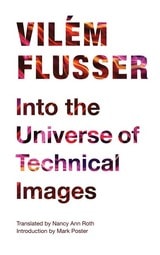
Into the Universe of Technical Images
Vilém Flusser
University of Minnesota Press, 2010
Flusser charts how communication evolved from direct interaction with the world to mediation through various technologies. The invention of writing marked one significant shift; the invention of photography marked another, heralding the current age of the technical image. The automation of the processing of technical images carries both promise and threat: the promise of freeing humans to play and invent and the threat for networks of automation to proceed independently of humans.
Natural
MindVilém Flusser
University of Minnesota Press, 2013
In Natural:Mind, published for the first time in São Paulo, Brazil, in 1979, Vilém Flusser investigates the paradoxical connection between the concepts of nature and culture through a lively para-phenomenological analysis of natural and cultural phenomena. Can culture be considered natural and nature cultural? If culture is our natural habitat then do we not inhabit nature? These are only some of the questions that are raised in Natural:Mind in order to examine our continual redefinition of both terms and what that means for us existentially.
Always applying his fluid and imagistic Husserlian style of phenomenology, Flusser explores different perspectives and relations of items from everyday life. The book is composed of a series of essays based on close observations of familiar objects such as paths, valleys, cows, meadows, trees, fingers, grass, the moon, and buttons. By focusing on things we mostly take for granted, he manages not only to reveal some aspects of their real and obscured nature but also to radically change how we look at them. The ordinary cow will never be seen in the same way again.
Natural
MindVilém Flusser
University of Minnesota Press, 2027
Philosophical reflections on the relations between nature and culture
In Natural:Mind, published for the first time in São Paulo, Brazil, in 1979, Vilém Flusser investigates the paradoxical connection between the concepts of nature and culture through a lively para-phenomenological analysis of natural and cultural phenomena. Can culture be considered natural and nature considered cultural? If culture is our natural habitat then do we not inhabit nature? These are only some of the questions that are raised in Natural:Mind in order to examine our continual redefinition of both terms and what that means for us existentially.
Always applying his fluid and imagistic Husserlian style of phenomenology, Flusser explores different perspectives and relations of items from everyday life. The book is composed of a series of essays based on close observations of familiar objects such as paths, valleys, cows, meadows, trees, fingers, grass, the moon, and buttons. By focusing on things we mostly take for granted, he manages not only to reveal some aspects of their real and obscured nature but also to radically change how we look at them. The ordinary cow will never be seen in the same way again.

On Doubt
Vilém Flusser
University of Minnesota Press, 2014
In On Doubt, Vilém Flusser refines Martin Heidegger’s famous declaration that “language is the dwelling of Being.” For Flusser, “the word is the dwelling of being,” because in fact, in the beginning, there was the word.
On Doubt is a treatise on the human intellect, its relation to language, and the reality-forming discourses that subsequently emerge. For Flusser, the faith that the modern age places in Cartesian doubt plays a role similar to the one that faith in God played in previous eras—a faith that needs to be challenged. Descartes doubts the world through his proposition cogito ergo sum, but leaves doubt itself untouched as indubitable and imperious. His cogito ergo sum may have proved to the Western intellect that thoughts exist, but it did not prove the existence of that which thinks: one can eliminate thinking and yet continue being.
Therefore, should we not doubt doubt itself? Should we not try to go beyond this last step of Cartesian doubt and look for a new faith? The twentieth century has seen many attempts to defeat Cartesian doubt, however, this doubt of doubt has instead generated a complete loss of faith, which the West experiences as existential nihilism. Hence, the emergent emptying of values that results from such extreme doubt. Everything loses its meaning. Can this climate be overcome? Will the West survive the modern age?
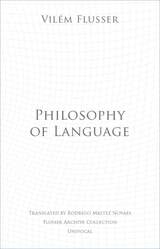
Philosophy of Language
Vilém Flusser
University of Minnesota Press, 2016
In 1963 Vilém Flusser presented a series of lectures at the Brazilian Institute of Philosophy (IBF) in São Paulo concerning the philosophy of language. The resulting ten essays would eventually be published in 1965 in the annual magazine of the Brazilian Institute of Technology and Aeronautics (ITA), and published here for the first time in book form.
Flusser prepared each lecture as a response to the dialogs that followed the preceding lecture, thereby expanding and explicating his philosophy of language in an intense dialogical process. Despite the fact that the other side of the dialogue was not recorded, it becomes clear to the reader that the resulting discussions and polemics generated by the lectures progressively and profoundly changed Flusser’s intended trajectory for the course. This kind of philosophy in fieri was in part the result of a group effort between all of those present, and subsequently synthesized by Flusser in every essay. As a result of this experience, Flusser adopted this dialogic method as an integral part of his future work.
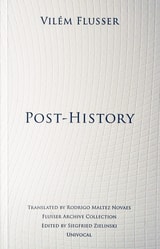
Post-History
Vilém Flusser
University of Minnesota Press, 2013
Is there any room left for freedom in a programmed world? This is the essential question that Vilém Flusser asks in Post-History. Written as a series of lectures to be delivered at universities in Brazil, Israel, and France, it was subsequently developed as a book and published for the first time in Brazil in 1983. This first English translation of Post-History brings to an anglophone readership Flusser’s first critique of apparatus as the aesthetic, ethical, and epistemological model of present times.
In his main argument, Flusser suggests that our times may be characterized by the term “program,” much in the same way that the seventeenth century is loosely characterized by the term “nature,” the eighteenth by “reason,” and the nineteenth by “progress.” In suggesting this shift in worldview, he then poses a provocative question: If I function within a predictable programmed reality, can I rebel and how can I do it? The answer comes swiftly: Only malfunctioning programs and apparatus allow for freedom.
Throughout the twenty essays of Post-History, Flusser reminds us that any future theory of political resistance must consider this shift in worldview, together with the horrors that Western society has brought into realization because of it. Only then may we start to talk again about freedom.

Shape of Things
A Philosophy of DesignVilém Flusser
Reaktion Books, 1999

The History of the Devil
Vilém Flusser
University of Minnesota Press, 2014
In 1939, a young Vilém Flusser faced the Nazi invasion of his hometown of Prague. He escaped with his wife to Brazil, taking with him only two books: a small Jewish prayer book and Goethe’s Faust. Twenty-six years later, in 1965, Flusser would publish The History of the Devil, and it is the essence of those two books that haunts his own. From that time his life as a philosopher was born. While Flusser would later garner attention in Europe and elsewhere as a thinker of media culture, The History of the Devil is considered by many to be his first significant work, containing nascent forms of the main themes that would come to preoccupy him over the following decades.
In The History of the Devil, Flusser frames the human situation from a pseudo-religious point of view. The phenomenal world, or “reality” in a general sense, is identified as the “Devil,” and that which transcends phenomena, or the philosophers’ and theologians’ “reality,” is identified as “God.” Referencing Wittgenstein’s Tractatus Logico-Philosophicus in its structure, Flusser provocatively leads the reader through an existential exploration of nothingness as the bedrock of reality, where “phenomenon” and “transcendence,” “Devil” and “God” become fused and confused. So radically confused, in fact, that Flusser suggests we abandon the quotation marks from the terms “Devil” and “God.” At this moment of abysmal confusion, we must make the existential decisions that give direction to our lives.

The History of the Devil
Vilém Flusser
University of Minnesota Press, 2027
A fascinating exploration into the early work of the celebrated philosopher of media culture and technology, Vilém Flusser
In 1939, a young Vilém Flusser faced the Nazi invasion of his hometown of Prague. He escaped with his wife to Brazil, taking with him only two books: a small Jewish prayer book and Goethe’s Faust. Twenty-six years later, in 1965, Flusser would publish The History of the Devil, and it is the essence of those two books that haunts his own. From that time his life as a philosopher was born. While Flusser would later garner attention in Europe and elsewhere as a thinker of media culture, The History of the Devil is considered by many to be his first significant work, containing nascent forms of the main themes that would come to preoccupy him over the following decades.
In The History of the Devil, Flusser frames the human situation from a pseudo-religious point of view. The phenomenal world, or “reality” in a general sense, is identified as the “Devil,” and that which transcends phenomena, or the philosophers’ and theologians’ “reality,” is identified as “God.” Referencing Wittgenstein’s Tractatus Logico-Philosophicus in its structure, Flusser provocatively leads the reader through an existential exploration of nothingness as the bedrock of reality, where “phenomenon” and “transcendence,” “Devil” and “God” become fused and confused. So radically confused, in fact, that Flusser suggests we abandon the quotation marks from the terms “Devil” and “God.” At this moment of abysmal confusion, and of the downfall of all values, we must make the existential decisions that give direction to our lives.
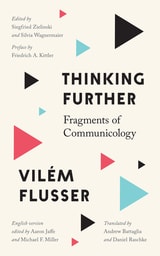
Thinking Further
Fragments of CommunicologyVilém Flusser
University of Minnesota Press, 2026
The first English-language translation of Vilém Flusser’s final series of lectures: the definitive introduction to his methods and ideas in new media theory
In summer 1991, shortly before his death, Vilém Flusser gave a series of lectures as guest professor at Ruhr University Bochum at the invitation of Friedrich Kittler. Flusser intended for these lectures to be the definitive introduction to his “communicology,” the study of human communication and the means by which acquired information is saved, processed, and passed on. In Thinking Further, Aaron Jaffe and Michael F. Miller have curated “fragments” from these lectures—first published in German in 2008—to present the most exciting and timely parts of Flusser’s foundational contributions to what is now known as media studies.
These fragments capture Flusser’s engagements with a wide range of theories, approaches, and interventions, including ecocriticism, posthumanities, game theory, cybernetics, and translinguistic exchanges. Offering sustained engagements with the ideas of Walter Benjamin, Michel Foucault, Michel Serres, and Jean Baudrillard, Thinking Further models possibilities for thinking through and clarifying the most obscure and obdurate implications of technology and modernity.
As they demonstrate Flusser’s contextual positionality and antiuniversalism, the writings presented here also underscore the pleasures and the power of his aphoristic style. Focusing less on Flusser-as-philosopher and more on his role as wry sage at the end of history, Thinking Further is a comprehensive but approachable introduction to his boundary-transcending exploration of the possibilities for communication, writing, and the human condition.
Retail e-book files for this title are screen-reader friendly.
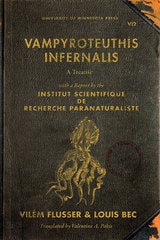
Vampyroteuthis Infernalis
A Treatise, with a Report by the Institut Scientifique de Recherche ParanaturalisteVilém Flusser
University of Minnesota Press, 2012
How far apart are humans from animals—even the “vampire squid from hell”? Playing the scientist/philosopher/provocateur, Vilém Flusser uses this question as a springboard to dive into a literal and a philosophical ocean. “The abyss that separates us” from the vampire squid (or vampire octopus, perhaps, since Vampyroteuthis infernalis inhabits its own phylogenetic order somewhere between the two) “is incomparably smaller than that which separates us from extraterrestrial life, as imagined in science fiction and sought by astrobiologists,” Flusser notes at the outset of the expedition.
Part scientific treatise, part spoof, part philosophical discourse, part fable, Vampyroteuthis Infernalis gives its author ample room to ruminate on human—and nonhuman—life. Considering the human condition along with the vampire squid/octopus condition seems appropriate because “we are both products of an absurd coincidence . . . we are poorly programmed beings full of defects,” Flusser writes. Among other things, “we are both banished from much of life’s domain: it into the abyss, we onto the surfaces of the continents. We have both lost our original home, the beach, and we both live in constrained conditions.”
Thinking afresh about the life of an “other”—as different from ourselves as the vampire squid/octopus—complicates the linkages between animality and embodiment. Odd, and strangely compelling, Vampyroteuthis Infernalis offers up a unique posthumanist philosophical understanding of phenomenology and opens the way for a non-philosophy of life.
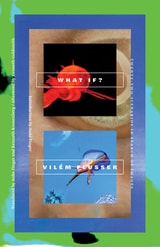
What If?
Twenty-Two Scenarios in Search of ImagesVilém Flusser
University of Minnesota Press, 2022
An imagination of possibilities, of miscalculations, of futures off-kilter
“Probability is a chimera, its head is true, its tail a suggestion. Futurologists attempt to compel the head to eat the tail (ouroboros). Here, though, we will try to wag the tail.” —Vilém Flusser
Two years after his Vampyroteuthis Infernalis, the philosopher Vilém Flusser engaged in another thought experiment: a collection of twenty-two “scenarios for the future” to be produced as computer-generated media, or technical images, that would break the imaginative logjam in conceiving the social, political, and economic future of the universe. What If? is not just an “impossible journey” to which Flusser invites us in the first scenario; it functions also as a distorting mirror held up to humanity.
Flusser’s disarming scenarios of an Anthropocene fraught with nightmares offer new visions that range from the scientific to the fantastic to the playful and whimsical. Each essay reflects our present sense of understanding the world, considering the exploitation of nature and the dangers of global warming, overpopulation, and blind reliance on the promises of scientific knowledge and invention. What If? offers insight into the radical futures of a slipstream Anthropocene that have much to do with speculative fiction, with Flusser’s concept of design as “crafty” or slippery, and with art and the immense creative potential of failure versus reasonable, “good” computing or calculability. As such, the book is both a warning and a nudge to imagine what we may yet become and be.