Results by title
5 books match the query 'Fog'
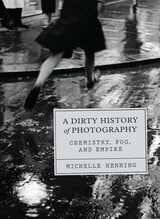
A Dirty History of Photography
Chemistry, Fog, and EmpireMichelle Henning
University of Chicago Press, 2025
Dependent on the extractive practices of fossil-fueled industrial capitalism, chemical photography’s emulsions and films were highly sensitive to polluted atmospheres, and photographic companies had to work hard to control this sensitivity. Drawing on histories of empire, coal, and chemistry and from the archives of British photographic manufacturer Ilford Limited, Michelle Henning exposes the ways photography shaped how we see and understand the atmosphere while leaving its toxic residues in the air, soil, and water.
Structured as thirty-six short chapters and with over seventy illustrations, this innovative book begins in interwar London, follows the supply of Ilford products to photographers on the West African coast, and considers photography as a military technology linked to the development of chemical warfare. Combining close readings of photographs with discussions of low-light, tropical, and aerial photography, Henning examines the extraction and development of photographic materials, their role in the current environmental crisis, and how they have shaped experiences of time and the environment.
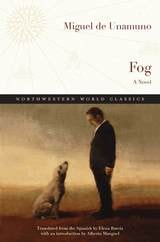
Fog
A NovelMiguel de Unamuno, Translated from the Spanish by Elena Barcia with an introduction by Alberto Manguel
Northwestern University Press, 2017
The novel’s central character, Augusto, is a pampered, aimless young man who falls in love with Eugenia, a woman he randomly spots on the street. Augusto’s absurd infatuation offers an irresistible target for the philosophical ruminations of Unamuno’s characters, including Eugenia’s guardian aunt and “theoretical anarchist” uncle, Augusto’s comical servants, and his best friend, Victor, an aspiring writer who introduces him to a new, groundbreaking type of fiction. In a desperate moment, Augusto consults his creator about his fate, arguing with Unamuno about what it means to be “real.” Even Augusto’s dog, Orfeo, offers his canine point of view, reflecting on the meaning of life and delivering his master’s funeral oration.
Fog is a comedy, a tragic love story, a work of metafiction, and a novel of ideas. After more than a century, Unamuno’s classic novel still moves us, makes us laugh, and invites us to question our assumptions about literature, relationships, and mortality.
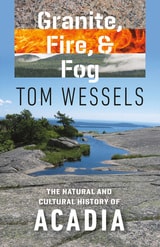
Granite, Fire, and Fog
The Natural and Cultural History of AcadiaTom Wessels
University Press of New England, 2017
Lifting the Fog of Peace
How Americans Learned to Fight Modern WarJanine Davidson
University of Michigan Press, 2011
"Lifting the Fog of Peace is a captivating study of an agile and adaptive military evolving through the chaos of the post-9/11 world. In what is certain to be regarded as the definitive analysis of the reshaping of American combat power in the face of a complex and uncertain future, Dr. Janine Davidson firmly establishes herself as a rising intellectual star in government and politics. A thoroughly captivating study of organizational learning and adaptation—a 'must read' for leaders in every field."
---LTG William B. Caldwell, IV, Commanding General, NATO Training Mission - Afghanistan
"In Lifting the Fog of Peace, Dr. Janine Davidson explains how the American military has adapted itself to succeed in the wars in Afghanistan and Iraq that are the most likely future face of combat. The book is informed by her experience of these wars in the Department of Defense, where she now plays a critical role in continuing the process of learning that has so visibly marked the military's performance in today's wars. Highly recommended."
---John A. Nagl, President, Center for a New American Security
"Janine Davidson’s Lifting the Fog of Peace is a superb, concise, and well-written book that makes important contributions in three areas. It advances our knowledge of organizational learning in the Armed Forces. It also accurately captures the rich post-Vietnam operational and doctrinal history of the Army and the Marine Corps. The simplistic cartoon of dim-witted generals fixated on the Fulda Gap is replaced here by a more accurate version, where engaged senior officers studied the security environment, absorbed important lessons, and began to improve the learning capacity of the military services. Finally, Lifting the Fog of Peace assesses the state of contemporary stability operations and what must be done to further prepare our Armed Forces for modern war on the low end of the spectrum of conflict. It will be a 'must read' on the E-Ring of the Pentagon and in security studies programs across the nation."
---Joseph J. Collins, Professor, National War College, and former Deputy Assistant Secretary of Defense for Stability Operations
Counterinsurgency and stability operations in Iraq and Afghanistan are only the most recent examples of the U.S. Armed Forces fighting insurgents, building infrastructure, enforcing laws, and governing cities. For more than two centuries, these assignments have been a regular part of the military's tasks; yet until recently the lessons learned from the experiences have seldom been formally incorporated into doctrine and training. As a result, each generation of soldiers has had to learn on the job.
Janine Davidson traces the history of the U.S. military's involvement in these complex and frustrating missions. By comparing the historical record to the current era, Davidson assesses the relative influence of organizational culture and processes, institutional structures, military leadership, and political factors on the U.S. military's capacity to learn and to adapt. Pointing to the case of Iraq, she shows that commanders serving today have benefited at the tactical level from institutional changes following the Vietnam War and from the lessons of the 1990s. Davidson concludes by addressing the question of whether or not such military learning, in the absence of enhanced capabilities and capacity in other U.S. government agencies, will be sufficient to meet the complex challenges of the 21st century.
Janine Davidson, a former Air Force pilot, is a professor of national security at George Mason University, currently serving in the Pentagon as Deputy Assistant Secretary of Defense for Plans.
The views presented in this book are those of the author and do not necessarily represent the views of the Department of Defense or its Components.
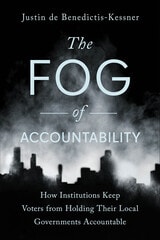
The Fog of Accountability
How Institutions Keep Voters from Holding Their Local Governments AccountableJustin de Benedictis-Kessner
University of Chicago Press, 2026
An astute, data-rich examination of the structural reasons that elections fail to hold US city officials accountable.
In the United States, hundreds of thousands of elected and appointed officials serve more than 50,000 subnational governments, making important decisions about services ranging from education to infrastructure to policing. The provision of critical city services shapes citizens’ everyday lives.
Supposedly, local politicians are the elected representatives closest to the people they serve, but are they actually accountable to their constituents? Justin de Benedictis-Kessner shows that they are not: local elections routinely fail to punish bad politicians or reward strong performers. The Fog of Accountability argues that this is because urban politics is defined by minimally effective competition, complex institutions that confuse voters, and a lack of effective media coverage. These institutional features combine to stymie even well-intentioned voters and make accountability difficult. Fixing these problems is challenging, but, as de Benedictis-Kessner shows, change is possible if we can enable citizens to reclaim and assert their political power.