Results by title
36 books match the query 'Folk'
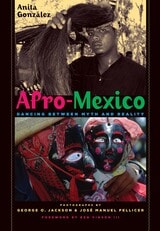
Afro-Mexico
Dancing between Myth and RealityBy Anita González
University of Texas Press, 2010
While Africans and their descendants have lived in Mexico for centuries, many Afro-Mexicans do not consider themselves to be either black or African. For almost a century, Mexico has promoted an ideal of its citizens as having a combination of indigenous and European ancestry. This obscures the presence of African, Asian, and other populations that have contributed to the growth of the nation. However, performance studies—of dance, music, and theatrical events—reveal the influence of African people and their cultural productions on Mexican society.
In this work, Anita González articulates African ethnicity and artistry within the broader panorama of Mexican culture by featuring dance events that are performed either by Afro-Mexicans or by other ethnic Mexican groups about Afro-Mexicans. She illustrates how dance reflects upon social histories and relationships and documents how residents of some sectors of Mexico construct their histories through performance. Festival dances and, sometimes, professional staged dances point to a continuing negotiation among Native American, Spanish, African, and other ethnic identities within the evolving nation of Mexico. These performances embody the mobile histories of ethnic encounters because each dance includes a spectrum of characters based upon local situations and historical memories.
An Illini Place
Building the University of Illinois CampusIncoronata Inserra
University of Illinois Press, 2017
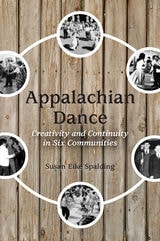
Appalachian Dance
Creativity and Continuity in Six CommunitiesSusan Eike Spalding
University of Illinois Press, 2014
Spalding analyzes how issues as disparate as industrialization around coal, plantation culture, race relations, and the 1970s folk revival influenced freestyle clogging and other dance forms like square dancing in profound ways. She reveals how African Americans and Native Americans, as well as European immigrants drawn to the timber mills and coal fields, brought movement styles that added to local dance vocabularies. Placing each community in its sociopolitical and economic context, Spalding analyzes how the formal and stylistic nuances found in Appalachian dance reflect the beliefs, shared understandings, and experiences of the community at large, paying particular attention to both regional and racial diversity.
Written in clear and accessible prose, Appalachian Dance is a lively addition to the literature and a bold contribution to scholarship concerned with the meaning of movement and the ever-changing nature of tradition.
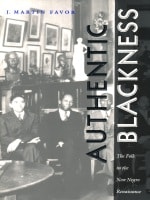
Authentic Blackness
The Folk in the New Negro RenaissanceJ. Martin Favor
Duke University Press, 1999
Authentic Blackness looks at the place of the “folk”—those African Americans “furthest down,” in the words of Alain Locke—and how the representation of the folk and the black middle class both spurred the New Negro Movement and became one of its most serious points of contention. Drawing on vernacular theories of African American literature from such figures as Henry Louis Gates Jr. and Houston Baker as well as theorists Judith Butler and Stuart Hall, Favor looks closely at the work of four Harlem Renaissance fiction writers: James Weldon Johnson, Nella Larsen, George Schuyler, and Jean Toomer. Arguing that each of these writers had, at best, an ambiguous relationship to African American folk culture, Favor demonstrates how they each sought to redress the notion of a fixed black identity. Authentic Blackness illustrates how “race” has functioned as a type of performative discourse, a subjectivity that simultaneously builds and conceals its connections with such factors as class, gender, sexuality, and geography.
Bells of Change
Kathak Dance, Women and Modernity In IndiaPallabi Chakravorty
Seagull Books, 2008
Caribbean and Atlantic Diaspora Dance
Igniting CitizenshipYvonne Daniel
University of Illinois Press, 2011

Chinese Dance
National Movements in a Revolutionary AgeLiangyu Fu & Emily Wilcox
Michigan Publishing Services, 2019
Choreographing the Folk
The Dance Stagings of Zora Neale HurstonAnthea Kraut
University of Minnesota Press, 2008
Recovers an important dimension of the work of the renowned African American artist
While Zora Neale Hurston and her 1937 novel Their Eyes Were Watching God have become widely celebrated, she was also a prolific stage director and choreographer. In the 1930s Hurston produced theatrical concerts that depicted a day in the life of a railroad work camp in Florida and featured a rousing Bahamian Fire Dance as the dramatic finale. In Choreographing the Folk, Anthea Kraut traces the significance and influence of Hurston’s little-known choreographic work.
Hurston’s concerts were concrete illustrations of the “real Negro art theatre” she was eager to establish, and they compellingly demonstrate how she used the arena of performance to advance a nuanced understanding of the black diaspora. Her version of the Fire Dance was staged in a variety of venues during the 1930s. In its multiple representations, Kraut asserts, the dance raised critical issues about ownership, artistry, and authenticity. Choreographing the Folk argues for the significance of Hurston’s choreography, and with perceptiveness, sensitivity, and originality, Kraut illuminates the important and often-contested place of black folk dance in American culture.
Conjuring the Folk
Forms of Modernity in African AmericaDavid G. Nicholls
University of Michigan Press, 2000
In a series of revisionary readings, Nicholls studies how the "folk" is shaped by the ideology of form. He examines the presence of a spectral "folk" in Toomer's modernist pastiche, Cane. He explores how Hurston presents folklore as a contemporary language of resistance in her ethnography, Mules and Men. In Claude McKay's naturalistic romance, Banana Bottom, Nicholls discovers the figuration of an alternative modernity in the heroine's recovery of her lost "folk" identity. He unearths the individualist ethos of Booker T. Washington in two novels by George Wylie Henderson. And he reveals how Richard Wright's photo-documentary history, 12 Million BlackVoices, places the "folk" in a Marxian narrative of modernization toward class-consciousness.
A provocative rereading of the cultural politics of the Harlem Renaissance, Conjuring the Folk offers a new way of understanding literary responses to migration, modernization, and the concept of the "folk" itself.
David G. Nicholls is a post-doctoral fellow in the Center for the Study of Race, Politics, and Culture, University of Chicago.
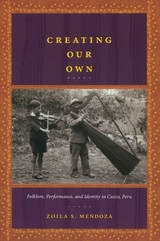
Creating Our Own
Folklore, Performance, and Identity in Cuzco, PeruZoila S. Mendoza
Duke University Press, 2007
Mendoza draws on early-twentieth-century newspapers and other archival documents as well as interviews with key artistic and intellectual figures and their descendants. She offers vivid descriptions of the Peruvian Mission of Incaic Art, a tour undertaken by a group of artists from Cuzco, at their own expense, to represent Peru to Bolivia, Argentina, and Uruguay in 1923–24, as well as of the origins in the 1920s of the Qosqo Center of Native Art, the first cultural institution dedicated to regional and national folkloric art. She highlights other landmarks, including both The Charango Hour, a radio show that contributed to the broad acceptance of rural Andean music from its debut in 1937, and the rise in that same year of another major cultural institution, the American Art Institute of Cuzco. Throughout, she emphasizes the intricate local, regional, national, and international pressures that combined to produce folkloric art, especially the growing importance of national and international tourism in Cuzco.
Please visit the Web site http://nas.ucdavis.edu/creatingbook for samples of the images and music discussed in this book.
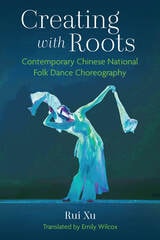
Creating with Roots
Contemporary Chinese National Folk Dance ChoreographyRui Xu
University of Michigan Press, 2025
Creating with Roots offers a detailed breakdown of key terms and concepts necessary for understanding Chinese national folk dance and analyzes 37 examples of choreography dating from the 1940s to 2000. The author situates these explanations within the longer history of cultural practice and theory in China and in relation to the international dance discourses of the former Soviet Union, Eastern Europe, Western Europe, and North America.

Dance and Authoritarianism
These Boots are Made for DancingAnthony Shay
Intellect Books, 2021
Using dance as a lens through which to study political, ethnic, and gendered phenomena, Anthony Shay shows us how dance and mass movement have served as important political tools throughout history and across a variety of authoritarian regimes. Dance and Authoritarianism is a significant and original contribution to the scholarship at the intersection of dance, ethnology, anthropology, cultural studies, and history.
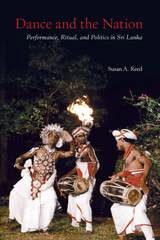
Dance and the Nation
Performance, Ritual, and Politics in Sri LankaSusan A. Reed
University of Wisconsin Press, 2010
As the national dance of Sri Lanka, Kandyan dance is identified with the majority Sinhala ethnic group and heavily supported by the state. Derived from the kohomba kankariya—an elaborate village ritual performed by men of the hereditary drummer caste—the dance was adopted by the state as a symbol of traditional Sinhala culture in the post-independence period. When state officials introduced the dance into the school curriculum, it was opened to individuals of all castes, and high-caste women have emerged as prominent teachers and performers. Reed’s evocative account traces the history and consequences of this transition from ritual to stage, situating the dance in relation to postcolonial nationalism and ethnic politics and emphasizing the voices and perspectives of the hereditary dancers and of women performers.
Although Kandyan dance is related to other south Asian dance forms, it is unique, distinguished by an elegant, energetic style, and lively displays of acrobatics and agility. The companion DVD includes unparalleled footage of this vibrant dance in ritual, stage, and training contexts, and features the most esteemed performers of the Kandyan region.
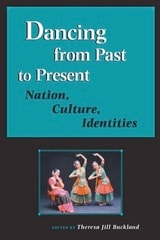
Dancing from Past to Present
Nation, Culture, IdentitiesEdited by Theresa Jill Buckland
University of Wisconsin Press, 2007
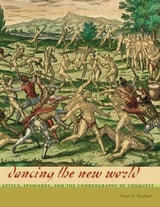
Dancing the New World
Aztecs, Spaniards, and the Choreography of ConquestBy Paul A. Scolieri
University of Texas Press, 2013
Winner, Oscar G. Brockett Book Prize in Dance Research, 2014
Honorable Mention, Sally Banes Publication Prize, American Society for Theatre Research, 2014
de la Torre Bueno® Special Citation, Society of Dance History Scholars, 2013
From Christopher Columbus to “first anthropologist” Friar Bernardino de Sahagún, fifteenth- and sixteenth-century explorers, conquistadors, clerics, scientists, and travelers wrote about the “Indian” dances they encountered throughout the New World. This was especially true of Spanish missionaries who intensively studied and documented native dances in an attempt to identify and eradicate the “idolatrous” behaviors of the Aztec, the largest indigenous empire in Mesoamerica at the time of its European discovery.
Dancing the New World traces the transformation of the Aztec empire into a Spanish colony through written and visual representations of dance in colonial discourse—the vast constellation of chronicles, histories, letters, and travel books by Europeans in and about the New World. Scolieri analyzes how the chroniclers used the Indian dancing body to represent their own experiences of wonder and terror in the New World, as well as to justify, lament, and/or deny their role in its political, spiritual, and physical conquest. He also reveals that Spaniards and Aztecs shared an understanding that dance played an important role in the formation, maintenance, and representation of imperial power, and describes how Spaniards compelled Indians to perform dances that dramatized their own conquest, thereby transforming them into colonial subjects. Scolieri’s pathfinding analysis of the vast colonial “dance archive” conclusively demonstrates that dance played a crucial role in one of the defining moments in modern history—the European colonization of the Americas.
Dissenting Through Dance
Folk Dance, Gender, and Political Protest in TurkeySevi Bayraktar
University of Michigan Press, 2026
Dissenting Through Dance examines how femme activists in contemporary Turkey deploy folk dance as a powerful tool of political resistance and collective solidarity. Drawing on extensive ethnographic fieldwork, choreographic analysis, and archival research, the book examines how traditional dances, particularly those rooted in marginalized cultures such as Kurdish, Roma, Alevi, Laz, and Hemşin communities, are reimagined to contest misogyny, cultural erasure, and oppressive gender politics. Sevi Bayraktar brings to life the stories of feminist, LGBTQ+, and grassroots activists occupying public spaces with dance as a form of protest when conventional forms of assembly are suppressed or criminalized in Turkey.
Working outward from these femmes’ stories, protests, and dances, Bayraktar argues that by reconfiguring Turkey’s folk-dance heritage for their contemporary political aims, dissenting femmes rechoreograph national space in opposition to the state as a way to reclaim the public sphere for pluralist democracy and to subvert hegemonic discourses about Turkish national identity, neoliberal economic development, and female and ethnic bodies. By moving together, activists subvert patriarchal norms, embody new visions of community, and create moments of hope, joy, and resistance even under conditions of surveillance and fear.

Ecomusicology
Rock, Folk, and the EnvironmentMark Pedelty
Temple University Press, 2012
Can musicians really make the world more sustainable? Anthropologist Mark Pedelty, joined an eco-oriented band, the Hypoxic Punks, to find out. In his timely and exciting book, Ecomusicology, Pedelty explores the political ecology of rock, from local bands to global superstars. He examines the climate change controversies of U2's 360 Degrees stadium tour—deemed excessive by some—and the struggles of local folk singers who perform songs about the environment. In the process, he raises serious questions about the environmental effects and meanings on music.
Ecomusicology examines the global, national, regional, and historical contexts in which environmental pop is performed. Pedelty reveals the ecological potentials and pitfalls of contemporary popular music, in part through ethnographic fieldwork among performers, audiences, and activists. Ultimately, he explains how popular music dramatically reflects both the contradictions and dreams of communities searching for sustainability.
Everynight Life
Culture and Dance in Latin/o AmericaCeleste Fraser Delgado and José Esteban Muñoz, eds.
Duke University Press, 1997
This anthology looks at many modes of dance—including salsa, merengue, cumbia, rumba, mambo, tango, samba, and norteño—as models for the interplay of cultural memory and regional conflict. Barbara Browning’s essay on capoeira, for instance, demonstrates how dance has been used as a literal form of resistance, while José Piedra explores the meanings conveyed by women of color dancing the rumba. Pieces such as Gustavo Perez Fírmat’s "I Came, I Saw, I Conga’d" and Jorge Salessi’s "Medics, Crooks, and Tango Queens" illustrate the lively scope of this volume’s subject matter.
Contributors. Barbara Browning, Celeste Fraser Delgado, Jane C. Desmond, Mayra Santos Febres, Juan Carlos Quintero Herencia, Josh Kun, Ana M. López, José Esteban Muñoz, José Piedra, Gustavo Perez Fírmat, Augusto C. Puleo, David Román, Jorge Salessi, Alberto Sandoval
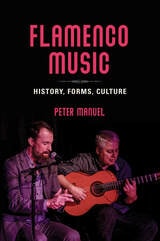
Flamenco Music
History, Forms, CulturePeter Manuel
University of Illinois Press, 2023
An iconic symbol of Spain, flamenco has become a global phenomenon. Peter Manuel offers English-language readers a rare portrait of the music’s history, styles, and cultural impact. Beginning with flamenco’s Moorish and Roma influences, Manuel follows the music’s evolution through its consolidation in the mid-1800s and on to the vibrant contemporary scene. An investigation of flamenco’s major song-types looks at rhythm and compás, guitar technique, and many other aspects of the music while Manuel’s description and analysis of the repertoire range from soleares and bulerías to tangos. His overview of contemporary flamenco culture provides insight into issues that surround the music, including globalization, gender dynamics, notions of ownership, and the ongoing debates on purity versus innovation and the relative roles played by Gitanos and non-Gitanos.
Multifaceted and entertaining, Flamenco Music is an in-depth study of the indelible art form that inspires enthusiasts and practitioners around the world.
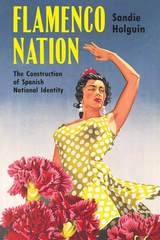
Flamenco Nation
The Construction of Spanish National IdentitySandie Holguín
University of Wisconsin Press, 2019
Holguín brings forth an important interplay between regional nationalists and image makers actively involved in building a tourist industry. Soon they realized flamenco performances could be turned into a folkloric attraction that could stimulate the economy. Tourists and Spaniards alike began to cultivate flamenco as a representation of the country's national identity. This study reveals not only how Spain designed and promoted its own symbol but also how this cultural form took on a life of its own.

Folklórico in the United States
Unwritten HistoriesEdited by Norma E. Cantú and Olga Nájera-Ramírez
University of Illinois Press, 2027
Multidimensional and enlightening, Folklórico in the United States expands our knowledge of a powerful and creative dance tradition central to Mexican Americans’ sense of self and community.
Contributors: Erica Acevedo-Ontiveros, Jenna Cortez-Aguirre, Manuel R. Cuellar, Alma Ixchel Flores-Pérez, Guadalupe Friaz, Ennio García-Miera, Javier Sepúlveda Garibay, Jacquelyn Y. Guzmán, Aida Hurtado, Cándida F. Jácquez, Gabriela Mendoza-García, Mona Lisa Montgomery, Cassondra Montoya, Felisa Patiño-Longoria, Cindy Padilla, Russell C. Rodriguez, Gema Sandoval, Sarahí Lay Trigo
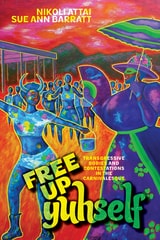
Free Up Yuhself
Transgressive Bodies and Contestations in the CarnivalesqueNikoli A. Attai
Rutgers University Press, 2025
Free Up Yuhself explores and theorizes what it means to embody and be empowered by the chaos of transgression, evaluating the implications for people who destabilize the Caribbean region’s dominant gender and sexuality politics within the Caribbean and the Caribbean diaspora. This book examines how people actively utilize the carnivalesque—spaces of festivity and places of excitement, the extraordinary, the ritualistic—to confront, negotiate, disrupt, and transgress normative trends, boundaries, and perspectives in the Caribbean and Caribbean diaspora communities. This book is particularly concerned with the ways that Caribbean people contest sexual and gendered expectations through their bodily performances across regional and diasporic festival spaces. Through illustrative, analytical, evaluative, and reflective chapters, the collection contemplates the themes of freedom, belonging, acceptance, and recognition as these affect the experience of people’s sense of being. The authors reflect on “freeing up” as a contentious politics, understanding that people have the capacity to enact their freedom through transgressive movements and performances that persistently grapple with notions of respectability, agency, empowerment, disruption, and the meanings and consequences of their varied social and political locations.
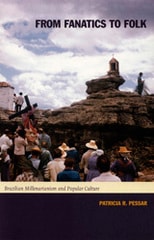
From Fanatics to Folk
Brazilian Millenarianism and Popular CulturePatricia R. Pessar
Duke University Press, 2004
Pessar combines cultural history spanning the colonial period to the present; comparative case studies of the Canudos, Contestado, Juazeiro, and Santa Brígida movements; and three decades of ethnographic research in the Brazilian Northeast. Highlighting the involvement of a broad range of individuals and institutions, the cross-fertilization between movements, contestation and accommodation vis-à-vis the church and state, and matters of spirituality and faith, From Fanatics to Folk reveals Brazilian millenarianism as long-enduring and constantly in flux.
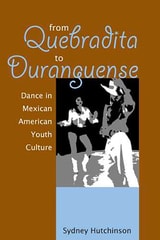
From Quebradita to Duranguense
Dance in Mexican American Youth CultureSydney Hutchinson
University of Arizona Press, 2007
Quebradita, meaning “little break,” is a modern Mexican American dance style that became hugely popular in Los Angeles and across the southwestern United States during the early to mid 1990s. Over the decade of its popularity, this dance craze offered insights into the social and cultural experience of Mexican American youth. Accompanied by banda, an energetic brass band music style, quebradita is recognizable by its western clothing, hat tricks, and daring flips. The dance’s combination of Mexican, Anglo, and African American influences represented a new sensibility that appealed to thousands of young people. Hutchinson argues that, though short-lived, the dance filled political and sociocultural functions, emerging as it did in response to the anti-immigrant and English-only legislation that was then being enacted in California. Her fieldwork and interviews yield rich personal testimony as to the inner workings of the quebradita’s aesthetic development and social significance. The emergence of pasito duranguense, a related yet distinct style originating in Chicago, marks the evolution of the Mexican American youth dance scene.
Like the quebradita before it, pasito duranguense has picked up the task of demonstrating the relevance of regional Mexican music and dance within the U.S. context.
Global Tarantella
Reinventing Southern Italian Folk Music and DancesIncoronata Inserra
University of Illinois Press, 2017
Graceful Resistance
How Capoeiristas Use Their Art for Activism and Community EngagementLauren Miller Griffith
University of Illinois Press, 2023
Capoeira began as a martial art developed by enslaved Afro-Brazilians. Today, the practice incorporates song, dance, acrobatics, and theatrical improvisation—and leads many participants into activism.
Lauren Miller Griffith’s extensive participant observation with multiple capoeira groups informs her ethnography of capoeiristas--both individuals and groups--in the United States. Griffith follows practitioners beyond their physical training into social justice activities that illuminate capoeira’s strong connection to resistance and subversion. As both individuals and communities of capoeiristas, participants march against racial discrimination, celebrate Martin Luther King Jr. Day and Juneteenth, organize professional clothing drives for job seekers, and pursue economic and environmental justice in their neighborhoods. For these people, capoeira becomes a type of serious leisure that contributes to personal growth, a sense of belonging, and an overall sense of self, while also imposing duties and obligations.
An innovative look at capoeira in America, Graceful Resistance reveals how the practicing of an art can catalyze action and transform communities.
Restaging the Past
Historical Pageants, Culture and Society in Modern BritainEdited by Angela Bartie, Linda Fleming, Mark Freeman, and Alexander Hutton
University College London, 2020
Pageants were community events, bringing people together in a shared celebration and performance of the past; they also involved many prominent novelists, professional historians, and other writers, and as a result were featured repeatedly in popular and highbrow literature. Although the pageant tradition has largely died out, the contributors argue that it deserves to be acknowledged as a key aspect of community history during a period of great social and political change—and, they show, because of its former prominence, some lingering signs of “pageant fever” can still be seen in Britain today.
Ring of Liberation
Deceptive Discourse in Brazilian CapoeiraJ. Lowell Lewis
University of Chicago Press, 1992
Capoeira originated in early slave culture and is practiced widely today by urban Brazilians and others. At once game, sport, mock combat, and ritualized performance, it involves two players who dance and "battle" within a ring of musicians and singers. Stunning physical performances combine with music and poetry in a form as expressive in movement as it is in word.
J. Lowell Lewis explores the convergence of form and content in capoeira. The many components and characteristics of this elaborate black art form—for example, competing genre frameworks and the necessary fusion of multiple modes of expression—demand, Lewis feels, to be given "body" as well as "voice." In response, he uses Peircean semiotics and recent work in discourse and performance theory to map the connections between physical, musical, and linguistic play in capoeira and to reflect on the general relations between semiotic systems and the creation and recording of cultural meaning.

Spirit and Folk
Jewish Mysticism and the Struggle for German NationhoodAmir Engel
University of Chicago Press, 2027
A study of the twentieth-century construction of a Jewish mystical tradition by German Jewish intellectuals.
For most of European history, the notion of Jewish spirituality was unthinkable—buried beneath a pervasive desire to understand Judaism as uniquely material and Christianity as uniquely spiritual. In Spirit and Folk, Amir Engel tells the story of how a group of Jewish intellectuals, seeking greater involvement in political life, worked to invent a mystical tradition for Judaism amid the existential crises of twentieth-century Germany.
Beginning with Martin Buber in 1900 and ending with Gershom Scholem in 1942, Engel traces the rich debate among thinkers both well-known and forgotten about the need to imagine and construct a uniquely Jewish mystical tradition from historical religious sources. This quest and the tradition that emerged, Engel argues, developed in response to one of the most volatile questions of the last century: can Jews be Germans? The invention of Jewish spirituality, Engel shows, was not only a religious innovation but also a political gambit—a demand to be accepted as equal contributors to the German national project.
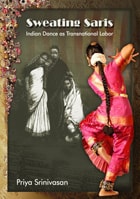
Sweating Saris
Indian Dance as Transnational LaborPriya Srinivasan
Temple University Press, 2011
A groundbreaking book that seeks to understand dance as labor, Sweating Saris examines dancers not just as aesthetic bodies but as transnational migrant workers and wage earners who negotiate citizenship and gender issues.
Srinivasan merges ethnography, history, critical race theory, performance and post-colonial studies among other disciplines to investigate the embodied experience of Indian dance. The dancers’ sweat stained and soaked saris, the aching limbs are emblematic of global circulations of labor, bodies, capital, and industrial goods. Thus the sweating sari of the dancer stands in for her unrecognized labor.
Srinivasan shifts away from the usual emphasis on Indian women dancers as culture bearers of the Indian nation. She asks us to reframe the movements of late nineteenth century transnational Nautch Indian dancers to the foremother of modern dance Ruth St. Denis in the early twentieth century to contemporary teenage dancers in Southern California, proposing a transformative theory of dance, gendered-labor, and citizenship that is far-reaching.
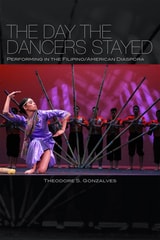
The Day the Dancers Stayed
Performing in the Filipino/American DiasporaTheodore S. Gonzalves
Temple University Press, 2009
Pilipino Cultural Nights at American campuses have been a rite of passage for youth culture and a source of local community pride since the 1980s. Through performances—and parodies of them—these celebrations of national identity through music, dance, and theatrical narratives reemphasize what it means to be Filipino American. In The Day the Dancers Stayed, scholar and performer Theodore Gonzalves uses interviews and participant observer techniques to consider the relationship between the invention of performance repertoire and the development of diasporic identification.
Gonzalves traces a genealogy of performance repertoire from the 1930s to the present. Culture nights serve several functions: as exercises in nostalgia, celebrations of rigid community entertainment, and occasionally forums for political intervention. Taking up more recent parodies of Pilipino Cultural Nights, Gonzalves discusses how the rebellious spirit that enlivened the original seditious performances has been stifled.
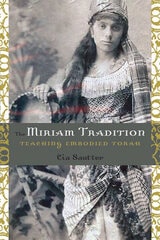
The Miriam Tradition
Teaching Embodied TorahCia Sautter
University of Illinois Press, 2010
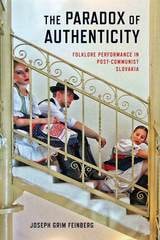
The Paradox of Authenticity
Folklore Performance in Post-Communist SlovakiaJoseph Grim Feinberg
University of Wisconsin Press, 2018
In Slovakia and elsewhere in Eastern Europe after World War II, Communist governments promoted folklore revivals and staged performances of song and dance as representations of "the people." When the Communists fell from power in Slovakia in 1989, folklore was also discredited in the eyes of many. By the early twenty-first century, however, a new generation launched a movement to revive folklore's reputation and reintroduce it to a broad public.
Weaving together personal narrative, ethnographic analysis, and philosophical reflection, Feinberg examines the aspirations and difficulties of young folk dance devotees as they recognize that authenticity is more easily prized than achieved. He sheds new light on the problems of specialized performance and broad participation, the uneasy relationship between folklore and the public sphere, and the paradoxical pursuit of authenticity in the modern world.

Under the Oaken Bough
Folk and Fairy TalesSimon Brooks
Parkhurst Brothers, Inc., 2017
Uncommon folktales and a few old favorites revived and retold for young people and tradition keepers. Folk and fairy tales celebrate different cultures and ways to see the world.
A collection of the author’s favorite folktales from his professional storytelling repertoire, retold in contemporary jargon for young reader, UNDER THE OAKEN BOUGH is an anthology which breathes new life into the folk and fairy tales of old. Professional storyteller, Simon Brooks, has written the stories he loves to tell in the style he uses on stage, whether at a library, school, college, private event or festival. Each story concludes with brief notes about the tale. This wonderful little book is a must have, not just for young people entering the realm of folk and fairy tales for themselves, but for parents who love to read to their children, teachers and librarians. The book includes a Q & A section with the author, a guide on how to tell stories, suggested reading, and a list of vocabulary words and their meanings. Half of the eighteen stories come from Europe, the remainder from the rest of the world. Some of these stories are old favorites, but inside you will find stories which can be hard to find, and seldom told. Join Simon Under the Oaken Bough and step into another realm, far, far away.
Uses of the Folk, Volume 2002
Karl Hagstrom Miller and Ellen Noonan, eds.
Duke University Press, 0
The essays explore a variety of incarnations of "the folk," from the contested meanings of folk dance in creating a national culture in twentieth-century Haiti and Nicaragua, to the ways that the London Museum’s collection of artifacts challenged early-twentieth-century British notions of gender, labor, and citizenship, to the production of urban folklore in New York City. The Uses of the Folk identifies folk culture of the past and present as an important site of ongoing struggle—one affecting all scholars who draw on folk or vernacular culture in their work.
Contributors. Adina Back, Jordanna Bailkin, Regina Bendix, Katherine Borland, Sally Charnow, Peggy P. Hargis, Georgina Hickey, John Howard, Shafali Lal, R. J. Lambrose, Ronald Radano, Kate Ramsey, Gerald Shenk, David Takacs, David Waldstreicher, Daniel Walkowitz, Steve Zeitlin
Zapotecs on the Move
Cultural, Social, and Political Processes in Transnational PerspectiveCruz-Manjarrez, Adriana
Rutgers University Press, 2013
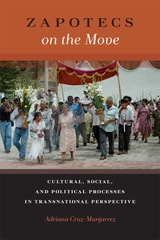
Based on multi-site fieldwork conducted over a five-year period, Adriana Cruz-Manjarrez analyzes how and why Yalálag Zapotec identity and culture have been reconfigured in the United States, using such cultural practices as music, dance, and religious rituals as a lens to bring this dynamic process into focus. By illustrating the sociocultural, economic, and political practices that link immigrants in Los Angeles to those left behind, the book documents how transnational migration has reflected, shaped, and transformed these practices in both their place of origin and immigration.