Results by title
10 books match the query 'Folk dancing'
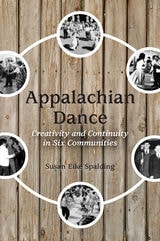
Appalachian Dance
Creativity and Continuity in Six CommunitiesSusan Eike Spalding
University of Illinois Press, 2014
Spalding analyzes how issues as disparate as industrialization around coal, plantation culture, race relations, and the 1970s folk revival influenced freestyle clogging and other dance forms like square dancing in profound ways. She reveals how African Americans and Native Americans, as well as European immigrants drawn to the timber mills and coal fields, brought movement styles that added to local dance vocabularies. Placing each community in its sociopolitical and economic context, Spalding analyzes how the formal and stylistic nuances found in Appalachian dance reflect the beliefs, shared understandings, and experiences of the community at large, paying particular attention to both regional and racial diversity.
Written in clear and accessible prose, Appalachian Dance is a lively addition to the literature and a bold contribution to scholarship concerned with the meaning of movement and the ever-changing nature of tradition.
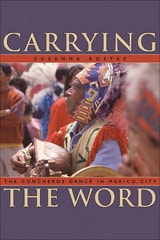
Carrying the Word
The Concheros Dance in Mexico CitySusanna Rostas
University Press of Colorado, 2009
The Concheros blend Catholic and indigenous traditions in their performances, but are not governed by a predetermined set of beliefs; rather they are bound together by long standing interpersonal connections framed by the discipline of their tradition. The Concheros manifest their spirituality by means of the dance. Rostas traces how they construct their identity and beliefs, both individual and communal, by its means. The book offers new insights into the experience of dancing as a Conchero while also exploring their history, organization and practices.
Carrying the Word provides a new way for audiences to understand the Conchero's dance tradition, and will be of interest to students and scholars of contemporary Mesoamerica. Those studying identity, religion, and tradition will find this social-anthropological work particularly enlightening.
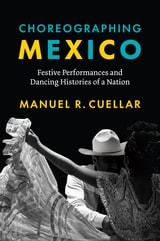
Choreographing Mexico
Festive Performances and Dancing Histories of a NationManuel R. Cuellar
University of Texas Press, 2022
2023 de la Torre Bueno® First Book Award, Dance Studies Association
The impact of folkloric dance and performance on Mexican cultural politics and national identity.
The years between 1910 and 1940 were formative for Mexico, with the ouster of Porfirio Díaz, the subsequent revolution, and the creation of the new state. Amid the upheaval, Mexican dance emerged as a key arena of contestation regarding what it meant to be Mexican. Through an analysis of written, photographic, choreographic, and cinematographic renderings of a festive Mexico, Choreographing Mexico examines how bodies in motion both performed and critiqued the nation.
Manuel Cuellar details the integration of Indigenous and regional dance styles into centennial celebrations, civic festivals, and popular films. Much of the time, this was a top-down affair, with cultural elites seeking to legitimate a hegemonic national character by incorporating traces of indigeneity. Yet dancers also used their moving bodies to challenge the official image of a Mexico full of manly vigor and free from racial and ethnic divisions. At home and abroad, dancers made nuanced articulations of female, Indigenous, Black, and even queer renditions of the nation. Cuellar reminds us of the ongoing political significance of movement and embodied experience, as folklórico maintains an important and still-contested place in Mexican and Mexican American identity today.
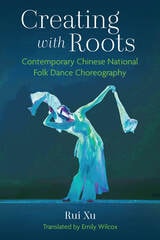
Creating with Roots
Contemporary Chinese National Folk Dance ChoreographyRui Xu
University of Michigan Press, 2025
Creating with Roots offers a detailed breakdown of key terms and concepts necessary for understanding Chinese national folk dance and analyzes 37 examples of choreography dating from the 1940s to 2000. The author situates these explanations within the longer history of cultural practice and theory in China and in relation to the international dance discourses of the former Soviet Union, Eastern Europe, Western Europe, and North America.
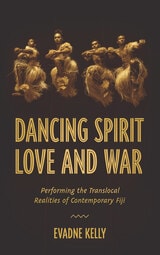
Dancing Spirit, Love, and War
Performing the Translocal Realities of Contemporary FijiEvadne Kelly
University of Wisconsin Press, 2022
Through extensive archival and ethnographic fieldwork in both Fiji and Canada, Kelly offers key insights into an underrepresented dance form, region, and culture. Her perceptive analysis of meke will be of interest in dance studies, postcolonial and Indigenous studies, anthropology and performance ethnography, and Pacific Island studies.
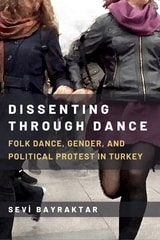
Dissenting Through Dance
Folk Dance, Gender, and Political Protest in TurkeySevi Bayraktar
University of Michigan Press, 2026
Dissenting Through Dance examines how femme activists in contemporary Turkey deploy folk dance as a powerful tool of political resistance and collective solidarity. Drawing on extensive ethnographic fieldwork, choreographic analysis, and archival research, the book examines how traditional dances, particularly those rooted in marginalized cultures such as Kurdish, Roma, Alevi, Laz, and Hemşin communities, are reimagined to contest misogyny, cultural erasure, and oppressive gender politics. Sevi Bayraktar brings to life the stories of feminist, LGBTQ+, and grassroots activists occupying public spaces with dance as a form of protest when conventional forms of assembly are suppressed or criminalized in Turkey.
Working outward from these femmes’ stories, protests, and dances, Bayraktar argues that by reconfiguring Turkey’s folk-dance heritage for their contemporary political aims, dissenting femmes rechoreograph national space in opposition to the state as a way to reclaim the public sphere for pluralist democracy and to subvert hegemonic discourses about Turkish national identity, neoliberal economic development, and female and ethnic bodies. By moving together, activists subvert patriarchal norms, embody new visions of community, and create moments of hope, joy, and resistance even under conditions of surveillance and fear.
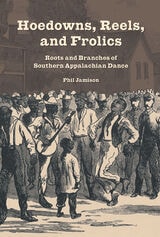
Hoedowns, Reels, and Frolics
Roots and Branches of Southern Appalachian DancePhil Jamison
University of Illinois Press, 2015
These distinctive folk dances, Jamison argues, are not the unaltered jigs and reels brought by early British settlers, but hybrids that developed over time by adopting and incorporating elements from other popular forms. He traces the forms from their European, African American, and Native American roots to the modern day. On the way he explores the powerful influence of black culture, showing how practices such as calling dances as well as specific kinds of steps combined with white European forms to create distinctly "American" dances.
From cakewalks to clogging, and from the Shoo-fly Swing to the Virginia Reel, Hoedowns, Reels, and Frolics reinterprets an essential aspect of Appalachian culture.
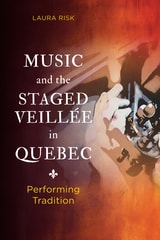
Music and the Staged Veillée in Quebec
Performing TraditionLaura Risk
University of Illinois Press, 2026
Fiddlers, step dancers, storytellers, traditional singers, and folklorists staged Montreal’s first veillée in 1919. All that was missing, announced one of the organizers, was a magic carpet to transport the audience into the countryside and a kiss of forgetfulness to erase the woes of modern life.
Laura Risk tells the story of the veillées and explores how these commercial performances of idealized rural life became part of Quebec’s cultural heritage. Her in-depth examinations of key performances and recordings follow traditional music and dance from the stage onto radio, records and other audio media, and television. Throughout, Risk documents how veillées redefined folklore in twentieth-century Quebec and illuminates how their distinctive framing of traditional musicians and repertoire impacts the performance and reception of the music to the present day.
Astute and evocative, Music and the Staged Veillée in Quebec reveals the music, dancing, call-and-response songs, and extramusical associations winding through century-long conversations about nation, culture, and identity in Quebec.
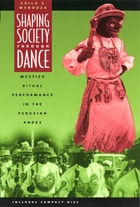
Shaping Society through Dance
Mestizo Ritual Performance in the Peruvian AndesZoila S. Mendoza
University of Chicago Press, 2000
In this fluid world, she argues, racial and ethnic identities are shaped more by notions of what is decent, elegant, and modern rather than by skin color or status. As the different troupes vie for the townspeople's recognition as the most "authentic" group, these notions are challenged and reworked. A fascinating look at a rich tradition, this innovative work is also a compelling example of the critical anthropology of performance.
The Performer-Audience Connection
Emotion to Metaphor in Dance and SocietyBy Judith Lynne Hanna
University of Texas Press, 1983
The Performer-Audience Connection is a pioneering foray into one of the major puzzles of human communication: the communication of emotion in dance. It is the first attempt of its kind systematically to investigate what performers wish to convey and what audiences perceive in the performance of dance.
The centerpiece of this provocative book is an examination of performer intentions and audience response at eight dance performances in Washington, D.C. Part of the Smithsonian Institution Division of Performing Arts Dance Series, these concerts featured a variety of dance genres and cultures: American tap dance, Kathakali dance-drama from Kerala, India, Japanese Kabuki, contemporary avant-garde dance, Philippine folk dance, the Indian classical tradition of Kuchipudi, and modern dance to an AfroAmerican spiritual.
How did dancer and audience interact at the emotional level on these eight occasions? What affected performer-audience rapport? Through interviews of both spectators and dancers, Judith Lynne Hanna explores the performers' ways of imparting emotion through movement and audience members' expectations and responses. In doing so she casts new light on important issues of cultural identity, sex role, historic attitudes toward dance, and even marketing the arts today.
A landmark work not only for performers who wish to reach their audiences more effectively but also for choreographers, anthropologists, specialists in nonverbal communication, behavioral scientists, educators, and all who are fascinated by the arts and the special magic of the "performer-audience connection."