Results by title
6 books match the query 'Folklore and history'
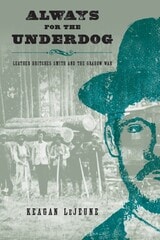
Always for the Underdog
Leather Britches Smith and the Grabow WarKeagan LeJeune
University of North Texas Press, 2010

Fiestas in Laredo
Matachines, Quinceañeras, and George Washington’s BirthdayNorma E. Cantú
University of North Texas Press, 2024
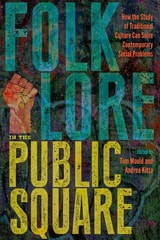
Folklore in the Public Square
How the Study of Traditional Culture Can Solve Contemporary Social ProblemsAndrea Kitta
Utah State University Press, 2026
Folklore is often positioned at the center of critical social issues. While folklorists have acknowledged this power and explored how folklore has been used for political ends, far less attention has been paid to the role folklorists and folklore scholarship can play in addressing contemporary social issues in public discourse. Folklore in the Public Square explores how folklorists apply their research to engage general audiences and address the challenging issues we face daily.
Folklore in the Public Square brings together folklorists working in the humanities and the social sciences committed to applying their research to help solve contemporary social challenges, formalizing an undercurrent of thought that has gained growing attention. Case studies apply ethical research to address pervasive questions about the environment, poverty, health and healthcare, political partisanship, war, tourism, stigma, racism, and conspiracy theories, among others. Building on conversations raised by folklorists who have contributed to public programming or conducted collaborative research in local communities, this book appeals to anyone interested in contemporary social issues, applied research, or collaborative and ethical fieldwork.
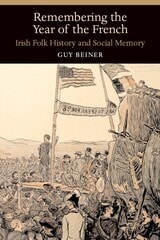
Remembering the Year of the French
Irish Folk History and Social MemoryGuy Beiner
University of Wisconsin Press, 2007
Beiner analyzes hundreds of hitherto unstudied historical, literary, and ethnographic sources. Though his focus is on 1798, his work is also a comprehensive study of Irish folk history and grass-roots social memory in Ireland. Investigating how communities in the West of Ireland remembered, well into the mid-twentieth century, an episode in the late eighteenth century, this is a “history from below” that gives serious attention to the perspectives of those who have been previously ignored or discounted. Beiner brilliantly captures the stories, ceremonies, and other popular traditions through which local communities narrated, remembered, and commemorated the past. Demonstrating the unique value of folklore as a historical source, Remembering the Year of the French offers a fresh perspective on collective memory and modern Irish history.
Winner, Wayland Hand Competition for outstanding publication in folklore and history, American Folklore Society
Finalist, award for the best book published about or growing out of public history, National Council on Public History
Winner, Michaelis-Jena Ratcliff Prize for the best study of folklore or folk life in Great Britain and Ireland
“An important and beautifully produced work. Guy Beiner here shows himself to be a historian of unusual talent.”—Marianne Elliott, Times Literary Supplement
“Thoroughly researched and scholarly. . . . Beiner’s work is full of empathy and sympathy for the human remains, memorials, and commemorations of past lives and the multiple ways in which they actually continue to live.”—Stiofán Ó Cadhla, Journal of British Studies
“A major contribution to Irish historiography.”—Maureen Murphy, Irish Literary Supplement
"A remarkable piece of scholarship . . . . Accessible, full of intriguing detail, and eminently teachable.”?—Ray Casman, New Hibernia Review
“The most important monograph on Irish history of the nineteenth and twentieth centuries to be published in recent years.”—Matthew Kelly, English Historical Review
“A strikingly ambitious work . . . . Elegantly constructed, lucidly written and inspired, and displaying an inexhaustible capacity for research”—Ciarán Brady, History IRELAND
“A closely argued, meticulously detailed and rich analysis . . . . providing such innovative treatment of a wide array of sources, his work will resonate with the concerns of many cultural and historical geographers working on social memory in quite different geographical settings and historical contexts.”—Yvonne Whelan, Journal of Historical Geography

Shared Traditions
SOUTHERN HISTORY AND FOLK CULTURECharles Joyner
University of Illinois Press, 1999
By examining the mutual influence of history and folk culture, Shared Traditions reveals the essence of southern culture in the complex and dynamic interactions of descendants of Europeans, Africans, and Native Americans. The book covers a broad spectrum of southern folk groups, folklore expressions, and major themes of southern history, including antebellum society, slavery, the coming of the Civil War, economic modernization in the Appalachians and the Sea Islands, immigration, the civil rights movement, and the effects of cultural tourism.
Joyner addresses the convergence of African and European elements in the Old South and explores how specific environmental and demographic features shaped the acculturation process. He discusses divergent practices in worship services, funeral and burial services, and other religious ceremonies. He examines links between speech patterns and cultural patterns, the influence of Irish folk culture in the American South, and the southern Jewish experience. He also investigates points of intersection between history and legend and relations between the new social history and folklore.
Ranging from rites of power and resistance on the slave plantation to the creolization of language to the musical brew of blues, country, jazz, and rock, Shared Traditions reveals the distinctive culture born of a sharing by black and white southerners of their deep-rooted and diverse traditions.
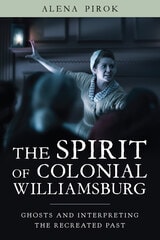
The Spirit of Colonial Williamsburg
Ghosts and Interpreting the Recreated PastAlena Pirok
University of Massachusetts Press, 2022
On any given night, hundreds of guests walk the darkened streets of Colonial Williamsburg looking for ghosts. Since the early 2000s, both the museum and private companies have facilitated these hunts, offering year-round ghost tours. Critics have called these excursions a cash grab, but in truth, ghosts and hauntings have long been at the center of the Colonial Williamsburg project.
The Spirit of Colonial Williamsburg examines how the long-dead past comes alive at this living-history museum. In the early twentieth century, local stories about the ghosts of former residents—among them Revolutionary War soldiers and nurses, tavern owners and prominent attorneys, and enslaved African Americans—helped to turn Williamsburg into a desirable site for historical restoration. But, for much of the twentieth century, the museum tried diligently to avoid any discussion of ghosts, considering them frivolous and lowbrow. Alena Pirok explores why historic sites have begun to embrace their spectral residents in recent decades, arguing that through them, patrons experience an emotional connection to place and a palpable understanding of the past through its people.