Results by title
3 books match the query 'Folklore and nationalism'
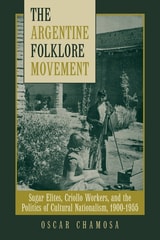
The Argentine Folklore Movement
Sugar Elites, Criollo Workers, and the Politics of Cultural Nationalism, 1900–1955Oscar Chamosa
University of Arizona Press, 2010
Oscar Chamosa brings forth the compelling story of an important but often overlooked component of the formation of popular nationalism in Latin America: the development of the Argentine folklore movement in the first part of the twentieth century. This movement involved academicians studying the culture of small farmers and herders of mixed indigenous and Spanish descent in the distant valleys of the Argentine northwest, as well as artists and musicians who took on the role of reinterpreting these local cultures for urban audiences of mostly European descent.
Oscar Chamosa combines intellectual history with ethnographic and sociocultural analysis to reconstruct the process by which mestizo culture—in Argentina called criollo culture—came to occupy the center of national folklore in a country that portrayed itself as the only white nation in South America. The author finds that the conservative plantation owners—the “sugar elites”—who exploited the criollo peasants sponsored the folklore movement that romanticized them as the archetypes of nationhood. Ironically, many of the composers and folk singers who participated in the landowner-sponsored movement adhered to revolutionary and reformist ideologies and denounced the exploitation to which those criollo peasants were subjected. Chamosa argues that, rather than debilitating the movement, these opposing and contradictory ideologies permitted its triumph and explain, in part, the enduring romanticizing of rural life and criollo culture, essential components of Argentine nationalism.
The book not only reveals the political motivations of culture in Argentina and Latin America but also has implications for understanding the articulation of local culture with national politics and entertainment markets that characterizes contemporary cultural processes worldwide today.
[more]
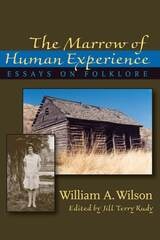
The Marrow of Human Experience
Essays on Folklore by William A. Wilsonedited by William A. Wilson and Jill Terry Rudy
Utah State University Press, 2006
Composed over several decades, the essays here are remarkably fresh and relevant. They offer instruction for the student just beginning the study of folklore as well as repeated value for the many established scholars who continue to wrestle with issues that Wilson has addressed. As his work has long offered insight on critical mattersn--nationalism, genre, belief, the relationship of folklore to other disciplines in the humanities and arts, the currency of legend, the significance of humor as a cultural expression, and so forth--so his recent writing, in its reflexive approach to narrative and storytelling, illuminates today's paradigms. Its notable autobiographical dimension, long an element of Wilson's work, employs family and local lore to draw conclusions of more universal significance. Another way to think of it is that newer folklorists are catching up with Wilson and what he has been about for some time. As a body, Wilson's essays develop related topics and connected themes. This collection organizes them in three coherent parts. The first examines the importance of folklore. What it is and its value in various contexts. Part two, drawing especially on the experience of Finland, considers the role of folklore in national identity, including both how it helps define and sustain identity and the less savory ways it may be used for the sake of nationalistic ideology. Part three, based in large part on Wilson's extensive work in Mormon folklore, which is the most important in that area since that of Austin and Alta Fife, looks at religious cultural expressions and outsider perceptions of them and, again, at how identity is shaped, by religious belief, experience, and participation; by the stories about them; and by the many other expressive parts of life encountered daily in a culture. Each essay is introduced by a well-known folklorist who discusses the influence of Wilson's scholarship. These include Richard Bauman, Margaret Brady, Simon Bronner, Elliott Oring, Henry Glassie, David Hufford, Michael Owen Jones, and Beverly Stoeltje.
[more]
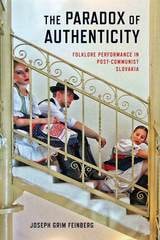
The Paradox of Authenticity
Folklore Performance in Post-Communist SlovakiaJoseph Grim Feinberg
University of Wisconsin Press, 2018
Observing the activities of urban folk dance enthusiasts in Slovakia, Joseph Grim Feinberg sets out to scrutinize the processes by which "authentic folklore" is identified, talked about, represented, reconstructed, reenacted, and revived.
In Slovakia and elsewhere in Eastern Europe after World War II, Communist governments promoted folklore revivals and staged performances of song and dance as representations of "the people." When the Communists fell from power in Slovakia in 1989, folklore was also discredited in the eyes of many. By the early twenty-first century, however, a new generation launched a movement to revive folklore's reputation and reintroduce it to a broad public.
Weaving together personal narrative, ethnographic analysis, and philosophical reflection, Feinberg examines the aspirations and difficulties of young folk dance devotees as they recognize that authenticity is more easily prized than achieved. He sheds new light on the problems of specialized performance and broad participation, the uneasy relationship between folklore and the public sphere, and the paradoxical pursuit of authenticity in the modern world.
[more]