Results by title
15 books match the query 'Folse, Keith S.'
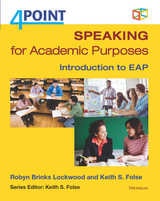
4 Point Speaking for Academic Purposes
Introduction to EAPRobyn Brinks Lockwood and Keith S. Folse
University of Michigan Press, 2017
The 4 Point series is designed for English language learners whose primary goal is to succeed in an academic setting. Academic English learners need skills-based books that focus on reading, listening, and speaking, as well as the two primary language bases of vocabulary and grammar. The ultimate goal is to help your students improve these skills and earn a 4.0 (GPA).
The Introduction to English for Academic Purposes (EAP) level is designed for students in academic programs who need a more general introduction to authentic academic content. The discrete skills volumes are designed for programs and courses that want to more intensively focus on key strategies and authentic academic content in one skill area.
Each 4 Point volume covers academic skills while providing reinforcement and systematic recycling of key vocabulary issues and further exposure to grammar issues. These volumes focus very heavily on vocabulary because language learners know that they are way behind their native-speaker counterparts when it comes to vocabulary. Each book highlights key vocabulary items, including individual words, compound words, phrasal verbs, short phrases, idioms, metaphors, collocations and longer set lexical phrases.
Speaking for Academic Purposes is an introductory textbook containing English for Academic Purposes content. Each unit includes activities to strengthen a range of speaking skills, notably: understanding classroom discourse, using academic language functions, recognizing signal words and phrases, and synthesizing information. These activities are presented within the context of one field of academic study (Architecture, Marketing, Earth Science, U.S. History, Chemistry, and Fine Arts) per unit.
Unique to this speaking text are six videos showing common student interactions. Access to the videos is free.
Each unit includes three academic speaking strategies (including one specific to making presentations) and tasks that involve participating in group discussions, interacting with native speakers, and making a presentation. The goal is to provide students with a variety of strategies/tools to master academic situations in which they need to participate.
A Practical Guide to Assessing English Language Learners
Christine Coombe, Keith Folse, and Nancy Hubley
University of Michigan Press, 2007
Tips to improve students’ test-taking strategies are offered, and each chapter ends with a helpful list of Ten Things to Remember, as well as informative case studies featuring two teachers and their assessment decisions. Incorporating its own principles, A Practical Guide to Assessing English Language Learners opens with a short quiz for the reader called Are You Testwise? that quickly determines how each teacher will benefit from this indispensable guide.
Academic Word Lists
What Every Teacher Needs to KnowKeith S. Folse
University of Michigan Press, 2020
Clear Grammar 2, 2nd Edition
Keys to Grammar for English Language LearnersKeith S. Folse
University of Michigan Press, 2012
Clear Grammaris a four-level grammar series that features a unique combination of useful grammar information written in clear language with activities that promote more accurate and fluent vocabulary usage, writing, speaking, and reading.
Important features of all four new editions of Clear Grammarinclude:
- More user-friendly charts to accompany grammar explanations
- High-frequency, corpus-based vocabulary related to each grammar point
- Grammar discovery tasks using students’ inductive learning skills
- A greater variety and increased number of activities, including more practice online
- Many more activities at the longer discourse level
- The addition of reading practice at the end of the unit, as well a critical-reading task
- More writing practice, including one on editing student writing and another for original student writing
- Two vocabulary practice activities, including a focus on collocations, in each unit, as well as many one-minute mini lessons showing the connection between grammar and vocabulary
- More speaking practice, with activities that require students to speak and listen to each other while using the target grammar
Support for teachers in the form of indicators that reference how to teach the grammar points in the Clear Grammar series from Keys to Teaching Grammar for English Language Learners by Keith S. Folse (978-0-472-03220-4).
Clear Grammar 2offers students and teachers a solid introduction to low-intermediate grammar.
Clear Grammar 2, 2nd Ed., includes
* Articles
* Past tense of irregular verbs
* Present perfect tense
* Adverbs of frequency
* Nouns used as adjectives
* Object pronouns
* Past progressive tense
* One and Other
* Possessives
*Comparatives and superlatives
*Modals
The book's companion website includes the additional grammar/vocabulary activities that are referenced in the textbook.
Clear Grammar 3, 2nd Edition
Keys to Grammar for English Language LearnersKeith S. Folse
University of Michigan Press, 2015
Clear Grammar 3 introduces high-intermediate grammar. Clear Grammar 3, 2nd Ed., includes
- phrasal verbs
- infinitives and gerunds
- participial adjectives: -ing and -ed
- prepositions after verbs, adjectives, and nouns
- passive voice
- adjective clauses
- adverbs
- connectors
- review of verb tenses
Clear Grammar 3 concludes with a review of this volume’s contents of high-intermediate grammar points.
Clear Grammar is a four-level grammar series that features a unique combination of useful grammar information written inclearlanguage with activities that promote more accurate and fluent writing, speaking, reading, and vocabulary usage. Important features of the new editions of Clear Grammar include:
- More user-friendly charts to accompany grammar explanations
- High-frequency, corpus-informed vocabulary related to each grammar point
- Grammar discovery tasks using students’ inductive learning skills
- A greater variety and more activities, including practice online (www.press.umich.edu/esl/compsite/cleargrammar/)
- Many more activities at the longer discourse level
- The addition of reading practice at the end, plus a critical-reading task
- More writing practice, including one on editing student writing and another for original student writing
- Two vocabulary practice activities per unit, with one on collocations; plus many one-minute lessons showing the connection between grammar and vocabulary
- More speaking practice, with activities that require students to speak and listen to each other while using the target grammar
- Support for teachers in the form of indicators that reference how to teach the grammar points in the Clear Grammar series from Keys to Teaching Grammar for English Language Learners by Keith S. Folse (978-0-472-03220-4).
Clear Grammar 4, 2nd Edition
Keys to Advanced ESL GrammarKeith S. Folse, Deborah Mitchell, Barbara Smith-Palinkas, and Donna Tortorella
University of Michigan Press, 2013
Clear Grammar 4 introduces advanced grammar. Clear Grammar 4, 2nd Ed., includes
- Subject-verb agreement
- Word forms
- Past perfect tense
- Conditionals
- Adverb clauses
- Noun clauses
- Reduction of adjective and adverb clauses (including appositives)
- Past modals
- Review of verb tenses
Clear Grammar 4 concludes with a review of this volume’s contents of advanced grammar points.
Clear Grammar is a four-level grammar series that features a unique combination of useful grammar information written in clear language with activities that promote more accurate and fluent writing, speaking, reading, and vocabulary usage. Important features of the new editions of Clear Grammar include:
- More user-friendly charts to accompany grammar explanations
- High-frequency, corpus-informed vocabulary related to each grammar point
- Grammar discovery tasks using students’ inductive learning skills
- A greater variety and more activities, including practice online (www.press.umich.edu/esl/compsite/cleargrammar/)
- Many more activities at the longer discourse level
- The addition of reading practice at the end, plus a critical-reading task
- More writing practice, including one on editing student writing and another for original student writing
- Two vocabulary practice activities per unit, with one on collocations; plus many one-minute lessons showing the connection between grammar and vocabulary
- More speaking practice, with activities that require students to speak and listen to each other while using the target grammar
- Support for teachers in the form of indicators that reference how to teach the grammar points in the Clear Grammar series from Keys to Teaching Grammar for English Language Learners by Keith S. Folse (978-0-472-03220-4).
English Structure Practices
Keith S. Folse
University of Michigan Press, 1983
This is the workbook to accompany English Sentence Structure.
Four Point Listening and Speaking 2, Second Edition (No Audio)
English for Academic PurposesBetsy Parrish
University of Michigan Press, 2018
This version has the same content as 978-0-472-03535-9; it just is not packaged with the audio. The audio (MP3) files, available for download, must be purchased separately: 978-0-472-00362-4.
This product replaces 978-0-472-03535-9.
The Four Point series is designed for English language learners whose primary goal is to succeed in an academic setting.The series covers the four academic skills of reading, writing, listening, and speaking while providing reinforcement and systematic recycling of key vocabulary and further exposure to grammar issues. In order to participate in academic settings, English learners need focused activities to develop and then maintain their use of vocabulary and grammar. Each book in the series focuses heavily on vocabulary in particular, highlighting between 125-150 key vocabulary items including individual words, compound words, phrasal verbs, short phrases, idioms, metaphors, collocations, and longer set lexical phrases.
The 2nd Edition of Listening-Speaking 2 contains six lectures on the topic within a field of academic study: applied linguistics, geology, economics, history, health sciences, and engineering. The lectures range in length from 11 to 16 minutes in length. Audio files are sold separately. The exercises practice an array of important academic listening and speaking skills, including making presentations, and also reinforce vocabulary and reading and writing skills. Each unit includes activities based on the in-class interactions students will encounter in academic settings—including making impromptu and prepared presentations, debating, participating in group discussions. Toward this end, video scenes (available on the companion website) for each unit model student behavior when working in groups and incorporate key words and phrases typically used when working in groups. By addressing the breadth and depth of listening and speaking tasks required in academic settings, students will grow confident in areas that build the fluencies needed to succeed in their academic endeavors.
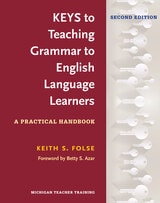
Keys to Teaching Grammar to English Language Learners, Second Ed.
A Practical HandbookKeith S. Folse
University of Michigan Press, 2016
Keys to Teaching Grammar to English Language Learners: A Practical Handbook is not intended to be an exhaustive reference book about ESL grammar. Written for classroom teachers (K-12, ESL, EFL), this book teaches the most common ESL grammar points in an accessible way through real ESL errors together with suggested teaching techniques. Relevant grammar terminology is explained.
The four objectives of this book are to help teachers: (1) identify common ESL grammar points and understand the details associated with each one; (2) improve their ability to answer any grammar question on the spot (when on the “hot seat”); (3) anticipate common ESL errors by grammar point, by first language, and/or by proficiency level; and (4) develop more effective grammar/language learning lessons. These objectives are for all teachers, whether they are teaching grammar directly or indirectly in a variety of classes – including a grammar class, a writing class, a speaking class, an ESP class, or a K-12 class.
In the Second Edition, all chapters have been updated and substantively revised. The number of marginal (gray) boxes with tips and extra information has doubled. A 16th Key, on Negating, and three new appendixes have been added. One of the new appendixes provides a sample exercise from an actual ESL textbook plus relevant notes about the designing of grammar activities and suggestions for teaching each grammar point.
Also added to each Key is a section on the vocabulary items (e.g., collocations) that are related to the teaching of that particular grammar point. This information is unique to this edition and cannot be found elsewhere on the market.
The Workbook for the Second Edition (978-0-472-03679-0), available in 2017, includes numerous activities that practice the essentials of grammar and issues relevant to ESL teachers.
Teaching Vocabulary Is the Writing Teacher's Job
Why and HowKeith S. Folse
University of Michigan Press, 2020
The Art of Teaching Speaking
Research and Pedagogy for the ESL/EFL ClassroomKeith S. Folse
University of Michigan Press, 2006
*Which tasks or activities really help build speaking fluency?
*What does the research show regarding speaking activities?
*What mistakes do ESL teachers often make in speaking activity design?
In this highly accessible and practical resource, Keith S. Folse provides a wealth of information to help ESL/EFL teachers design and use speaking tasks that will actually improve students' speaking fluency. The book presents and discusses the relevant research and assessment issues and includes case studies from twenty different settings and classrooms around the world so that readers learn from others about the problems and successes of using various speaking activities.
Teachers will find the chapters on Twenty Successful Activities and Ten Unsuccessful Activities particularly valuable. The successful activities are provided for classroom use and are reproducible. The book also contains five appendixes that explain what teachers need to know about vocabulary, pronunciation, and grammar and how they affect the teaching of speaking. Samples of successful lesson plans and a list of resources useful for teaching speaking are also included.
Keith S. Folse, Ph.D., is Coordinator, TESOL Programs, University of Central Florida (Orlando). He is the author of Vocabulary Myths (University of Michigan Press, 2004) and more than 35 second language textbooks, including texts on grammar, reading, speaking, listening, and writing.
The Grammar Answer Key
Short Explanations to 100 ESL QuestionsKeith S. Folse
University of Michigan Press, 2018
The 100 questions are organized into 12 chapters on topics that teachers and students can relate to well: adjectives, articles, clauses, connectors, gerunds and infinitives, prepositions, pronouns, pronunciation, subject-verb agreement, suffixes, verbs, and vocabulary-grammar connections. The number of questions in each chapter ranges from 3 to 13 and is based on the questions submitted. Each chapter begins with a short overview of the topic that features key terminology and a chart explaining three common ESL errors.
Each question is presented in a box and is followed by an "answer" that can inform instruction, often in chart format. Examples of questions are:
- How do you know if a word is an adjective?
- Can I say the Monday or the January?
- Do you say on July or in July?
- I received an email from someone that said “Greetings from my wife and I.” Is this right? Why?
- How do I know which way to pronounce the -ed at the end of a word?
- Which verb tenses are the most common in English? Which ones should I study?
- Why do you say turn on the light instead of turn the light?
- In my language, we have one word for make and do. In English, when should I use make and when should I use do?
The book is the ideal teacher resource and professional development tool.
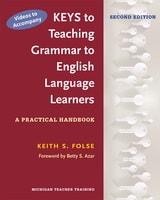
Videos to Accompany Keys to Teaching Grammar to English Language Learners
Keith S. Folse
University of Michigan Press, 2019
- Key 6, Prepositions
- Key 11, Phrasal Verbs
- Chapter 4: Hot Seat Questions
These videos are only available through our online platform: michelt.ublish.com.
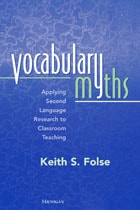
Vocabulary Myths
Applying Second Language Research to Classroom TeachingKeith S. Folse
University of Michigan Press, 2004
In Vocabulary Myths, Keith S. Folse breaks down the teaching of second language vocabulary into eight commonly held myths. In debunking each myth, he introduces the myth with a story based on his 25 years of teaching experience (in the United States and abroad), continues with a presentation of what empirical research has shown on the topic, and finishes with a list of what teachers can do in their classrooms to facilitate true vocabulary acquisition.
The goal of Vocabulary Myths is to foster a paradigm shift that correctly views vocabulary as fundamental in any second language learning process and demonstrates that research supports this goal-that in fact there is a wealth of empirical evidence to support these views. In addition, an important theme is that teachers have overestimated how much vocabulary students really understand, and as a result, the so-called "comprehensible input" is neither comprehensible nor input.
The second language vocabulary acquisition myths reexamined in this book are:
*In learning another language, vocabulary is not as important as grammar or other areas.
*Using word lists to learn L2 vocabulary is unproductive.
*Presenting new vocabulary in semantic sets facilitates learning.
*The use of translations to learn new vocabulary should be discouraged.
*Guessing words from context is an excellent strategy for learning L2 vocabulary.
*The best vocabulary learners make use of one or two really specific vocabulary learning strategies.
*The best dictionary for L2 learners is a monolingual dictionary.
*Teachers, textbooks, and curricula cover L2 vocabulary adequately.
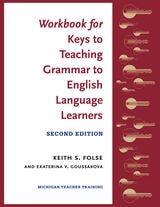
Workbook for Keys to Teaching Grammar to English Language Learners, Second Ed.
Keith S. Folse and Ekaterina V. Goussakova
University of Michigan Press, 2017
The Workbook has been updated to reflect new content in the Second Edition of the Handbook and once again features exercises that carefully follow the sequence of material in the Handbook. To facilitate use of the Workbook with the Handbook, each exercise is coded with the corresponding pages for the material in the Handbook. Reflecting the different learning styles in any given class, the exercises practice identifying grammatical features in a variety of different ways, including many charts, matching activities, and short answer questions. In addition, the Workbook has a variety of exercises consisting of sentences typical of English language learners so that teachers can become familiar with specific types of errors that ESL students make with certain grammar points.
The Workbook also features some action research projects to guide teachers in collecting small samples of data from their target student populations.