Results by title
4 books match the query 'Food chains (Ecology)'
Food Webs
Stuart L. Pimm
University of Chicago Press, 2002
Food webs are diagrams depicting which species interact or in other words, who eats whom. An understanding of the structure and function of food webs is crucial for any study of how an ecosystem works, including attempts to predict which communities might be more vulnerable to disturbance and therefore in more immediate need of conservation.
Although it was first published twenty years ago, Stuart Pimm's Food Webs remains the clearest introduction to the study of food webs. Reviewing various hypotheses in the light of theoretical and empirical evidence, Pimm shows that even the most complex food webs follow certain patterns and that those patterns are shaped by a limited number of biological processes, such as population dynamics and energy flow. Pimm provides a variety of mathematical tools for unravelling these patterns and processes, and demonstrates their application through concrete examples. For this edition, he has written a new foreword covering recent developments in the study of food webs and demonstrates their continuing importance to conservation biology.
Although it was first published twenty years ago, Stuart Pimm's Food Webs remains the clearest introduction to the study of food webs. Reviewing various hypotheses in the light of theoretical and empirical evidence, Pimm shows that even the most complex food webs follow certain patterns and that those patterns are shaped by a limited number of biological processes, such as population dynamics and energy flow. Pimm provides a variety of mathematical tools for unravelling these patterns and processes, and demonstrates their application through concrete examples. For this edition, he has written a new foreword covering recent developments in the study of food webs and demonstrates their continuing importance to conservation biology.
[more]
Food Webs at the Landscape Level
Edited by Gary A. Polis, Mary E. Power, and Gary R. Huxel
University of Chicago Press, 2004
Scientists rely on food webs—complex networks that trace the flow of nutrients and energy between species and through ecosystems—to understand the infrastructure of ecological communities.
But given the complexities of food webs—think of following the flow of nutrients through the microbes, fungi, roots, worms, ants, and birds that pass over or through a single cubic meter of prairie soil—it's not difficult to see why most experiments on food-web dynamics focus on small, local habitats. Yet as this book convincingly shows, important insights come when scientists expand the temporal and spatial scope of their research to look at the ways energy, organisms, nutrients, and pollutants flow not just at the local level, but across whole landscapes—between and among food webs in a wide variety of habitats.
Paying special attention to the fertile boundaries between terrestrial, freshwater, and marine ecosystems, Food Webs at the Landscape Level not only shows what this new methodology means for ecology, conservation, and agriculture but also serves as a fitting tribute to Gary Polis and his major contributions to the field.
[more]
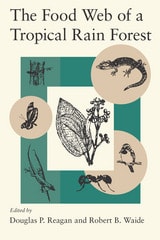
The Food Web of a Tropical Rain Forest
Edited by Douglas P. Reagan and Robert B. Waide
University of Chicago Press, 1996
Destruction of tropical rain forests has increased exponentially in recent years, as have efforts to conserve them. However, information essential to these conservation programs—an understanding of the population dynamics of the community at risk—is often unavailable to the scientists and resource managers who need it most.
This volume helps fill the gap by presenting a comprehensive description and analysis of the animal community of the tropical rain forest at El Verde, Puerto Rico. Building on more than a decade of field research, the contributors weave the complex strands of information about the energy flow within the forest—who eats whom—into a powerful tool for understanding community dynamics known as a food web. This systematic approach to organizing the natural histories of the many species at El Verde also reveals basic patterns and processes common to all rain forests, making this book a valuable contribution for anyone concerned with studying and protecting these fragile ecosystems.
This volume helps fill the gap by presenting a comprehensive description and analysis of the animal community of the tropical rain forest at El Verde, Puerto Rico. Building on more than a decade of field research, the contributors weave the complex strands of information about the energy flow within the forest—who eats whom—into a powerful tool for understanding community dynamics known as a food web. This systematic approach to organizing the natural histories of the many species at El Verde also reveals basic patterns and processes common to all rain forests, making this book a valuable contribution for anyone concerned with studying and protecting these fragile ecosystems.
[more]
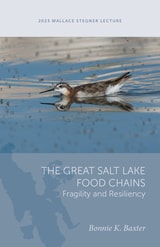
The Great Salt Lake Food Chains
Fragility and ResiliencyBonnie K. Baxter
University of Utah Press, 2024
Bonnie K. Baxter explains the trophic structure of Great Salt Lake food chains and resulting impacts from recent years of a shrinking lake and corresponding increases in salinity. Moving from the foundational organisms to brine shrimp, flies, and ten million birds reliant on the lake, Baxter illuminates how salinity and desiccation can affect each level of a complex ecosystem. Presented in the context of current science, she explores the pressures of persistent water diversions and climate change and provides a cautionary tale of a lake on the brink of collapse. Baxter’s hopeful tone, sounding the lake ecosystem’s inherent resiliency, is a welcome voice in the climate conversation and a plea to help save a lake that can survive with a little help from its human neighbors.
[more]