Results by title
4 books match the query 'Food crops'
Ancient Plants and People
Contemporary Trends in ArchaeobotanyEdited by Marco Madella, Carla Lancelotti, and Manon Savard
University of Arizona Press, 2014
Mangroves and rice, six-row brittle barley and einkorn wheat. Ancient crops for prehistoric people. What do they have in common? All tell us about the lives and cultures of long ago, as humans cultivated or collected these plants for food. Exploring these and other important plants used for millennia by humans, Ancient Plants and People presents a wide-angle view of the current state of archaeobotanical research, methods, and theories.
Food has both a public and a private role, and it permeates the life of all people in a society. Food choice, production, and distribution probably represent the most complex indicators of social life, and thus a study of foods consumed by ancient peoples reveals many clues about their lifestyles. But in addition to yielding information about food production, distribution, preparation, and consumption, plant remains recovered from archaeological sites offer precious insights on past landscapes, human adaptation to climate change, and the relationship between human groups and their environment. Revealing important aspects of past human societies, these plant-driven insights widen the spectrum of information available to archaeologists as we seek to understand our history as a biological and cultural species.
Often answers raise more questions. As a result, archaeobotanists are constantly pushed to reflect on the methodological and theoretical aspects of their discipline. The contributors discuss timely methodological issues and engage in debates on a wide range of topics from plant utilization by hunter-gatherers and agriculturalists, to uses of ancient DNA. Ancient Plants and People provides a global perspective on archaeobotanical research, particularly on the sophisticated interplay between the use of plants and their social or environmental context.
[more]
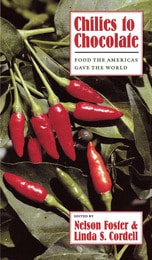
Chilies to Chocolate
Food the Americas Gave the WorldNelson Foster and Linda S. Cordell
University of Arizona Press, 1992
Columbus stumbled upon the New World while seeking the riches of the orient, yet native peoples of the Americas already held riches beyond his knowing. From maize to potatoes to native beans, a variety of crops unfamiliar to Europeans were cultivated by indigenous peoples of the Americas, with other foods like chilies and chocolate on hand to make diets all the more interesting (even when used in combination, as aficionados of molé will attest).
Chilies to Chocolate traces the biological and cultural history of some New World crops that have worldwide economic importance. Drawing on disciplines as diverse as anthropology, ethnobotany, and agronomy, it focuses on the domestication and use of these plants by native peoples and their dispersion into the fields and kitchens of the Old World: tomatoes to Italy, chili peppers throughout Asia, cacao wherever a sweet tooth craves chocolate. Indeed, potatoes and maize now rank with wheat and rice as the world's principal crops.
"The sweetness of corn on the cob is sweeter for knowing the long, winding way by which it has come into one's hands," observe Foster and Cordell. Featuring contributions by Gary Nabhan, Alan Davidson, and others, Chilies to Chocolate will increase readers' appreciation of the foods we all enjoy, of the circuitous routes by which they have become part of our diets, and of the vital role that Native Americans have played in this process.
[more]
Gardens of New Spain
How Mediterranean Plants and Foods Changed AmericaBy William W. Dunmire
University of Texas Press, 2004
When the Spanish began colonizing the Americas in the late fifteenth and sixteenth centuries, they brought with them the plants and foods of their homeland—wheat, melons, grapes, vegetables, and every kind of Mediterranean fruit. Missionaries and colonists introduced these plants to the native peoples of Mexico and the American Southwest, where they became staple crops alongside the corn, beans, and squash that had traditionally sustained the original Americans. This intermingling of Old and New World plants and foods was one of the most significant fusions in the history of international cuisine and gave rise to many of the foods that we so enjoy today. Gardens of New Spain tells the fascinating story of the diffusion of plants, gardens, agriculture, and cuisine from late medieval Spain to the colonial frontier of Hispanic America. Beginning in the Old World, William Dunmire describes how Spain came to adopt plants and their foods from the Fertile Crescent, Asia, and Africa. Crossing the Atlantic, he first examines the agricultural scene of Pre-Columbian Mexico and the Southwest. Then he traces the spread of plants and foods introduced from the Mediterranean to Spain’s settlements in Mexico, New Mexico, Arizona, Texas, and California. In lively prose, Dunmire tells stories of the settlers, missionaries, and natives who blended their growing and eating practices into regional plantways and cuisines that live on today in every corner of America.
[more]
Shattering
Food, Politics, and the Loss of Genetic DiversityCary Fowler and Pat Mooney
University of Arizona Press, 1990
It was through control of the shattering of wild seeds that humans first domesticated plants. Now control over those very plants threatens to shatter the world's food supply, as loss of genetic diversity sets the stage for widespread hunger.
Large-scale agriculture has come to favor uniformity in food crops. More than 7,000 U.S. apple varieties once grew in American orchards; 6,000 of them are no longer available. Every broccoli variety offered through seed catalogs in 1900 has now disappeared. As the international genetics supply industry absorbs seed companies—with nearly one thousand takeovers since 1970—this trend toward uniformity seems likely to continue; and as third world agriculture is brought in line with international business interests, the gene pools of humanity's most basic foods are threatened.
The consequences are more than culinary. Without the genetic diversity from which farmers traditionally breed for resistance to diseases, crops are more susceptible to the spread of pestilence. Tragedies like the Irish Potato Famine may be thought of today as ancient history; yet the U.S. corn blight of 1970 shows that technologically based agribusiness is a breeding ground for disaster.
Shattering reviews the development of genetic diversity over 10,000 years of human agriculture, then exposes its loss in our lifetime at the hands of political and economic forces. The possibility of crisis is real; this book shows that it may not be too late to avert it.
[more]