Results by title
2 books match the query 'Food waste'

A Mass Conspiracy to Feed People
Food Not Bombs and the World-Class Waste of Global CitiesDavid Boarder Giles
Duke University Press, 2021
In A Mass Conspiracy to Feed People, David Boarder Giles explores the ways in which capitalism simultaneously manufactures waste and scarcity. Illustrating how communities of marginalized people and discarded things gather and cultivate political possibilities, Giles documents the work of Food Not Bombs (FNB), a global movement of grassroots soup kitchens that recover wasted grocery surpluses and redistribute them to those in need. He explores FNB's urban contexts: the global cities in which late-capitalist economies and unsustainable consumption precipitate excess, inequality, food waste, and hunger. Beginning in urban dumpsters, Giles traces the logic by which perfectly edible commodities are nonetheless thrown out—an act that manufactures food scarcity—to the social order of “world-class” cities, the pathways of discarded food as it circulates through the FNB kitchen, and the anticapitalist political movements the kitchen represents. Describing the mutual entanglement of global capitalism and anticapitalist transgression, Giles captures those emergent forms of generosity, solidarity, and resistance that spring from the global city's marginalized residents.
[more]
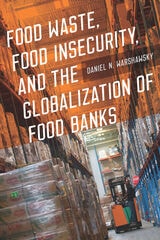
Food Waste, Food Insecurity, and the Globalization of Food Banks
Daniel N. Warshawsky
University of Iowa Press, 2023
Food banks—warehouses that collect and systematize surplus food—have expanded into one of the largest mechanisms to redistribute food waste. From their origins in North America in the 1960s, food banks provide food to communities in approximately one hundred countries on six continents. This book analyzes the development of food banks across the world and the limits of food charity as a means to reduce food insecurity and food waste.
Based on fifteen years of in-depth fieldwork on four continents, Daniel Warshawsky illustrates how and why food banks proliferate across the globe even though their impacts may be limited. He suggests that we need to reformulate the role of food banks. The mission of food banks needs to be more realistic, as food surpluses cannot reduce food insecurity on a significant scale. Food banks need to regain their institutional independence from the state and corporations, and incorporate the knowledge and experiences of the food insecure in the daily operations of the food system. These collective changes can contribute to a future where food banks play a smaller but more targeted role in food systems.
Based on fifteen years of in-depth fieldwork on four continents, Daniel Warshawsky illustrates how and why food banks proliferate across the globe even though their impacts may be limited. He suggests that we need to reformulate the role of food banks. The mission of food banks needs to be more realistic, as food surpluses cannot reduce food insecurity on a significant scale. Food banks need to regain their institutional independence from the state and corporations, and incorporate the knowledge and experiences of the food insecure in the daily operations of the food system. These collective changes can contribute to a future where food banks play a smaller but more targeted role in food systems.
[more]