Results by title

10 books match the query 'Foreign trade regulation'
cover of Aggressive Unilateralism: America's 301 Trade Policy and the World Trading System

Aggressive Unilateralism

America's 301 Trade Policy and the World Trading System

Jagdish Bhagwati and Hugh T. Patrick, Editors

University of Michigan Press, 1990
United States trade policy has moved in recent years toward aggressive unilateralism. This volume provides the most comprehensive, coherent, and insightful analysis of this dramatic development. The essays collected here explain the legislative history of this policy as expressed in Section 301 and the more recent Super 301 and explore the political forces driving their adoption on Capitol Hill. The targeting of Japan, India, and Brazil by the administration using Super 301 powers is discussed, as are the reactions of those countries to this targeting. These American actions raise questions about the legality of such tariff retaliation under GATT rules and about America’s simultaneous support of multilateral talks at the Uruguay Round intended to reconstitute and revitalize the GATT.
[more]
cover of Analytical and Negotiating Issues in the Global Trading System

Analytical and Negotiating Issues in the Global Trading System

Alan Deardorff and Robert M. Stern, Editors

University of Michigan Press, 1994
This title was formally part of the Studies in International Trade Policy Series, now called Studies in International Economics.
[more]
cover of Regulatory Barriers and the Principle of Non-discrimination in World Trade Law: Past, Present, and Future

Regulatory Barriers and the Principle of Non-discrimination in World Trade Law

Past, Present, and Future

Thomas Cottier and Petros C. Mavroidis, Editors

University of Michigan Press, 2000
The University of Michigan Press is pleased to announce the second volume in an annual series, the World Trade Forum. The Forum's members include scholars, lawyers, and government and business practitioners working in the area of international trade, law, and policy. They meet annually to discuss integration issues in international economic relations, focusing on a new theme each year.
The World Trade Forum 1998 deals with the issue of regulatory barriers. Contributors focus their attention on the implications that government intervention has on the principle of nondiscrimination, the cornerstone of the World Trade Organization. The chapters, which cover both the positive and the normative level, deal in particular with the issue of "like product" definition, and with mutual recognition agreements. The relevant WTO case law is presented and analyzed, and the roundtable discussions are primarily aimed at clarifying to what extent a constitutional function should be assigned to the WTO organs, if at all.
Contributors include: Christoph Bail, Jacques Bourgeois, Marco Bronckers, Thomas Cottier, William Davey, Paul Demaret, Piet Eeckhout, Crawford Falconer, Olivier Guillod, Meinhard Hilf, Gary Horlick, Robert Howse, Robert Hudec, Patrick Low, Aaditya Mattoo, Petros C. Mavroidis, Patrick Messerlin, Damien Neven, Kalypso Nicolaidis, David Palmeter, Ernst Ulrich Petresmann, Andre Sapir, and Michel Waelbroeck.
Thomas Cottier is Professor of Law, Institute of European and International Economic Law, University of Bern Law School. Petros C. Mavroidis is Professor of Law, University of Neuchâtel.
[more]
cover of State Trading in the Twenty-First Century: The World Trade Forum, Volume 1

State Trading in the Twenty-First Century

The World Trade Forum, Volume 1

Thomas Cottier and Petros C. Mavroidis, Editors

University of Michigan Press, 1998
The University of Michigan Press is pleased to announce the first volume in an annual series, The World Trade Forum. The Forum's members include scholars, lawyers, and government and business practitioners working in the area of international trade, law, and policy. They meet annually and discuss integration issues in international economic relations, focusing on a new theme each year.
The central topic of the first World Trade Forum is state trading. To what extent has trade liberalization, as we have experienced it over the last fifty years, affected property ownership? Contributors to the 1998 World Trade Forum explore this question, examining both state practice and the regulatory framework. Their discussions are divided into three parts: Part 1 looks at the World Trade Organization's legal framework for state trading enterprises, taking on such issues as monopolies and state enterprises, the WTO Antidumping Agreement and the economies in transition, and relationship of state trading and the Government Purchasing Act. Part 2 deals with regional experiences in state trading (for the EC, United States, Canada, Japan, China, and Russia). Part 3 examines conceptual issues such as auctions as a trade policy instrument and rule-making alternatives for entities with exclusive rights. The conclusion synthesizes the foregoing chapters in discussing the reach of modern international trade law.
Contributors are Frederick Abbott, Ichiro Araki, Christian Bach, Jacques H. J. Bourgeois, Thomas Cottier, William J. Davey, Vladimir Dbrentsov, Toni Haniotis, Bernard M. Hoekman, Gary Horlick, Henrik Horn, Robert Howse, Patrick Low, Will Martin, Mitsuo Matsushita, Petros Mavroidis, Aaditya Mattoo, Patrick Messerlin, Constantine Michalopoulos, Kristin Heim Mowry, Stilpon Nestor, Damien Neven, N. David Palmeter, Ernst-Ulrich Petersmann, André Sapir, Diane P. Wood, and Werner Zdouc.
Petros Mavroidis is Professor of Law, University of Neuchatel. Thomas Cottier is Professor of Law, Institute of European and International Economic Law, University of Bern Law School.
[more]
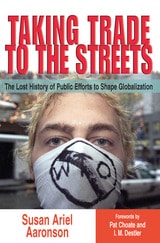
cover of Taking Trade to the Streets: The Lost History of Public Efforts to Shape Globalization

Taking Trade to the Streets

The Lost History of Public Efforts to Shape Globalization

Susan Ariel Aaronson

University of Michigan Press, 2002

In the wake of civil protest in Seattle during the 1999 World Trade Organization meeting, many issues raised by globalization and increasingly free trade have been in the forefront of the news. But these issues are not necessarily new. Taking Trade to the Streets describes how so many individuals and nongovernmental organizations came over time to see trade agreements as threatening national systems of social and environmental regulations. Using the United States as a case study, Susan Ariel Aaronson examines the history of trade agreement critics, focusing particular attention on NAFTA (the North American Free Trade Agreement between Canada, Mexico, and the United States) and the Tokyo and Uruguay Rounds of trade liberalization under the GATT. She also considers the question of whether such trade agreement critics are truly protectionist.
The book explores how trade agreement critics built a fluid global movement to redefine the terms of trade agreements (the international system of rules governing trade) and to redefine how citizens talk about trade. (The "terms of trade" is a relationship between the prices of exports and of imports.) That movement, which has been growing since the 1980s, transcends borders as well as longstanding views about the role of government in the economy. While many trade agreement critics on the left say they want government policies to make markets more equitable, they find themselves allied with activists on the right who want to reduce the role of government in the economy.
Aaronson highlights three hot-button social issues--food safety, the environment, and labor standards--to illustrate how conflicts arise between trade and other types of regulation. And finally she calls for a careful evaluation of the terms of trade from which an honest debate over regulating the global economy might emerge.
Ultimately, this book links the history of trade policy to the history of social regulation. It is a social, political, and economic history that will be of interest to policymakers and students of history, economics, political science, government, trade, sociology, and international affairs.
Susan Ariel Aaronson is Senior Fellow at the National Policy Institute and occasional commentator on National Public Radio's "Morning Edition."
[more]
cover of The Courts of International Trade: Judicial Specialization, Expertise, and Bureaucratic Policymaking

The Courts of International Trade

Judicial Specialization, Expertise, and Bureaucratic Policymaking

Isaac Unah

University of Michigan Press, 1998

In the United States cases involving the interpretation of laws dealing with international trade are heard by a specialized court, the Court of International Trade, and on appeal by a specialized appellate court, the Court of Appeals for the Federal Circuit. In a groundbreaking study, Isaac Unah studies these courts to explore the way specialized courts work and how they fit into the federal court system. We know little about why specialized courts are created and how their role in interpreting law might differ from the role played by the courts of general jurisdiction. These courts play an important role in regulating agencies that affect many aspects of our lives, including the Internal Revenue Service, the Patent Office, and agencies that administer trade laws. The author considers the way these courts relate to the work of the agencies whose cases must always come to these courts. And he offers fresh insights into the differences between specialized courts and courts of general jurisdiction.
This book will be of interest to scholars studying the judiciary, bureaucracies, and international trade law and administration.
Isaac Unah is Assistant Professor of Political Science, University of North Carolina.
[more]
cover of The Multilateral Trading System: Analysis and Options for Change

The Multilateral Trading System

Analysis and Options for Change

Robert M. Stern, Editor

University of Michigan Press, 1993
This volume provides an analytical approach to most of the major items on the agenda of the Uruguay Round of Multilateral Trade Negotiations, which was convened in 1986 under the auspices of the General Agreement on Tariffs and Trade (GATT).The Uruguay Round negotiating agenda is ambitious in scope, consisting of such topics as barriers to trade, sectoral issues, and GATT rules, and a number of topics that had not been addressed in previous negotiations. The Multilateral Trading System begins with an introduction and overview of the issues, followed by two chapters that put the Uruguay Round in context and provide some historical perspective relating to previous GATT negotiations. The bulk of the volume consists of twelve analytical chapters that address many of the central issues, including tariffs and nontariff barriers; dumping; safeguards; agriculture; services; trade-related intellectual property rights; and trade-related investment measures. The concluding chapters deal with options for change, focusing on trade-offs, coalitions, and national interests and on suggestions for the design of a new constitution to govern the global trading system.The Multilateral Trading System deals with issues of central importance in the global trading system. It will be of particular interest to specialists in international trade and staff economists in national and international agencies. Specialists and students in political science, law, and business administration will also find much that is useful.
[more]
cover of The Political Economy of Trade Protection

The Political Economy of Trade Protection

Edited by Anne O. Krueger

University of Chicago Press, 1995

This clear, concise summary of the in-depth analyses presented in The Political Economy of American Trade Policy examines the level, form, and evolution of American trade protection.

In case studies of trade barriers imposed during the 1980s to help the steel, semiconductor, automobile, lumber, wheat, and textile and apparel industries, the contributors trace the evolution of efforts to obtain protection, protectionist measures, and their results. A chapter assessing the common themes that emerge from the studies concludes that the focus of current trade law is exclusively on the individual protection-seeking industries, with little regard for indirect effects on using industries or for consumers. Reform could usefully take these effects into account.

This volume will interest policymakers, business executives, and anyone interested in trade policy formulation and practice.
[more]
cover of The Role of the Judge in International Trade Regulation: Experience and Lessons for the WTO

The Role of the Judge in International Trade Regulation

Experience and Lessons for the WTO

Thomas Cottier and Petros C. Mavroidis, Editors

University of Michigan Press, 2003

The WTO is generally seen as a key actor of globalization and, as such, has been the point of convergence of popular irritation worldwide. Many of the reproaches addressed to the WTO show civil societys concern with what is perceived as a democratic deficit in the way the organization operates. The main fear is to see trade rise as the ultimate value, prevailing over concerns such as health and environment. The Role of the Judge offers insight into how disputes are solved at the WTO level, into how the judicial branch interacts with the rest of the organization, and into the degree of sensitivity of the system to external input. The book sheds light on the judicial system governing the WTO and shows it to be the only truly multilateral system where disputes are solved by third-party adjudication.
The book develops along three lines: the first a search for cases submitted to the WTO where the judge exceeded its authority; the second a comparison of the WTO with the operations of national judicial systems having different levels of integration, specifically the United States (federal level) and the EC (quasi-federal level); and the third an exploration of directions for the future of dispute settlement in the WTO.
Reflecting the diversity of its contributors, this book addresses questions of economics, political science, and law, bringing an unusual level of multidisciplinarity to this topic and context. It is designed for both academic readers and practitioners, who will find it full of practical insights as well as rich and detailed analysis.
Thomas Cottier is Professor of European and International Economic Law, University of Bern, and Managing Director, World Trade Institute, University of Bern.
Petros C. Mavroidis is Professor of Law, University of Neuchâtel. He formerly worked in the Legal Affairs Division of the World Trade Organization.
Patrick Blatter is Mavroidiss scientific collaborator.
[more]
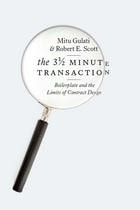
cover of The Three and a Half Minute Transaction: Boilerplate and the Limits of Contract Design

The Three and a Half Minute Transaction

Boilerplate and the Limits of Contract Design

Mitu Gulati and Robert E. Scott

University of Chicago Press, 2012

Boilerplate language in contracts tends to stick around long after its origins and purpose have been forgotten. Usually there are no serious repercussions, but sometimes it can cause unexpected problems. Such was the case with the obscure pari passu clause in cross-border sovereign debt contracts, until a novel judicial interpretation rattled international finance by forcing a defaulting sovereign—for one of the first times in the market’s centuries-long history—to repay its foreign creditors. Though neither party wanted this outcome, the vast majority of contracts subsequently issued demonstrate virtually no attempt to clarify the imprecise language of the clause.

Using this case as a launching pad to explore the broader issue of the “stickiness” of contract boilerplate, Mitu Gulati and Robert E. Scott have sifted through more than one thousand sovereign debt contracts and interviewed hundreds of practitioners to show that the problem actually lies in the nature of the modern corporate law firm. The financial pressure on large firms to maintain a high volume of transactions contributes to an array of problems that deter innovation. With the near certainty of massive sovereign debt restructuring in Europe, The Three and a Half Minute Transaction speaks to critical issues facing the industry and has broader implications for contract design that will ensure it remains relevant to our understanding of legal practice long after the debt crisis has subsided.
[more]