Results by title
18 books match the query 'Forests'

Culture and the Question of Rights
Forests, Coasts, and Seas in Southeast AsiaCharles Zerner, ed.
Duke University Press, 2003
Calling for radical redefinitions of development and ownership and for new understandings of the translation of culture and rights in politically dangerous contexts—natural resource frontiers—this volume links social injustice and the degradation of Southeast Asian environments. Charles Zerner and his colleagues show how geographical areas once viewed as wild and undeveloped are actually cultural artifacts shaped by complex interactions with human societies. Drawing on richly varied sources of evidence and interpretation—from trance dances, court proceedings, tree planting patterns, marine and forest rituals, erotic poems, and codifications of customary law, Culture and the Question of Rights reveals the ironies, complexities, and histories of contemporary communities’ struggles to retain their gardens, forests, fishing territories, and graveyards. The contributors examine how these cultural activities work to both construct and to lay claim to nature. These essays open up new avenues for negotiating indigenous rights against a background of violence, proliferating markets, and global ideas of biodiversity and threatened habitat.
Contributors. Jane Atkinson, Don Brenneis, Stephanie Fried, Nancy Peluso, Marina Roseman, Anna Tsing, Charles Zerner

Forests of Gold
Essays on the Akan and the Kingdom of AsanteIvor Wilks
Ohio University Press, 1995
Forests of Gold is a collection of essays on the peoples of Ghana with particular reference to the most powerful of all their kingdoms: Asante. Beginning with the global and local conditions under which Akan society assumed its historic form between the fifteenth and seventeenth centuries, these essays go on to explore various aspects of Asante culture: conceptions of wealth, of time and motion, and the relationship between the unborn, the living, and the dead. The final section is focused upon individuals and includes studies of generals, of civil administrators, and of one remarkable woman who, in 1831, successfully negotiated peace treaties with the British and the Danes on the Gold Coast. The author argues that contemporary developments can only be fully understood against the background of long-term trajectories of change in Ghana.
Forests
A Naturalist’s Guide to Woodland TreesBy Laurence C. Walker
University of Texas Press, 1997
First published in 1990, Forests explores the ecological, economic, and human influences on over thirty significant types of woodlands. Laurence Walker focuses especially on the effects of site factors—climate, physiography, biology, and soils—upon the growth of various kinds of trees. Projects for amateur naturalists, reading lists, and a glossary make this the perfect introduction for general readers.
Forests
The Shadow of CivilizationRobert Pogue Harrison
University of Chicago Press, 1992
"Forests is one of the most remarkable essays on the human place in nature I have ever read, and belongs on the small shelf that includes Raymond Williams' masterpiece, The Country and the City. Elegantly conceived, beautifully written, and powerfully argued, [Forests] is a model of scholarship at its passionate best. No one who cares about cultural history, about the human place in nature, or about the future of our earthly home, should miss it.—William Cronon, Yale Review
"Forests is, among other things, a work of scholarship, and one of immense value . . . one that we have needed. It can be read and reread, added to and commented on for some time to come."—John Haines, The New York Times Book Review
Harnessing Farms and Forests in the Low-Carbon Economy
How to Create, Measure, and Verify Greenhouse Gas OffsetsNicholas Institute for Environmental Policy Solutions and Zach Willey and Bill Chameides, editors, eds.
Duke University Press, 2007
This guide is the first comprehensive technical publication providing direction to landowners for sequestering carbon and information for traders and others who will need to verify the sequestration. It will provide invaluable direction to farmers, foresters, land managers, consultants, brokers, investors, regulators, and others interested in creating consistent, credible greenhouse gas offsets as a tradable commodity in the United States.
The guide contains a non-technical section detailing methodologies for scoping of the costs and benefits of a proposed project, quantifying offsets of various sorts under a range of situations and conditions, and verifying and registering the offsets. The technical section provides specific information for quantifying, verifying, and regulating offsets from agricultural and forestry practices.
Visit the Nicholas Institute for Environmental Policy Solutions website for audio from the press conference announcing the book.
Read the press release announcing the book.
La Frontera
Forests and Ecological Conflict in Chile's Frontier TerritoryThomas Miller Klubock
Duke University Press, 2014
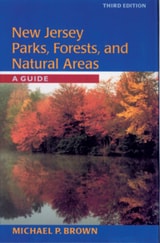
New Jersey Parks, Forests, and Natural Areas
A GuideBrown, Michael P
Rutgers University Press, 2004
Want to know where in New Jersey you can go fossil hunting? How about cranberry harvesting? Perhaps you’d like to find the most accessible Garden State fishing areas for people with disabilities? Or maybe you’ve just been wondering how Double Trouble State Park got its name?
Now in its third edition, this updated guide—the first of its kind for New Jersey—lists over 250 parks, forests, and natural areas in the Garden State, from national, state, city, and county parks to nature preserves run by non-profit groups, arboretums, and undeveloped wildlife management areas. Wherever you live in New Jersey, you can find a beautiful place nearby for picnicking, hiking, camping, hunting, fishing, boating, and a host of other outdoor activities. All are open to the public, and most are free or charge only a small fee. Michael Brown divides the state into six regions along county lines and includes helpful maps, so outdoor enthusiasts can easily plan excursions.
For each park, the guide provides up-to-date, practical information about locations and phone numbers, fees, hours, seasons, acreage, regulations, handicap access, special facilities and activities, campsites, swimming and boat launching sites, restrooms, playgrounds and picnic sites, hunting and fishing, and hiking. Also included in this edition is broadened coverage of mountain biking and horseback riding.
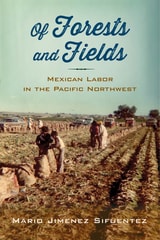
Of Forests and Fields
Mexican Labor in the Pacific NorthwestMario Jimenez Sifuentez
Rutgers University Press, 2016
Just looking at the Pacific Northwest’s many verdant forests and fields, it may be hard to imagine the intense work it took to transform the region into the agricultural powerhouse it is today. Much of this labor was provided by Mexican guest workers, Tejano migrants, and undocumented immigrants, who converged on the region beginning in the mid-1940s. Of Forests and Fields tells the story of these workers, who toiled in the fields, canneries, packing sheds, and forests, turning the Pacific Northwest into one of the most productive agricultural regions in the country.
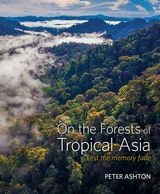
On the Forests of Tropical Asia
Lest the Memory FadePeter Ashton
Royal Botanic Gardens, Kew, 2014
On the Forests of Tropical Asia is the first book to describe the forests of the entire tropical Asian region, from Sind to New Guinea. It opens with chapters on physical geography and geological history and then moves on to address forest and tree structure and dynamics, floristics, and symbiotic organisms, as well as genetics, evolutionary history, species diversity, and human impact. A final chapter covers future policy and practice options for saving what remains. Hundreds of full-color illustrations serve as a lasting testimony to the diverse forests. Ashton combines existing research with his own experience and collaborations, creating a broad, comprehensive understanding of forest variation. By presenting a clear picture of where the forests stand today, he offers a framework for future research, policy, and conservation.
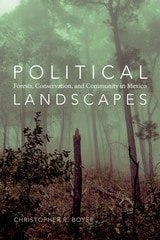
Political Landscapes
Forests, Conservation, and Community in MexicoChristopher R. Boyer
Duke University Press, 2015
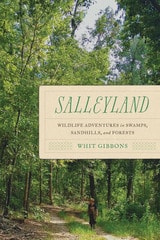
Salleyland
Wildlife Adventures in Swamps, Sandhills, and ForestsWhit Gibbons
University of Alabama Press, 2023
WINNER OF THE SOUTH CAROLINA OUTDOOR PRESS ASSOCIATION'S EXCELLENCE IN CRAFT FOR THE BEST OUTDOOR BOOK AWARD
Adventures and misadventures exploring nature on a patch of “worthless” abandoned farmland
Following his retirement from academic life, renowned naturalist and writer Whit Gibbons and his family purchased a tract of abandoned farmland where the South Carolina piedmont meets the coastal plain. Described as backcountry scrubland, it was originally envisioned as a family retreat, but soon the property became Gibbons’s outdoor learning laboratory where he was often aided by his four grandchildren, along with a host of enthusiastic visitors.
Inspired by nature’s power to excite, educate, and provide a sense of place in the world, Gibbons invites readers to learn about their surrounding environments by describing his latest adventures and sharing expert advice for exploring the world in which we live. Peppered throughout with colorful personal anecdotes and told with Gibbons’s affable style and wit, Salleyland: Wildlife Adventures in Swamps, Sandhills, and Forests is more than a personal memoir or a record of place. Rather, it is an exercise in learning about a patch of nature, thereby reminding us to open our eyes to the complexity and wonder of the natural world.
Starting with the simple advice of following your own curiosity, Gibbons discusses different opportunities and methods for exploring one’s surroundings, introduces key ecological concepts, offers advice for cultivating habitat, explains the value of and different approaches to keeping lists and field journals, and celebrates the advances that cell phone photography and wildlife cameras offer naturalists of all levels. With Gibbons’s guidance and encouragement, readers will learn to embrace their inner scientists, equipped with the knowledge and encouragement to venture beyond their own front doors, ready to discover the secrets of their habitat, regardless of where they live.
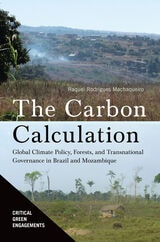
The Carbon Calculation
Global Climate Policy, Forests, and Transnational Governance in Brazil and MozambiqueRaquel Rodrigues Machaqueiro
University of Arizona Press, 2023
Focusing on REDD+ (Reducing Emissions from Deforestation and Forest Degradation), the book demonstrates how industrialized countries are able to maintain their socioeconomic models largely unaltered while claiming to address global warming using forests in the Global South to offset their pollution. By examining the creation and implementation of REDD+ historically and ethnographically, the book traces the social life of this mechanism as it travels across a complex network spanning several interacting levels: international, national, and local. Through cases in the Brazilian state of Acre and the Zambézia province in Mozambique, the author demonstrates how global climate policy has created new opportunities and rationales for unprecedented levels of intervention in the Global South—all under the guise of saving the planet.
The Carbon Calculation critically highlights the ways in which politics has reinforced a scientific focus on one possible solution to the problem of climate change—namely those that largely absolve the industrialized world from undertaking politically painful transformations in its own economic model.
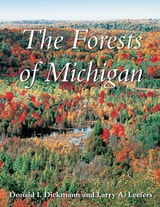
The Forests of Michigan
Donald I. Dickmann and Larry A. Leefers
University of Michigan Press, 2003
No book currently on bookstore shelves explores, as The Forests of Michigan does, the natural history, ecology, management, economic importance, and use of the rich and varied forests that cover about half of the state's 36.3 million acres. The authors look at the forests, where they are, how they got to be, and their present-day usage, using the story of Michigan forests as a backdrop for the state's history, including its archaeology.
The Forests of Michigan explores how the forests came back after the great Wisconsin glacier began to recede over 12,000 years ago, and how they recovered from the onslaught of unrestrained logging and wildfire that, beginning in the mid-1800s, virtually wiped them out. The emphasis of the book is on sustaining for the long term the forests of the state, with a view of sustainability that builds not only upon the lessons learned from native peoples' attitude and use of trees but also on the latest scientific principles of forest ecology and management.
Generously illustrated and written in an engaging style, The Forests of Michigan sees the forest and the trees, offering both education and delight. "As forest scientists," the authors note, "we opted for a hearty serving of meat and potatoes; anyone who reads this book with the intention of learning something will not be disappointed. Nonetheless, we do include some anecdotal desserts, too."
Donald I. Dickmann is Professor of Forestry at Michigan State University and holds a doctorate from the University of Wisconsin. He is the author of The Culture of Poplars. Larry A. Leefers is Associate Professor in the Department of Forestry at Michigan State University. He holds a doctorate from Michigan State University.
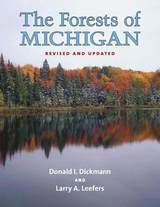
The Forests of Michigan, Revised Ed.
Donald I. Dickmann and Larry A. Leefers
University of Michigan Press, 2016
The Social Lives of Forests
Past, Present, and Future of Woodland ResurgenceEdited by Susanna B. Hecht, Kathleen D. Morrison, and Christine Padoch
University of Chicago Press, 2014
Focusing on the history and current use of woodlands from India to the Amazon, The Social Lives of Forests attempts to build a coherent view of forests sited at the nexus of nature, culture, and development. With chapters covering the effects of human activities on succession patterns in now-protected Costa Rican forests; the intersection of gender and knowledge in African shea nut tree markets; and even the unexpectedly rich urban woodlands of Chicago, this book explores forests as places of significant human action, with complex institutions, ecologies, and economies that have transformed these landscapes in the past and continue to shape them today. From rain forests to timber farms, the face of forests—how we define, understand, and maintain them—is changing.
Trees and Forests of Tropical Asia
Exploring TapovanPeter Ashton and David Lee
University of Chicago Press, 2022
Trees and Forests of Tropical Asia invites readers on an expedition into the leafy, humid, forested landscapes of tropical Asia—the so-called tapovan, a Sanskrit word for the forest where knowledge is attained through tapasya, or inner struggle. Peter Ashton and David Lee, two of the world’s leading scholars on Asian tropical rain forests, reveal the geology and climate that have produced these unique forests, the diversity of species that inhabit them, the means by which rain forest tree species evolve to achieve unique ecological space, and the role of humans in modifying the landscapes over centuries. Following Peter Ashton’s extensive On the Forests of Tropical Asia, the first book to describe the forests of the entire tropical Asian region from India east to New Guinea, this new book provides a more condensed and updated overview of tropical Asian forests written accessibly for students as well as tropical forest biologists, ecologists, and conservation biologists.
Understories
The Political Life of Forests in Northern New MexicoJake Kosek
Duke University Press, 2006
Kosek traces the histories of forest extraction and labor exploitation in northern New Mexico, where Hispano residents have forged passionate attachments to place. He describes how their sentiments of dispossession emerged through land tenure systems and federal management programs that remade forest landscapes as exclusionary sites of national and racial purity. Fusing fine-grained ethnography with insights gleaned from cultural studies and science studies, Kosek shows how the nationally beloved Smokey the Bear became a symbol of white racist colonialism for many Hispanos in the region, while Los Alamos National Laboratory, at once revered and reviled, remade regional ecologies and economies. Understories offers an innovative vision of environmental politics, one that challenges scholars as well as activists to radically rework their understandings of relations between nature, justice, and identity.
West Virginia
Its Farms and Forests, Mines and Oil-WellsJ. R. Dodge
West Virginia University Press, 2011
West Virginia: Its Farms and Forests, Mines and Oil-Wells celebrates the state of West Virginia. Originally published in 1865 as a series of studies on mineral resources, observations on agriculture, and interviews with businessmen, West Virginia details the industrial statistics, terrain, and population of a state during its infancy. With no record of natural wealth or reported transactions of agriculture or geography prior to this overview, West Virginia sparked the curiosity of non-residents, enticing investment and settlement through descriptions of abundant natural resources and an agreeable industrial condition. With an introduction by Kenneth R. Bailey, this new edition reminds us of the state’s alluring beginning and rich, yet often exploited development.