Results by title
20 books match the query 'Forgetting'

A Received Grace
Slavery, Heirlooms, and the Feminine Labor of ForgettingMacushla Robinson
Duke University Press, 2027
An Armchair Traveller's History of Istanbul
City of Remembering and ForgettingRichard Tillinghast
Haus Publishing, 2013
Commemorating and Forgetting
Challenges for the New South AfricaMartin J. Murray
University of Minnesota Press, 2013
When the past is painful, as riddled with violence and injustice as it is in postapartheid South Africa, remembrance presents a problem at once practical and ethical: how much of the past to preserve and recollect and how much to erase and forget if the new nation is to ever unify and move forward? The new South Africa’s confrontation of this dilemma is Martin J. Murray’s subject in Commemorating and Forgetting. More broadly, this book explores how collective memory works—how framing events, persons, and places worthy of recognition and honor entails a selective appropriation of the past, not a mastery of history.
How is the historical past made to appear in the present? In addressing these questions, Murray reveals how collective memory is stored and disseminated in architecture, statuary, monuments and memorials, literature, and art—“landscapes of remembrance” that selectively recall and even fabricate history in the service of nation-building. He examines such vehicles of memory in postapartheid South Africa and parses the stories they tell—stories by turn sanitized, distorted, embellished, and compressed. In this analysis, Commemorating and Forgetting marks a critical move toward recognizing how the legacies and impositions of white minority rule, far from being truly past, remain embedded in, intertwined with, and imprinted on the new nation’s here and now.
Disputed Pasts
Forgetting and Remembering the Dictatorship in BrazilCristina Buarque de Hollanda and José Szwako
University of Texas Press, 2026
How the memory of military dictatorship shapes Brazil's political divides and the far-right's rise.
Brazil’s military dictatorship ended in 1985, but its history still looms large over the country. Since the restoration of democracy, national politics have been shaped by heated contestation over the dictatorship’s legacy. Cristina Buarque de Hollanda and José Szwako examine how the state, the military, and civil society have variously mourned, celebrated, and suppressed memories of Brazil’s violent past—and to what ends.
As the dictatorship faltered under pressure from the opposition in the streets and in Congress, popular opinion favored democracy, which often meant forgetting. Today, the Brazilian left contends that the past has been silenced, paving the way for Jair Bolsonaro and the far right. Yet the past has been intensely contested: media outlets, social movements, and official commissions have long documented the dictatorship and spurred reparations. Disputed Pasts argues that the conservative ascendency is a reaction to these efforts of remembrance. The right seeks to rehabilitate the violent past by discrediting victims and elevating the dictatorship’s anti-communist ideology. Far from forgetting the past, Bolsonaro and Bolsonarismo actively remember and celebrate it.
Forgetting and the Forgotten
A Thousand Years of Contested Histories in the HeartlandMichael C. Batinski
Southern Illinois University Press, 2022
Revealing the forgotten in community histories
Histories try to forget, as this evocative study of one community reveals. Forgetting and the Forgotten details the nature of how a community forged its story against outsiders. Historian Michael C. Batinski explores the habits of forgetting that enable communities to create an identity based on silencing competing narratives. The white settlers of Jackson County, Illinois, shouldered the hopes of a community and believed in the justice of their labor as it echoed the national story. The county’s pastkeepers, or keepers of the past, emphasizing the white settlers’ republican virtue, chose not to record violence against Kaskaskia people and African Americans and to disregard the numerous transient laborers. Instead of erasing the presence of outsiders, the pastkeepers could offer only silence, but it was a silence that could be broken.
Batinski’s historiography critically examines local historical thought in a way that illuminates national history. What transpired in Jackson County was repeated in countless places throughout the nation. At the same time, national history writing rarely turns to experiences that can be found in local archives such as court records, genealogical files, archaeological reports, coroner’s records, and veterans’ pension files. In this archive, juxtaposed with the familiar actors of Jackson County history—Benningsen Boon, John A. Logan, and Daniel Brush—appear the Sky People, Italian immigrant workers, black veterans of the Civil War and later champions of civil rights whose stories challenge the dominant narrative.
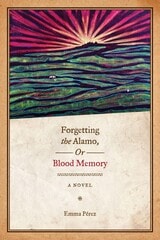
Forgetting the Alamo, Or, Blood Memory
A NovelBy Emma Pérez
University of Texas Press, 2009
Runner-up, Best Historical Fiction in English, Latino Book Awards Competition, 2010
This literary adventure takes place in nineteenth-century Texas and follows the story of a Tejana lesbian cowgirl after the fall of the Alamo. Micaela Campos, the central character, witnesses the violence against Mexicans, African Americans, and indigenous peoples after the infamous battles of the Alamo and of San Jacinto, both in 1836. Resisting an easy opposition between good versus evil and brown versus white characters, the novel also features Micaela's Mexican-Anglo cousin who assists and hinders her progress. Micaela's travels give us a new portrayal of the American West, populated by people of mixed races who are vexed by the collision of cultures and politics. Ultimately, Micaela's journey and her romance with a black/American Indian woman teach her that there are no easy solutions to the injustices that birthed the Texas Republic.
This novel is an intervention in queer history and fiction with its love story between two women of color in mid-nineteenth-century Texas. Pérez also shows how a colonial past still haunts our nation's imagination. The battles of the Alamo and San Jacinto offered freedom and liberty to Texans, but what is often erased from the story is that common people who were Mexican, Indian, and Black did not necessarily benefit from the influx of so many Anglo immigrants to Texas. The social themes and identity issues that Pérez explores—political climate, debates over immigration, and historical revision of the American West—are current today.

From Laughter to Forgetting
A Sourcebook of Czech Avant-Garde DiscoursesEdited by Zuzana Ríhová
Karolinum Press, 2023
In recent years a prominent trend in the study of European modernism and the avant-garde has been increased attention to texts and traditions that have long stood in the shadow of the French, German, and British traditions that dominate the canon. Yet this more expansive view of European modernism and the avant-garde has been hindered by the limited range of texts available outside the original languages. This book addresses that problem by offering a wide-ranging selection of literary, theoretical, and documentary sources from one of the most dynamic and original European avant-garde traditions: that of the first Czechoslovak Republic and of the Bohemian lands. The Czech avant-garde is in many respects the ideal “alternative” avant-garde to present in detail to a wider readership: it tracks Central European developments and was often influential internationally while being deeply embedded in particular cultural dynamics that produced original forms. This volume returns interwar Czech avant-garde writings to their place as a firmly embedded component of the European avant-garde.
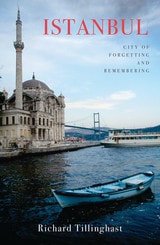
Istanbul
City of Forgetting and RememberingRichard Tillinghast
Haus Publishing, 2017
Istanbul was known in Byzantine times as the “Queen of Cities” and to the Ottoman Turks as the “Abode of Felicity.” Steeped in Istanbul’s history, Tillinghast takes his readers on a voyage of discovery through this storied cultural hub, and he is as comfortable talking about Byzantine mosaics and dervish ceremonies as Iznik ceramics and the imperial mosques. His lyrical writing brings Istanbul alive on the page as he accompanies readers to cafés, palaces, and taverns, perfectly conjuring the atmospheric delights, sounds, and senses of the city. Illuminating Istanbul’s great buildings with tales that bring Ottoman and Byzantine history to life, Tillinghast is adept at discovering both what the city remembers and what it chooses to forget.
Lost Time
On Remembering and Forgetting in Late Modern CultureDavid Gross
University of Massachusetts Press, 2000
What is the value of memory in human culture? More specifically, what role should remembering—and forgetting—play in our daily lives? These are the central questions that David Gross addresses in this original and thought-provoking book.
For centuries, Gross points out, remembering was considered essential not only to the perpetuation of society but to the maintenance of individual existence. Survival often depended on the memory of how to perform specific tasks, what values to honor, and what personal or collective identity to assume. Remembering, in short, put one in touch with the things that mattered, engendering wholeness and wisdom. Forgetting, on the other hand, led to emptiness, ignorance, and death.
With the advent of modernity, however, doubts about the value of memory grew while the negative implications of forgetting were reevaluated. In many quarters, forgetting came to be defended for the way it frees us from the past, opening the door to new perceptions, new possibilities, and new beginnings.
Now, in late modernity, Gross argues, we find ourselves in an unprecedented situation. For the first time in history, we are able to decide, without the pressure of social or cultural constraints, whether we want to remember or forget and to live our lives accordingly. But which is the better choice? Should we build our lives upon the meanings and values of a faded past? If so, what ought we to remember, and for what purpose? Or should we instead opt to forget what has come before and focus our attention on the present and future, thereby perpetually reinventing ourselves and the world we inhabit? According to Gross, our answers to these questions will determine not only who we are but what we will become as we pass from late modernity into the terra incognita of the “postmodern” age.
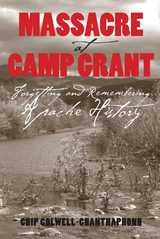
Massacre at Camp Grant
Forgetting and Remembering Apache HistoryChip Colwell-Chanthaphonh
University of Arizona Press, 2007
On April 30, 1871, an unlikely group of Anglo-Americans, Mexican Americans, and Tohono O’odham Indians massacred more than a hundred Apache men, women, and children who had surrendered to the U.S. Army at Camp Grant, near Tucson, Arizona. Thirty or more Apache children were stolen and either kept in Tucson homes or sold into slavery in Mexico. Planned and perpetrated by some of the most prominent men in Arizona’s territorial era, this organized slaughter has become a kind of “phantom history” lurking beneath the Southwest’s official history, strangely present and absent at the same time.
Seeking to uncover the mislaid past, this powerful book begins by listening to those voices in the historical record that have long been silenced and disregarded. Massacre at Camp Grant fashions a multivocal narrative, interweaving the documentary record, Apache narratives, historical texts, and ethnographic research to provide new insights into the atrocity. Thus drawing from a range of sources, it demonstrates the ways in which painful histories continue to live on in the collective memories of the communities in which they occurred.
Chip Colwell-Chanthaphonh begins with the premise that every account of the past is suffused with cultural, historical, and political characteristics. By paying attention to all of these aspects of a contested event, he provides a nuanced interpretation of the cultural forces behind the massacre, illuminates how history becomes an instrument of politics, and contemplates why we must study events we might prefer to forget.
Memory Care
Essays on ForgettingJennifer C. Nash
Duke University Press, 2027
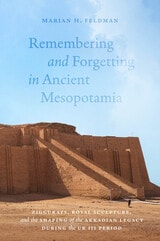
Remembering and Forgetting in Ancient Mesopotamia
Ziggurats, Royal Sculpture, and the Shaping of the Akkadian Legacy During the Ur III PeriodMarian H. Feldman
University of Chicago Press, 2026
In this innovative new study of ancient Mesopotamian art and architecture, Marian H. Feldman examines the complex legacy of the Akkadian dynasty, which spanned ca. 2350-2150 BCE in the region now known as southern Iraq. The Akkadian state played an essential role in the formation and expression of subsequent political entities in the region, yet our understanding of this period is based primarily on the historical lens of their successors, in particular the rulers of the Third Dynasty of Ur (ca. 2100-1000 BCE). Focusing on four remaining ziggurats in Ur, Eridu, Uruk, and Nippur, as well as surviving statues and steles, Feldman examines how the Ur III rulers selectively curated and erased Akkadian structures and monuments to serve their own political ambitions. Analyzing the archaeological evidence of Ur III building practices and the display of Akkadian royal sculpture, she considers the role of sacred spaces in our knowledge of the period and imagines how the cultivation of the Akkadian narrative helped the Ur III dynasty centralize its power. In so doing, this book proposes a new way to understand the impact of the survival—or erasure—of architectural and artistic remains on collective and historical memory.
Remembering and Forgetting in the Age of Technology
Teaching, Learning, and the Science of Memory in a Wired WorldMichelle D Miller
West Virginia University Press, 2022
Human minds are made of memories, and today those memories have competition. Biological memory capacities are being supplanted, or at least supplemented, by digital ones, as we rely on recording—phone cameras, digital video, speech-to-text—to capture information we’ll need in the future and then rely on those stored recordings to know what happened in the past. Search engines have taken over not only traditional reference materials but also the knowledge base that used to be encoded in our own brains. Google remembers, so we don’t have to. And when we don’t have to, we no longer can. Or can we?
Remembering and Forgetting in the Age of Technology offers concise, nontechnical explanations of major principles of memory and attention—concepts that all teachers should know and that can inform how technology is used in their classes. Teachers will come away with a new appreciation of the importance of memory for learning, useful ideas for handling and discussing technology with their students, and an understanding of how memory is changing in our technology-saturated world.
Silence on the Mountain
Stories of Terror, Betrayal, and Forgetting in GuatemalaDaniel Wilkinson
Duke University Press, 2004
Decades of terror-inspired fear have led the Guatemalans to adopt a survival strategy of silence so complete that it verges on collective amnesia. The author’s great triumph is that he finds a way for people to tell their stories, and it is through these stories—dramatic, intimate, heartbreaking—that we are shown the anatomy of a thwarted revolution that has relevance not only to Guatemala but also to countless places around the world where terror has been used as a political tool.
Slips of the Mind
Poetry as ForgettingJennifer Soong
University of Chicago Press, 2025
In Slips of the Mind, poet and critic Jennifer Soong turns away from forgetting’s long-standing associations with suppression, privation, and error to argue that the absence or failure of memory has often functioned as a generative creative principle. Exploring forgetting not as the mere rejection of a literary past or a form of negative poetics, Soong puts to the test its very aesthetic meaning. What new structures, forms of desires, styles, and long and short feelings do lapses in time allow? What is oblivion’s relationship to composition? And how does the twentieth-century poet come to figure as the quintessential embodiment of such questions?
Soong uncovers forgetting’s influence on Gertrude Stein, Lyn Hejinian, Tan Lin, Harryette Mullen, Lissa Wolsak, and New York School poets John Ashbery, James Schuyler, Bernadette Mayer, and Ted Berrigan, among others. She reveals that forgetting’s shapeshifting produces differences in poetic genre, interest, and degrees of intentionality—and that such malleability is part of forgetting’s nature. Most provocatively, Soong shows how losing track of things, leaving them behind, or finding them already gone resists overdetermination and causality in the name of surprise, as poets leverage forgetting in order to replace identity with style. Slips of the Mind is the kind of literary criticism that will reward all readers of modern and contemporary poetry.

The Feeling of Forgetting
Christianity, Race, and Violence in AmericaJohn Corrigan
University of Chicago Press, 2023
The dual traumas of colonialism and slavery are still felt by Native Americans and African Americans as victims of ongoing violence toward people of color today. In The Feeling of Forgetting, John Corrigan calls attention to the trauma experienced by white Americans as perpetrators of this violence. By tracing memory’s role in American Christianity, Corrigan shows how contemporary white Christian nationalism is motivated by a widespread effort to forget the role race plays in American society. White trauma, Corrigan argues, courses through American culture like an underground river that sometimes bursts forth into brutality, terrorism, and insurrection. Tracing the river to its source is a necessary first step toward healing.
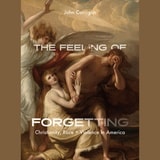
The Feeling of Forgetting
Christianity, Race, and Violence in AmericaJohn Corrigan
University of Chicago Press, 2023
A provocative examination of how religious practices of forgetting drive white Christian nationalism.
The dual traumas of colonialism and slavery are still felt by Native Americans and African Americans as victims of ongoing violence toward people of color today. In The Feeling of Forgetting, John Corrigan calls attention to the trauma experienced by white Americans as perpetrators of this violence. By tracing memory’s role in American Christianity, Corrigan shows how contemporary white Christian nationalism is motivated by a widespread effort to forget the role race plays in American society. White trauma, Corrigan argues, courses through American culture like an underground river that sometimes bursts forth into brutality, terrorism, and insurrection. Tracing the river to its source is a necessary first step toward healing.
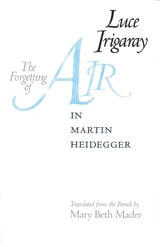
The Forgetting of Air in Martin Heidegger
By Luce Irigaray
University of Texas Press, 1999
French philosopher Luce Irigaray has become one of the twentieth century's most influential feminist thinkers. Among her many writings are three books (with a projected fourth) in which she challenges the Western tradition's construals of human beings' relations to the four elements—earth, air, fire, and water—and to nature. In answer to Heidegger's undoing of Western metaphysics as a "forgetting of Being," Irigaray seeks in this work to begin to think out the Being of sexedness and the sexedness of Being.
This volume is the first English translation of L'oubli de l'air chez Martin Heidegger (1983). In this complex, lyrical, meditative engagement with the later work of the eminent German philosopher, Irigaray critiques Heidegger's emphasis on the element of earth as the ground of life and speech and his "oblivion" or forgetting of air.
With the other volumes (Elemental Passions and Marine Lover of Friedrich Nietzsche, published elsewhere) in Irigaray's "elemental" series, The Forgetting of Air offers a fundamental rereading of basic tenets in Western metaphysics. And with its emphasis on dwelling and human habitation, it will be important reading not only in the humanities but also in architecture and the environmental sciences.
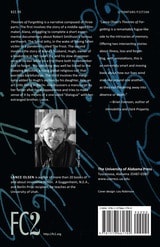
Theories of Forgetting
Lance Olsen
University of Alabama Press, 2014
Theories of Forgetting is a narrative in three parts. The first is the story of Alana, a filmmaker struggling to complete a short documentary about Robert Smithson’s famous earthwork, The Spiral Jetty, located where the Great Salt Lake meets the desert. Alana falls victim to a pandemic called The Frost, whose symptoms include an increasing sensation of coldness and growing amnesia. The second involves Alana’s husband, Hugh, owner of a rare-and-used bookstore in Salt Lake City, and his slow disappearance across Jordan while on a trip both to remember and to forget Alana’s death. The third involves marginalia added to Hugh’s section by his daughter, Aila, an art critic living in Berlin. Aila discovers a manuscript by her father after his disappearance and tries to make sense of it by means of a one-sided “dialogue” with her brother, Lance.
Each page of the novel is divided in half. Alana’s narrative runs across the top of the page, from back to front, while Hugh’s and his daughter’s tale runs “upside down” across the bottom of the page, from front to back. How a reader initially happens to pick up Theories of Forgetting determines which narrative is read first, and thereby establishing the reader’s meaning-making of the novel.

Transformations of Memory and Forgetting in Sixteenth-Century France
Marguerite de Navarre, Pierre de Ronsard, Michel de MontaigneNicolas Russell
University of Delaware Press, 2011
This book proposes that in a number of French Renaissance texts, produced in varying contexts and genres, we observe a shift in thinking about memory and forgetting. Focusing on a corpus of texts by Marguerite de Navarre, Pierre de Ronsard, and Michel de Montaigne, it explores several parallel transformations of and challenges to traditional discourses on the human faculty of memory.
Throughout Classical Antiquity and the Middle Ages, a number of influential authors described memory as a powerful tool used to engage important human concerns such as spirituality, knowledge, politics, and ethics. This tradition had great esteem for memory and made great efforts to cultivate it in their pedagogical programs. In the early sixteenth century, this attitude toward memory started to be widely questioned. The invention of the printing press and the early stages of the scientific revolution changed the intellectual landscape in ways that would make memory less important in intellectual endeavors. Sixteenth-century writers began to question the reliability and stability of memory. They became wary of this mental faculty, which they portrayed as stubbornly independent, mysterious, unruly, and uncontrollable–an attitude that became the norm in modern Western thought as is illustrated by the works of Descartes, Locke, Freud, Proust, Foucault, and Nora, for example.
Writing in this new intellectual landscape, Marguerite de Navarre, Ronsard, and Montaigne describe memory not as a powerful tool of the intellect but rather as an uncontrollable mental faculty that mirrored the uncertainty of human life. Their characterization of memory emerges from an engagement with a number of traditional ideas about memory. Notwithstanding the great many differences in concerns of these writers and in the nature of their texts, they react against or transform their classical and medieval models in similar ways. They focus on memory’s unruly side, the ways that memory functions independently of the will. They associate memory with the fluctuations of the body (the organic soul) rather than the stability of the mind (the intellectual soul). In their descriptions of memory, these authors both reflect and contribute to a modern understanding of and attitude towards this mental faculty.
Published by University of Delaware Press. Distributed worldwide by Rutgers University Press.