Results by title
15 books match the query 'Forging'
Apocalypse Never
Forging the Path to a Nuclear Weapon-Free WorldDaley, Tad
Rutgers University Press, 2012
Apocalypse Never maintains that the abolition of nuclear weapons is both essential and achievable, and reveals in fine detail what we need to do--both governments and movements--to make it a reality. Daley insists that while global climate change poses the single greatest long-term peril to the human race, the nuclear challenge in its many incarnation--nuclear terror, nuclear accident, a nuclear crisis spinning out of control--poses the single most immediate peril. Daley launches a wholesale assault on the nuclear double standard--the notion that the United States permits itself thousands of these weapons but forbids others from aspiring to even one--insisting that it is militarily unnecessary, morally indefensible, and politically unsustainable. He conclusively repudiates the most frequent objection to nuclear disarmament, "the breakout scenario"--the possibility that after abolition someone might whip back the curtain, reveal a dozen nuclear warheads, and proceed to "rule the world."
On the wings of a brand new era in American history, Apocalypse Never makes the case that a comprehensive nuclear policy agenda from President Obama, one that fully integrates nonproliferation with disarmament, can both eliminate immediate nuclear dangers and set us irreversibly on the road to abolition. In jargon-free language, Daley explores the possible verification measures, enforcement mechanisms, and governance structures of a nuclear weapon-free world. Most importantly, he decisively argues that universal nuclear disarmament is something we can transform from a utopian fantasy into a concrete political goal.

Chicanismo
The Forging of a Militant Ethos among Mexican AmericansIgnacio M. García
University of Arizona Press, 1997
Forging a Cherokee-American Alliance in the Creek War
From Creation to BetrayalSusan M. Abram
University of Alabama Press, 2015
The Creek War of 1813–1814 is studied primarily as an event that impacted its two main antagonists, the defending Creeks in what is now the State of Alabama and the expanding young American republic. Scant attention has been paid to how the United States’ Cherokee allies contributed to the war and how the war transformed their society. In Forging a Cherokee-American Alliance in the Creek War, Susan M. Abram explains in engrossing detail the pivotal changes within Cherokee society triggered by the war that ultimately ended with the Cherokees’ forced removal by the United States in 1838.
The Creek War (also known as the Red Stick War) is generally seen as a local manifestation of the global War of 1812 and a bright footnote of military glory in the dazzling rise of Andrew Jackson. Jackson’s victory, which seems destined only in historic hindsight, was greatly aided by Cherokee fighters. Yet history has both marginalized Cherokee contributions to that conflict and overlooked the fascinating ways Cherokee society changed as it strove to accommodate, rationalize, and benefit from an alliance with the expanding American republic. Through the prism of the Creek War and evolving definitions of masculinity and community within Cherokee society, Abram delineates as has never been done before the critical transitional decades prior to the Trail of Tears.
Deeply insightful, Abram illuminates the ad hoc process of cultural, political, and sometimes spiritual transitions that took place among the Cherokees. Before the onset of hostilities, the Cherokees already faced numerous threats and divisive internal frictions. Abram concisely records the Cherokee strategies for meeting these challenges, describing how, for example, they accepted a centralized National Council and replaced the tradition of conflict-resolution through blood law with a network of “lighthorse regulators.” And while many aspects of masculine war culture remained, it too was filtered and reinterpreted through contact with the legalistic and structured American military.
Rigorously documented and persuasively argued, Abram’s award-winning Forging a Cherokee-American Alliance in the Creek War fills a critical gap in the history of the early American republic, the War of 1812, the Cherokee people, and the South.
Forging a Mexican People
Collective Subjectivities in Postrevolutionary Print Culture, 1917–1968Pablo Zavala
University of Arizona Press, 2026
Forging a Mexican People shows how illustrated print culture helped to construct and deconstruct versions of “a people” in postrevolutionary Mexico.
Through meticulous research, Pablo Zavala uncovers the ways photographers, graphic artists, writers, and activists used print culture to challenge hegemonic conceptions of state-guided narratives and forge alternative collective subjectivities. This book offers a fresh perspective on the sociopolitical landscape of postrevolutionary Mexico, revealing how cultural artifacts simultaneously crafted and reflected the people vis-à-vis different political and social categories. By examining print culture, editorial practices, and related processes such as the creation, consumption, and distribution of said culture, Zavala’s research contributes to scholarship that has recently reexamined the construction of nationalism by moving away from the focus on state formation and addressing the horizontal and aesthetic dimensions in products by cultural producers from nonstate and grassroots political sectors.
Zavala examines the conceptual parameters of el pueblo by analyzing El Universal Ilustrado, El Machete, the Taller de Gráfica Popular, the protest graphic art used in Mexico City’s 1968 popular student movement, and graphic art used in California’s Chicano farmworkers’ struggle. Based on in-depth archival research, the work includes primary sources that have never been digitized, offering readers unique insights into the visual manifestations of Mexico’s postrevolutionary identity and their enduring significance.
Forging a Sustainable Southwest
The Power of Collaborative ConservationStephen E. Strom
University of Arizona Press, 2024
Forging a Sustainable Southwest introduces readers to four conservation efforts that provide insight into how diverse groups of citizens have worked collaboratively to develop visions for land use that harmonized sometimes conflicting ecological, economic, cultural, and community needs. Through the voices of more than seventy individuals involved in these efforts, we learn how they’ve developed plans for protecting, restoring, and stewarding lands sustainably; the management and funding tools they’ve used; and their perceptions of the challenges that remain and how to meet them.
This book details efforts to craft the Sonoran Desert Conservation Plan, establish Las Cienegas National Conservation Area, protect Cienega Ranch, and create the Malpai Borderlands Group. It will appeal to anyone interested in grassroots efforts to protect the vital ecosystems of the western United States.
These inspiring stories of citizens and groups working together demonstrate a path for the future built day-by-day: breaking bread at potlucks, holding informal front-porch discussions, and later finding common purpose in community-wide meetings. Might their efforts reveal a path to rebuilding our democratic systems from the ground up?

Forging an Integrated Europe
Barry Eichengreen and Jeffry Frieden, Editors
University of Michigan Press, 1998
Forging the Copper Collar
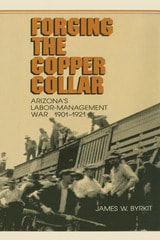
Arizona's Labor-Management War of 1901–1921James W. Byrkit
University of Arizona Press, 1982
Just after dawn, two thousand armed vigilantes took to the streets of this remote Arizona mining town to round up members and sympathizers of the radical Industrial Workers of the World. Before the morning was over, nearly twelve hundred alleged Wobblies had been herded onto waiting boxcars. By day's end, they had been hauled off to New Mexico.
While the Bisbee Deportation was the most notorious of many vigilante actions of its day, it was more than the climax of a labor-management war—it was the point at which Arizona donned the copper collar. That such an event could occur, James Byrkit contends, was not attributable so much to the marshaling of public sentiment against the I.W.W. as to the outright manipulation of the state's political and social climate by Eastern business interests.
In Forging the Copper Collar, Byrkit paints a vivid picture of Arizona in the early part of this century. He demonstrates how isolated mining communities were no more than mercantilistic colonies controlled by Eastern power, and how that power wielded control over all the Arizona's affairs—holding back unionism, creating a self-serving tax structure, and summarily expelling dissidents.
Because the years have obscured this incident and its background, the writing of Copper Collar involved extensive research and verification of facts. The result is a book that captures not only the turbulence of an era, but also the political heritage of a state.

Forging the Future of Special Collections
Arnold Hirshon
American Library Association, 2016

Forging the Star
The Official Modern History of the United States Marshals ServiceDavid S. Turk
University of North Texas Press, 2016

Forging the World
Strategic Narratives and International RelationsAlister Miskimmon, Ben O'Loughlin, and Laura Roselle, Editors
University of Michigan Press, 2017
Immigrants and Boomers
Forging a New Social Contract for the Future of AmericaDowell Myers
Russell Sage Foundation, 2007

Islamic and European Expansion
The Forging of a Global OrderMichael Adas
Temple University Press, 1993
Medieval Jerusalem
Forging an Islamic City in Spaces Sacred to Christians and JewsJacob Lassner
University of Michigan Press, 2017
Examining Muslim historiography and religious lore in light of Jewish traditions about the city, Jacob Lassner points out how these reworked Jewish traditions and the imposing monumental Islamic architecture of the city were meant to demonstrate that Islam had superseded Judaism and Christianity as the religion for all monotheists. He interrogates the literary sources of medieval Islamic historiography and their modern interpreters as if they were witnesses in a court of law, and applies the same method for the arguments about the monuments of the city’s material culture, including the great archaeological discoveries along the south wall of the ancient Temple Mount.
This book will be of interest to a broad range of readers given the significance of the city in the current politics of the Near East. It will in part serve as a corrective to narratives of Jerusalem’s past that are currently popular for scholarly and political reasons.

Morgan Park
Duluth, U.S. Steel, and the Forging of a Company TownArnold R. Alanen
University of Minnesota Press, 2008
From 1915 to 1971 the large U.S. Steel plant was a major part of Duluth’s landscape and life. Just as important was Morgan Park—an innovatively planned and close-knit community constructed for the plant’s employees and their families. In this new book Arnold R. Alanen brings to life Morgan Park, the formerly company-controlled town that now stands as a city neighborhood, and the U.S. Steel plant for which it was built.
Planned by renowned landscape architects, architects, and engineers, and provided with schools, churches, and recreational and medical services by U.S. Steel, Morgan Park is an iconic example—like Lowell, Massachusetts, and Pullman, Illinois—of a twentieth-century company town, as well as a window into northeastern Minnesota’s industrial roots.
Starting with the intense political debates that preceded U.S. Steel’s decision to build a plant in Duluth, Morgan Park follows the town and its residents through the boom years to the closing of the outmoded facility—an event that foreshadowed industrial shutdowns elsewhere in the United States—and up to today, as current residents work to preserve the community’s historic character.
Through compelling archival and contemporary photographs and vibrant stories of a community built of concrete and strong as steel, Alanen shows the impact both the plant and Morgan Park have had on life in Duluth.
Arnold R. Alanen is professor of landscape architecture at the University of Wisconsin–Madison. His previous books include Main Street Ready-Made: The New Deal Community of Greendale, Wisconsin and Preserving Cultural Landscapes in America.
Violent Histories, Livable Futures
Forging the Power of the PeopleEric King Watts
Michigan State University Press, 2026
Our political landscape is crowded with competing voices—claims, demands, grievances, and even acts of violence—all made in the name of some idea of “the people.” This powerful concept has been wielded both to assert democratic sovereignty and to justify exclusion and control. Violent Histories, Livable Futures unpacks this complex dynamic through compelling historical case studies, spanning sub-Saharan Africa in the 1950s, post–World War II Guatemala, and the United States in the aftermath of George Floyd’s murder. By tracing how societies have contended over which people matter and which do not, this book offers a deeply relevant exploration of power, representation, and the struggle for justice, all in pursuit of a more livable future.