Results by title

5 books match the query 'Formalism (Literary analysis)'
cover of Life-Destroying Diagrams

Life-Destroying Diagrams

Eugenie Brinkema

Duke University Press, 2021
In Life-Destroying Diagrams, Eugenie Brinkema brings the insights of her radical formalism to bear on supremely risky terrain: the ethical extremes of horror and love. Through close readings of works of film, literature, and philosophy, she explores how diagrams, grids, charts, lists, abecedaria, toroids, tempos, patterns, colors, negative space, lengths, increments, and thresholds attest to formal logics of torture and cruelty, violence and finitude, friendship and eros, debt and care. Beginning with a wholesale rethinking of the affect of horror, orienting it away from entrenched models of feeling toward impersonal schemes and structures, Brinkema moves outward to consider the relation between objects and affects, humiliation and metaphysics, genre and the general, bodily destruction and aesthetic generation, geometry and scenography, hatred and value, love and measurement, and, ultimately, the tensions, hazards, and speculative promise of formalism itself. Replete with etymological meditations, performative typography, and lyrical digressions, Life-Destroying Diagrams is at once a model of reading without guarantee and a series of generative experiments in the writing of aesthetic theory.
[more]
cover of The Forms of the Affects

The Forms of the Affects

Eugenie Brinkema

Duke University Press, 2014

What is the relationship between a cinematic grid of color and that most visceral of negative affects, disgust? How might anxiety be a matter of an interrupted horizontal line, or grief a figure of blazing light?

Offering a bold corrective to the emphasis on embodiment and experience in recent affect theory, Eugenie Brinkema develops a novel mode of criticism that locates the forms of particular affects within the specific details of cinematic and textual construction. Through close readings of works by Roland Barthes, Hollis Frampton, Sigmund Freud, Peter Greenaway, Michael Haneke, Alfred Hitchcock, Søren Kierkegaard, and David Lynch, Brinkema shows that deep attention to form, structure, and aesthetics enables a fundamental rethinking of the study of sensation. In the process, she delves into concepts as diverse as putrescence in French gastronomy, the role of the tear in philosophies of emotion, Nietzschean joy as a wild aesthetic of repetition, and the psychoanalytic theory of embarrassment. Above all, this provocative work is a call to harness the vitality of the affective turn for a renewed exploration of the possibilities of cinematic form.
[more]
cover of The Order of Forms: Realism, Formalism, and Social Space

The Order of Forms

Realism, Formalism, and Social Space

Anna Kornbluh

University of Chicago Press, 2019

In literary studies today, debates about the purpose of literary criticism and about the place of formalism within it continue to simmer across periods and approaches. Anna Kornbluh contributes to—and substantially shifts—that conversation in The Order of Forms by offering an exciting new category, political formalism, which she articulates through the co-emergence of aesthetic and mathematical formalisms in the nineteenth century. Within this framework, criticism can be understood as more affirmative and constructive, articulating commitments to aesthetic expression and social collectivity. 
 
Kornbluh offers a powerful argument that political formalism, by valuing forms of sociability like the city and the state in and of themselves, provides a better understanding of literary form and its political possibilities than approaches that view form as a constraint. To make this argument, she takes up the case of literary realism, showing how novels by Dickens, Brontë, Hardy, and Carroll engage mathematical formalism as part of their political imagining. Realism, she shows, is best understood as an exercise in social modeling—more like formalist mathematics than social documentation. By modeling society, the realist novel focuses on what it considers the most elementary features of social relations and generates unique political insights. Proposing both this new theory of realism and the idea of political formalism, this inspired, eye-opening book will have far-reaching implications in literary studies.
 
[more]
cover of The Origins of Russian Literary Theory: Folklore, Philology, Form

The Origins of Russian Literary Theory

Folklore, Philology, Form

Jessica Merrill

Northwestern University Press, 2022

Russian Formalism is widely considered the foundation of modern literary theory. This book reevaluates the movement in light of the current commitment to rethink the concept of literary form in cultural-historical terms. Jessica Merrill provides a novel reconstruction of the intellectual historical context that enabled the emergence of Formalism in the 1910s. Formalists adopted a mode of thought Merrill calls the philological paradigm, a framework for thinking about language, literature, and folklore that lumped them together as verbal tradition. For those who thought in these terms, verbal tradition was understood to be inseparable from cultural history. Merrill situates early literary theories within this paradigm to reveal abandoned paths in the history of the discipline—ideas that were discounted by the structuralist and post-structuralist accounts that would emerge after World War II.

The Origins of Russian Literary Theory reconstructs lost Formalist theories of authorship, of the psychology of narrative structure, and of the social spread of poetic innovations. According to these theories, literary form is always a product of human psychology and cultural history. By recontextualizing Russian Formalism within this philological paradigm, the book highlights the aspects of Formalism’s legacy that speak to the priorities of twenty-first-century literary studies.
[more]
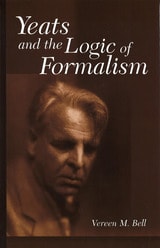
cover of Yeats and the Logic of Formalism

Yeats and the Logic of Formalism

Vereen M. Bell

University of Missouri Press, 2006

Yeats and the Logic of Formalism deals with formalism as a philosophy in Yeats’s works and how that in turn affects both his art and his social vision. Vereen M. Bell’s linking of “formalism” and “philosophy” stems from a meditation by Yeats in a manuscript note: “I am always feeling a lack of life's own values behind my
thought. They should have been there before the stream began, before it became necessary to let the work create its values.” In Bell’s reading, formalism is not simply a philosophy of art but a philosophy of life as directed by art—existential at its source and unpredictably political in its applications.
            Bell examines formalism as an ideology and evaluates its credibility in Yeats's practice in relation to other theoretical discourses and in the context of the turbulent cultural and historical circumstances under which Yeats worked. He invokes and elaborates upon Edward Said’s reading of Yeats as a special kind of colonial subject. He revisits in this context the issue of how much Yeats and Nietzsche have in common and argues, in the manner of J. Hillis Miller, that the primordial is for Yeats what formalism ultimately sets itself against.
            Yeats and the Logic of Formalism mediates between older, traditional readings and recent materialist critiques of Yeats’s work in an effort to restore a balanced perspective. The author centers most of his discussion on Yeats's poems as acts of thought, both as poetry and as a body of ideas. Within this context he
maintains that Yeats as a modernist is essentially aligned with Wallace Stevens in the project of creating supreme fictions. Formalism in this function, he argues, is an ideology without  content. As such, it compelled Yeats to remain unsettled in his outlook. On the other hand, it enabled him, as Richard Ellmann has pointed out, to continually adapt and readapt "himself to the changing conditions of his body and mind and of the outside world."
[more]