Results by title

10 books match the query 'Formative Years'

cover of British Television: The formative years

British Television

The formative years

Russell Burns

The Institution of Engineering and Technology, 1986

On 2 November 1936 the world's first high definition television station was inaugurated at Alexandra Palace. Two competing companies, Marconi-EMI Television Company Ltd and Baird Television Ltd, provided studio and transmitting equipment for the new service which operated, on an alternate basis, with the systems of the two companies. After a trial period the 405-line system of the Marconi-EMI company was adopted and the last transmission by the 240-line system of Baird Television Ltd was sent out on 30 January 1937.
[more]
cover of Communications: An international history of the formative years

Communications

An international history of the formative years

Russell W. Burns

The Institution of Engineering and Technology, 2004
Communications: An international history of the formative years traces the evolution of communications from 500 BC, when fire beacons were used for signalling, to the 1940s, when high definition television systems were developed for the entertainment, education and enlightenment of society. The book does not simply provide a chronicle of dates and events, nor is it a descriptive catalogue of devices and systems. Rather, it discusses the essential factors - technical, political, social, economic and general - that enabled the evolution of modern communications. The author has taken a contextual approach to show the influence of one discipline upon another, and the unfolding story has been widely illustrated with contemporary quotations, allowing the progress of communications to be seen from the perspective of the times and not from the standpoint of a later generation.
[more]
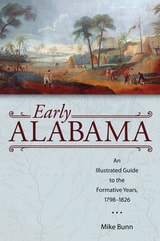
cover of Early Alabama: An Illustrated Guide to the Formative Years, 1798–1826

Early Alabama

An Illustrated Guide to the Formative Years, 1798–1826

Mike Bunn

University of Alabama Press, 2019

An illustrated guidebook documenting the history and sites of the state’s origins

Alabama’s territorial and early statehood years represent a crucial formative period in its past, a time in which the state both literally and figuratively took shape. The story of the remarkable changes that occurred within Alabama as it transitioned from frontier territory to a vital part of the American union in less than a quarter century is one of the most compelling in the state’s past. This history is rich with stories of charismatic leaders, rugged frontiersmen, a dramatic and pivotal war that shaped the state’s trajectory, raging political intrigue, and pervasive sectional rivalry.

Many of Alabama’s modern cities, counties, and religious, educational,  and governmental institutions first took shape within this time period.  It also gave way to the creation of sophisticated trade and communication networks, the first large-scale cultivation of cotton, and the advent of the steamboat. Contained within this story of growth and innovation is a parallel story, the dispossession of Native groups  of their lands and the forced labor of slaves, which fueled much  of Alabama’s early development.

Early Alabama: An Illustrated Guide to the Formative Years, 1798–1826 serves as a traveler’s guidebook with a fast-paced narrative that traces Alabama’s developmental years. Despite the great significance of this era in the state’s overall growth, these years are perhaps the least understood in all of the state’s history and have received relatively scant attention from historians. Mike Bunn has created a detailed guide—appealing to historians and the general public—for touring historic sites and structures including selected homes, churches, businesses, government buildings, battlefields, cemeteries, and museums..
[more]
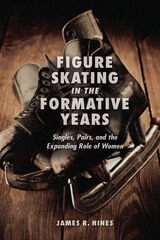
cover of Figure Skating in the Formative Years: Singles, Pairs, and the Expanding Role of Women

Figure Skating in the Formative Years

Singles, Pairs, and the Expanding Role of Women

James R. Hines

University of Illinois Press, 2015

Once a winter pastime for socializing and courtship, skating evolved into the wildly popular competitive sport of figure skating, one of the few athletic arenas where female athletes hold a public profile--and earning power--equal to that of men.
 
Renowned sports historian James R. Hines chronicles figure skating's rise from its earliest days through its head-turning debut at the 1908 Olympics and its breakthrough as entertainment in the 1930s. Hines credits figure skating's explosive expansion to an ever-increasing number of women who had become proficient skaters and wanted to compete, not just in singles but with partners as well.
 
Matters reached a turning point when British skater Madge Syers entered the otherwise-male 1902 World Championship held in London and finished second. Called skating's first feminist, Syers led a wave of women who made significant contributions to figure skating and helped turn it into today's star-making showcase at every Winter Olympics.
 
Packed with stories and hard-to-find details, Figure Skating in the Formative Years tells the early history of a sport loved and followed by fans around the world.
[more]
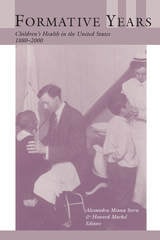
cover of Formative Years: Children's Health in the United States, 1880-2000

Formative Years

Children's Health in the United States, 1880-2000

Alexandra Minna Stern and Howard Markel, Editors

University of Michigan Press, 2004

Much has changed in the lives of children, and in the health care provided to them, over the past century. Formative Years explores how children's lives have become increasingly medicalized, traces the emergence of the fields of pediatrics and child health, and offers fascinating case studies of important and timely issues.

With contributions from historians and physicians, this collection illuminates some of the most important transformations in children's health in the United States since the 1880s. Opening with a history of pediatrics as a medical specialty, the book addresses such topics as the formulation of normal growth curves, Better Babies contests at county fairs, the "discovery" of the sexual abuse of children, and the political radicalism of the founder of pediatrics, Dr. Abraham Jacobi.

One of the first long-term historical and analytical overviews of pediatrics and child health in the twentieth century, Formative Years will be a welcome addition to several fields, including the history of medicine and technology, the history of childhood, modern U.S. history, women's history, and American studies. It also has ramifications for policymakers concerned with child welfare and development and poses important questions about the direction of children's health in the twenty-first century.
Alexandra Minna Stern is Associate Director of the Center for the History of Medicine and Assistant Professor of Obstetrics and Gynecology and American Culture at the University of Michigan. Howard Markel is the George Edward Wantz Professor of the History of Medicine, Professor of Pediatrics and Communicable Diseases, and Professor of History at the University of Michigan, and Director of the Center for the History of Medicine.
[more]
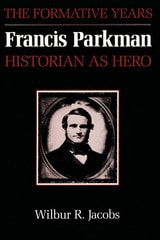
cover of Francis Parkman, Historian as Hero: The Formative Years

Francis Parkman, Historian as Hero

The Formative Years

By Wilbur R. Jacobs

University of Texas Press, 1991

A historian who lived the kind of history he wrote, Francis Parkman is a major—and controversial—figure in American historiography. His narrative style, while popular with readers wanting a "good story," has raised many questions with professional historians. Was Parkman writing history or historical fiction? Did he color historical figures with his own heroic self-image? Was his objectivity compromised by his "unbending, conservative, Brahmin" values? These are some of the many issues that Wilbur Jacobs treats in this thought-provoking study.

Jacobs carefully considers the "apprenticeship" of Francis Parkman, first spent in facing the rigors of the Oregon Trail and later in struggling to write his histories despite a mysterious, frequently incapacitating illness. He shows how these events allowed Parkman to create a heroic self-image, which impelled his desire for fame as a historian and influenced his treatment of both the "noble" and the "savage" characters of his histories.

In addition to assessing the influence of Parkman's development and personality on his histories, Jacobs comments on Parkman's relationship to basic social and cultural issues of the nineteenth century. These include the slavery question, Native American issues, expansion of the suffrage to new groups, including women, and anti-Catholicism.

[more]
cover of Justice and Reform: The Formative Years of the OEO Legal Services Program

Justice and Reform

The Formative Years of the OEO Legal Services Program

Earl Johnson

Russell Sage Foundation, 1974

Justice and Reform is the first study of the origins, philosophy, creation, management, and impact of the Office of Economic Opportunity Legal Services Program. As such, it clearly and concisely describes the Program's role both as an instrument of equal justice and as a strategy for overcoming poverty. Timely, important, and unique, it tells the story behind the OEO Legal Services Program—an endeavor that has been called both the most successful element of the war on poverty and the most stimulating development to occur in the American legal profession during the Twentieth Century. The early chapters in the book reveal the nature and motivations of the two groups which joined to create the Program: the conservative, American Bar Association sponsored 89-year-old legal aid movement and the Ford Foundation-financed neighborhood lawyer experiments that started in 1962 under the direction of young activist lawyers. Why they merged and how they merged forms the background for a description of how the partners persuaded the OEO bureaucracy to start a legal services program and convinced over 200 communities (including most large cities) to set up a federally funded legal assistance agency. Legal Services Program established policy, how it settled upon "law reform" as the priority function of the Program, how it preserved the integrity of its policies within OEO, and how it caused its grantees to engage in law reform. Chapter 8 evaluates, for the first time, the economic, political, and social impact of the Program as of 1972. The final chapter speculates on the future of government-subsidized legal assistance in the United States from the perspective of the OEO program's twin goals of equal justice and social reform.
[more]
cover of Television: An international history of the formative years

Television

An international history of the formative years

R.W. Burns

The Institution of Engineering and Technology, 1998
From the first notions of 'seeing by electricity' in 1878, through the period of the first demonstration of rudimentary television in 1926 and up to 1940, when war brought the advance of the technology to a temporary halt, the development of television gathered about it a tremendous history. Following the discovery of the photo-conductive effect, numerous schemes for television were suggested but it was in the wake of Baird's early demonstrations that real industrial interest developed and the pace of progress increased. Much research and development work was undertaken in the UK, the US, Germany and France. By 1936 television technology had advanced to the point where high definition broadcasting was realistic.
[more]
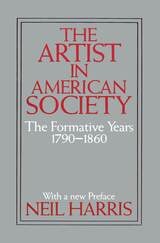
cover of The Artist in American Society: The Formative Years

The Artist in American Society

The Formative Years

Neil Harris

University of Chicago Press, 1982

What was the place of the artist in a new society? How would he thrive where monarchy, aristocracy, and an established church—those traditional patrons of painting, sculpture, and architecture—were repudiated so vigorously? Neil Harris examines the relationships between American cultural values and American society during the formative years of American art and explores how conceptions of the artist's social role changed during those years.
[more]
cover of The Struggle for Unity: Colour television, the formative years

The Struggle for Unity

Colour television, the formative years

Russell W. Burns

The Institution of Engineering and Technology, 2008

The Struggle for Unity: Colour television, the formative years traces the evolution of colour television from 1928, when rudimentary colour television was demonstrated for the first time, to c.1966, when the NTSC system and its variants, the PAL and SECAM systems, became widely available for the entertainment, education and enlightenment of society. Among the many topics discussed in the book, mention is made of the following: compatibility and non-compatibility; mechanical and all-electronic systems; field, line and dot sequential scanning; bandwidth constraints and band-sharing techniques; the CBS-RCA conflict; the relative merits of the different systems; the attempt to achieve unity of purpose in Europe; standards; and the development of colour cameras and display tubes. The book, which is based predominantly on written primary source material, does not simply provide a chronicle of dates and descriptions of events, devices and systems. Rather, it discusses the essential factors of colour television history from a general, technical and political viewpoint. Great care has been taken to ensure that an unbiased, accurate and balanced history has been written. Numerous references are given at the end of each chapter and the book is profusely illustrated.
[more]