Results by title
2 books match the query 'Forster'
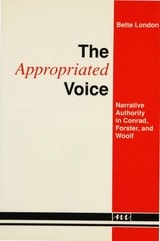
The Appropriated Voice
Narrative Authority in Conrad, Forster, and WoolfBette London
University of Michigan Press, 1990
The Appropriated Voice: Narrative Authority in Conrad, Forster, and Woolf reassesses questions of voice in three central modernist texts: Heart of Darkness, A Passage to India, and To the Lighthouse. Representing voice as the site of a struggle articulated on a number of fronts, Bette London challenges traditional assumptions about voice as a reliable marker of individuality, originality, self-identity, and aesthetic autonomy—assumptions reinforced in the recent reconstructions of modernism in postmodernism’s discourses.Drawing upon narrative theory, cultural criticism, and cultural ethnography, as well as feminist theory, London provides a sophisticated critique of the conventional categories at work in both traditional and revisionist criticism. Her method reveals the narrative and cultural appropriations through which modernism speaks, and produces what might be called modernism’s other ideology: its performance of its own political and aesthetic complicities; its display of its own second-handedness.The book is a contribution to contemporary theoretical debates as well as to the scholarship pertaining to Conrad, Forster, and Woolf.
[more]
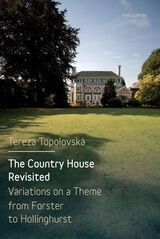
The Country House Revisited
Variations on a Theme from Forster to HollinghurstTereza Topolovská
Karolinum Press, 2017
From Howard’s End to Brideshead Revisited, this book explores the leitmotif of the English country house in twentieth- and twenty-first-century fiction, with a focus on the works of E. M. Forster, Evelyn Waugh, Iris Murdoch, Alan Hollinghurst, and Sarah Waters. Integrating wider social and cultural contexts with contemporary architectural developments, Tereza Topolovská reveals that the variety of literary depictions of the country house reflects the physical diversification of buildings that can be classified as such, from smaller variants to formerly grand residences on the brink of physical collapse. Within the scope of contemporary fiction, architecture, and poetics of space, the country house—with its uniquely integrating and exceptionally evocative qualities—accentuates different conceptions of dwelling. Consequently, literary portrayals of the country house can be seen as both prefiguring and reflecting the contemporary practice of living.
[more]