Results by title
3 books match the query 'Foster, Lawrence'

Differing Visions
DISSENTERS IN MORMON HISTORYEdited by Roger D. Launius and Linda Thatcher: Foreword by Leonard J. Arrington
University of Illinois Press, 1994
This exciting volume uses closeup looks at nineteen Mormon dissenters to focus on the variety of religious sentiment within the Mormon church and to explore how it has encouraged divergent ideas from the early 1800s through modern times.
"An absolute necessity for anyone interested in the history/direction of the Latter Day Saint Movement." -- Gerald John Kloss, Latter Day Saint History
"Well done. . . . Respectful and professional." -- Lynn D. Wardle, BYU Studies
"Makes a valuable contribution to our improved understanding of the rich heritage and faith of Mormonism." -- Milan D. Smith Jr., Sunstone
"An important and thought-provoking book." -- Lola Van Wagenen, Utah Historical Quarterly
"A splendid collection. . . . Essential reading for anyone interested even slightly in the Restoration movement." -- Paul Shupe, The John Whitmer Historical Association Journal
[more]
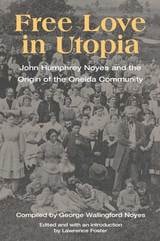
Free Love in Utopia
John Humphrey Noyes and the Origin of the Oneida CommunityCompiled by George Wallingford Noyes
University of Illinois Press, 2001
The "free love" Oneida Community, founded in New York state during the turbulent decades before the Civil War, practiced an extraordinary system of "complex marriage" as part of its sustained experiment in creating the kingdom of heaven on earth. For more than thirty years, two hundred adult members considered themselves heterosexually married to the entire community rather than to a single monogamous partner.
Free Love in Utopia provides the first in-depth account of how complex marriage was introduced among previously monogamous or single Oneida Community members. Bringing together vivid, firsthand writings by members of the community--including personal correspondence, memoranda on spiritual and material concerns, and official pronouncements--this volume portrays daily life in Oneida and the deep religious commitment that permeated every aspect of it. It also presents a complex portrait of the community's founder, John Humphrey Noyes, who demanded not only complete religious loyalty from his followers but also minute control over their sexual lives. It recounts the formidable legal suits faced by the community--one of which almost forced it to disband in 1852--and the critical behind-the-scenes work of Noyes's second-in-command, John L. Miller. Most important, Free Love in Utopia describes in detail how Oneida's "enlarged family" was created and how its unorthodox practices affected its members.
Key selections from a large collection of primary documents detailing Oneida's early years were compiled by George Wallingford Noyes, nephew of the founder. The present volume, astutely edited and introduced by noted communitarian scholar Lawrence Foster, marks the first publication of G. W. Noyes's remarkable manuscript, excerpted from the irreplaceable original documents that were deliberately burned after his death. The volume also reproduces Oneida's First Annual Report, which contains the sexual manifesto that underlay the community.
[more]
Religion and Sexuality
The Shakers, the Mormons, and the Oneida CommunityLawrence Foster
University of Illinois Press, 2009
"Most writers have treated these three groups and the social ferment out of which they grew as simply an American sideshow. . . . In this book, therefore, I have attempted to go beyond the conventional focus on what these groups did; I have also sought to explain why they did what they did and how successful they were in terms of their own objectives. By trying sympathetically to understand these extraordinary experiments in social and religious revitalization, I believe it is possible to come to terms with a broader set of questions that affect all men and women during times of crisis and transition."--From the preface
Winner of the Best Book Award, Mormon History Association
Winner of the Best Book Award, Mormon History Association
[more]