Results by title
9 books match the query 'Four Corners Region'
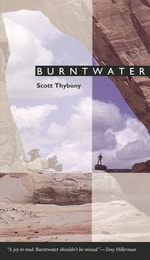
Burntwater
Scott Thybony
University of Arizona Press, 1997
This book takes the backroads, crossing the Colorado Plateau from the headwaters of the Virgin River to the mouth of the Dirty Devil, from the badlands below Twin Angels to a remote mesa in Bandelier. As the miles go by and the stories unfold, there is a growing sense of mystery, of words not spoken, of messages carried on the wind. Reaching the Shrine of the Stone Lions, the writer recounts a near-fatal descent into the Grand Canyon where he finds a way to reconnect with the beauty of life. There his journey ends with an emotional punch that goes straight to the mind and the heart.
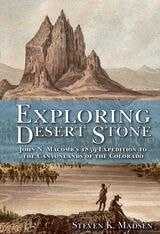
Exploring Desert Stone
John N. Macomb's 1859 Expedition to the Canyonlands of the ColoradoSteven K. Madsen
Utah State University Press, 2022
The soldiers and scientists followed in part the Old Spanish Trail, whose location they documented and verified. Seeking to find the confluence of the Colorado and the Green and looking for alternative routes into Utah, which was of particular interest in the wake of the Utah War, they produced a substantial documentary record, most of which is published for the first time in this volume. Theirs is also the first detailed map of the region, and it is published in Exploring Desert Stone, as well.
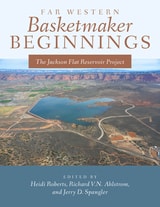
Far Western Basketmaker Beginnings
The Jackson Flat ProjectEdited by Heidi Roberts, Richard V. N. Ahlstrom, and Jerry D. Spangler
University of Utah Press, 2022
This volume, based on the results of excavations at Jackson Flat Reservoir south of Kanab, examines a litany of firsts: the earliest Archaic pithouses ever found in this region, evidence that maize farmers arrived here a thousand years earlier than previously reported, and the emergence of a complex Basketmaker farming and foraging culture. Specialists in Far Western Puebloan culture, architecture, settlement patterns, subsistence, chronometry, and prehistoric technologies make a compelling case that farming was introduced to the region by San Pedro immigrants, and that the blending of farmers with local foraging groups gave rise to a Basketmaker lifeway by 200 BC. This book marks a giant leap forward in archaeologists’ understanding of the earliest maize farmers north and west of the Colorado River.
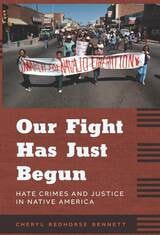
Our Fight Has Just Begun
Hate Crimes and Justice in Native AmericaCheryl Redhorse Bennett
University of Arizona Press, 2022
Illuminating largely untold stories of hate crimes committed against Native Americans in the Four Corners region of the United States, this work places these stories within a larger history, connecting historical violence in the United States to present-day hate crimes. Bennett contends that hate crimes committed against Native Americans have persisted as an extension of an “Indian hating” ideology that has existed since colonization, exposing how the justice system has failed Native American victims and families.
While this book looks deeply at multiple generations of unnecessary and ongoing pain and violence, it also recognizes that this is a time of uncertainty and hope. The movement to abolish racial injustice and racially motivated violence has gained fierce momentum. Our Fight Has Just Begun shows that racism, hate speech, and hate crimes are ever present and offers recommendations for racial justice.
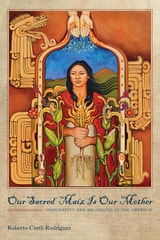
Our Sacred Maíz Is Our Mother
Indigeneity and Belonging in the AmericasRoberto Cintli Rodríguez
University of Arizona Press, 2014
Follow it he did, and his book Our Sacred Maíz Is Our Mother changes the way we look at Mexican Americans. Not so much peoples created as a result of war or invasion, they are people of the corn, connected through a seven-thousand-year old maíz culture to other Indigenous inhabitants of the continent. Using corn as the framework for discussing broader issues of knowledge production and history of belonging, the author looks at how corn was included in codices and Mayan texts, how it was discussed by elders, and how it is represented in theater and stories as a way of illustrating that Mexicans and Mexican Americans share a common culture.
Rodriguez brings together scholarly and traditional (elder) knowledge about the long history of maíz/corn cultivation and culture, its roots in Mesoamerica, and its living relationship to Indigenous peoples throughout the continent, including Mexicans and Central Americans now living in the United States. The author argues that, given the restrictive immigration policies and popular resentment toward migrants, a continued connection to maíz culture challenges the social exclusion and discrimination that frames migrants as outsiders and gives them a sense of belonging not encapsulated in the idea of citizenship. The “hidden transcripts” of corn in everyday culture—art, song, stories, dance, and cuisine (maíz-based foods like the tortilla)—have nurtured, even across centuries of colonialism, the living maíz culture of ancient knowledge.
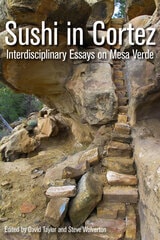
Sushi in Cortez
Interdisciplinary Essays on Mesa VerdeDavid Taylor and Steve Wolverton
University of Utah Press, 2015
The Mesa Verde region is one of the most popular tourist destinations in the world and is an area fraught with complexities, anomalies, and layers of histories. Sushi in Cortez is a collection of essays by an interdisciplinary group of academics, artists, and cultural observers that explores this diverse landscape and heritage by combining and sharing the differing perspectives provided by various disciplines. Poetry, film, environmental philosophy, nature photography, native Pueblo perspectives, and archaeology are used to touch on the common questions people ask about the value of their work and lives as well as the value of visiting ancient sites such as Mesa Verde. The authors share personal stories about the difficulties, joys, confusions, and epiphanies they experienced as they crossed the boundaries of their professional lives, coming to understand how incomplete any single rendition of place can be. Find additional images on our website www.uofupress.com.
Take a look inside the authors’ Mesa Verde experience in this short film,“Location Fracture” by Melinda Levin.
Tony Hillerman's Navajoland
Hideouts, Haunts, and Havens in the Joe Leaphorn and Jim Chee MysteriesLaurance D. Linford
University of Utah Press, 2005
Tony Hillerman's Navajoland
Hideouts, Haunts, and Havens in the Joe Leaphorn and Jim Chee MysteriesLaurance D. Linford
University of Utah Press, 2011
Tony Hillerman is beloved for his novels of intrigue in the American Southwest. In Tony Hillerman’s Navajoland, Laurance Linford takes readers on a journey through the Four Corners region to the haunts of Hillerman’s characters. Offered in encyclopedic form, each entry gives the common name of a particular location, the Navajo name and history, and a description of the location’s significance in various Hillerman novels. An understanding of the Navajo names and their relations to the landscape will lend a new dimension to the characters and events Tony Hillerman created.
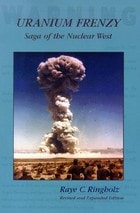
Uranium Frenzy
Saga of the Nuclear WestRaye C. Ringholz
Utah State University Press, 2002
The uranium boom is only part of the larger story of atomic weapons testing and its impact in the western United States. Nuclear explosions at the Nevada Test Site not only spurred uranium mining, they also had a disastrous impact on many Americans: downwinders in the eastward path of radiation clouds, military observers and guinea pigs in exposed positions, and Navajo and other uranium mill workers all became victims, as deaths from cancer and other radiation-caused diseases reached much higher than normal rates among them. Tons of radioactive waste left by mines, mills, and the nuclear industry and how to dispose of them are other nagging legacies of the nuclear era. Recent decades have brought multiple attempts by victims to obtain compensation from the federal government and other legal battles over disposal of nuclear waste. When courts refused to grant relief to downwinders and others, Congress eventually interceded and legislated compensation for a limited number of victims able to meet strict criteria, but did not adequately fund the program. Recently, Congress attempted to fix this shortfall, but in the meantime many downwinders and others holding compensation IOUs had died. Congressional and other efforts to dispose of waste have lately focused on Nevada and Utah, two states all too familiar with nuclear issues and reluctant to take on further radioactive burdens.