Results by title
4 books match the query 'Francis, Robert'
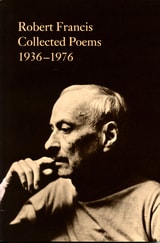
Collected Poems, 1936-1976
Robert Francis
University of Massachusetts Press, 1976
Gathered here in their entirety are the seven previous volumes of Robert Francis poetry—Stand with Me Here, Valhalla and Other Poems, The Sound I Listened For, The Face against the Glass, The Orb Weaver, Come Out into the Sun, and Like Ghosts of Eagles—together with a group of recent poems, many not previously published but “saved” to end this volume on a note of newness.
Because the original seven volumes are kept in chronological order, the reader can follow the author's journey from his quiet early work to poetry of greater color, warmth, vitality, vivacity, and sportiveness; and can note just when and where Francis' style becomes more and more diversified, with word-count, fragmented surface, and the celebration of words themselves.
The book is graced with eight wood engravings by Wang Hui-Ming.
Late Fire, Late Snow
New and Uncollected PoemsRobert Francis
University of Massachusetts Press, 1992
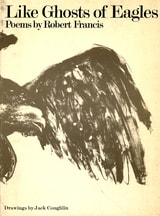
Like Ghosts of Eagles
Robert Francis
University of Massachusetts Press, 1974
Marianne Moore said of Robert Francis's poetry, “He is so penetrating, delicate, and wise, one goes away without having said a word, merely grateful to have received so much.”
Francis readers will welcome this new volume of verse which features poems in the whole technical gamut of Francis styles, including word count, with which he first delighted critics in Come out into the Sun.
Like Ghosts of Eagles also presents for the first time entirely new Francis styles and techniques. Such poems as “Bloodstains,” “Going to the Funeral,” and “Silent Poem” are distinguished by “fragmented surface,” a technique in which single words or short phrases are delivered without connecting tissue. Also new to his work are poems in which sentences are fused together in one continuous stream, as in “The Mountain,” “The Righteous,” and “The Peacock.”
The works are equally diversified in mood, ranging from the bitterly satirical through the elegiac, lyrical and playful, to poems of pure celebration. “Few others writing today work with such fragile sounds and with such delicate, almost pastel perceptions,” wrote David Clark upon first reading the manuscript of Like Ghosts of Eagles.
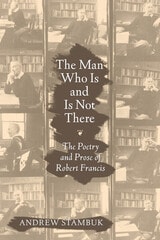
The Man Who Is and Is Not There
The Poetry and Prose of Robert FrancisAndrew Stambuk
University of Massachusetts Press, 2011
Robert Francis (1901–1987), the author of eight volumes of poetry, an autobiography, a book of fiction, essays on poetry, and a reminiscence of Robert Frost, lived for most of his career on the outskirts of Amherst, Massachusetts, devoting himself to Yankee simplicity and self-renunciation derived from his reading of Thoreau. His preference for solitude and disinclination to write about or promote himself account for the elusiveness of his persona in his prose and poetry.
This book charts how Francis developed and elaborated this persona through distanced self-portraits in prose and through poems that both reveal and conceal the self of the poet. Folded into the study are discussions of Francis's pastoralism, his affinities with Emerson and Thoreau, his experimentation with new poetic forms, his protest against the Vietnam War and environmental despoliation, his homoeroticism, and a comparison of his poetry with that of Robert Frost. The book also explores Francis's characteristic attitude, figured as “hovering,” where his speaker is both subject and object, writing about himself while inhabiting the role of detached observer.
Complementing the emphasis on Francis's elusiveness, Andrew Stambuk offers readings of his poems attentive to aesthetic qualities that give them their particular reticence. Stambuk's sensitive evaluations underscore that Francis is a craftsman of intricate precisions whose work speaks to contemporary political and global concerns.