Results by title
7 books match the query 'Franz Kafka'
Franz Kafka and His Prague Contexts
Studies on Language and LiteratureMarek Nekula
Karolinum Press, 2015
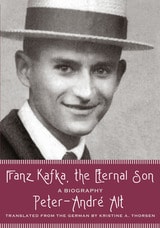
Franz Kafka, the Eternal Son
A BiographyPeter-André Alt, Translated from the German by Kristine A. Thorsen
Northwestern University Press, 2018
Franz Kafka remains one of the most influential writers of the twentieth century. His novels, stories, and letters are still regarded today as the epitome of the dark, fascinating, and uncanny, a model of the modernist aesthetic. Peter-André Alt’s landmark biography, Franz Kafka, the Eternal Son, recounts and explores Kafka’s life and literary work throughout the cultural and political upheavals of central Europe.
Alt’s biography explores Franz Kafka’s own view of life and writing as a unity that shaped his identity. He locates links and echoes among the author’s work, life, and surroundings, situating him within the traditions of Prague's German literature, modernity, psychoanalysis, and philosophy as well as within its Jewish culture, arts, theater, and intellectual tradition.
In this biographical tour de force, Kafka emerges as an observant flaneur and wistful loner, an anxious ascetic, an ecstatic and skeptic, a specialist in terror, and a master of irony. Alt masterfully illuminates Kafka's life not as source material but as a mirror of his literary genius. Readers begin to see Kafka’s unforgettable novels and stories as shards reflecting the life of their creator.
Franz Kafka
Narration, Rhetoric, and ReadingEdited by Jakob Lothe, Beatrice Sandberg, and Ronald Speirs
The Ohio State University Press, 2011
Franz Kafka: Narration, Rhetoric, and Reading presents essays by noted Kafka critics and by leading narratologists who explore Kafka’s original and innovative uses of narrative throughout his career. Collectively, these essays by Stanley Corngold, Anniken Greve, Gerhard Kurz, Jakob Lothe, J. Hillis Miller, Gerhard Neumann, James Phelan, Beatrice Sandberg, Ronald Speirs, and Benno Wagner examine a number of provocative questions that arise in narration and narratives in Kafka’s fiction. The arguments of the essays relate both to the peculiarities of Kafka’s story-telling and to general issues in narrative theory. They reflect, for example, the complexity of the issues surrounding the “somebody” doing the telling, the attitude of the narrator to what is told, the perceived purpose(s) of the telling, the implied or actual reader, the progression of events, and the progression of the telling. As the essays also demonstrate, Kafka’s narratives still present a considerable challenge to, as well as a great resource for, narrative theory and analysis.
Franz Kafka
Subversive DreamerMichael Löwy, translated by Inez Hedges
University of Michigan Press, 2016
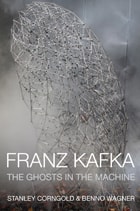
Franz Kafka
The Ghosts in the MachineStanley Corngold
Northwestern University Press, 2011
Corngold and Wagner frame Kafka’s writings as cultural events, each work reflecting the economic and cultural discourses of his epoch. In pursuing Kafka’s avowed interest in the theory and practice of insurance, the authors view the two systems of his literary worlds—the official and the personal—as a “bundling” together of the various cultural accidents of Kafka’s time. The work of two of the leading scholars of the single most influential writer of literary modernity, Franz Kafka: The Ghosts in the Machine constitutes a breathtakingly original advance in the study of both the more famous and less well-known works of this enigmatic master.
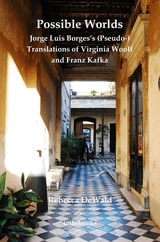
Possible Worlds
Jorge Luis Borges's (Pseudo-) Translations of Virginia Woolf and Franz KafkaRebecca DeWald
University of London Press, 2020

Three Sons
Franz Kafka and the Fiction of J. M. Coetzee, Philip Roth, and W. G. SebaldDaniel L. Medin
Northwestern University Press, 2010